A 2026 Technical Guide to Robot Food Runner UK Integration
If you are weighing a robot food runner UK deployment for a busy dining room, start with clearance, compliance, and how you want to pay for the hardware. The cost of integrating a service robot in the UK depends on UKCA and CE certifications, a 12-month warranty as standard, full warranty cover for the contract period, and 1-year parts and labour support. GO Robotics does not publish flat client figures, quoting instead after a physical site survey.
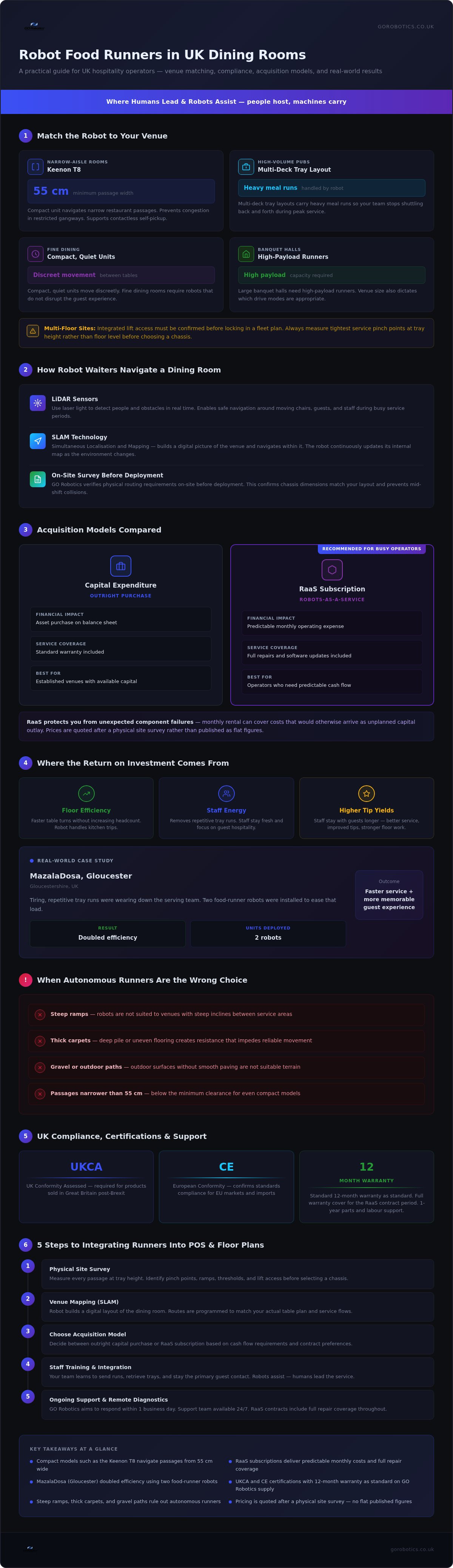
Key Takeaways: A robot food runner UK deployment is financially viable when used to assist staff with repetitive tray runs in aisles at least 55cm wide.
- Compact models like the Keenon T8 navigate narrow restaurant passages down to 55cm.
- Except when your venue has steep ramps, thick carpets, or gravel outdoor paths.
- Choose Robots-as-a-Service (RaaS) subscriptions to ensure predictable monthly costs and full repair coverage.
- The MazalaDosa case study in Gloucester shows robots doubled efficiency by assisting human staff.
The ideal robot runner matches your specific venue profile
You face a few common floor patterns, and each one points to a different chassis choice. In a narrow-aisle room where passages sit near 55 cm, a compact unit such as the Keenon T8 keeps traffic moving. In a high-volume pub, multi-deck tray layouts carry heavy meal runs so your team is not shuttling back and forth. On multi-floor sites, you need integrated lift access before you lock in a fleet plan.
Matching a robot food runner to your layout keeps service moving during peak hours. Narrow aisle dining rooms struggle with wide multi-tray units because passing space remains tight, so a compact model prevents congestion in restricted gangways.
Different hospitality spaces need distinct physical footprints and tray setups. Fine dining rooms call for compact, quiet units that move discreetly between tables. Smaller cafes benefit from agile single-tray units, whilst large banquet halls need high-payload runners. Venue size also dictates drive modes.
Choosing automated floor units gives your waiting staff an extra pair of hands and keeps them on the floor with guests. You can browse hospitality service robots and Robot Accessories & Add-ons suited to UK dining rooms. Reach out to our specialists to schedule an on-site evaluation of your facility. More on this: Robot Accessories & Add-ons.
How Do Robot Waiters Work?
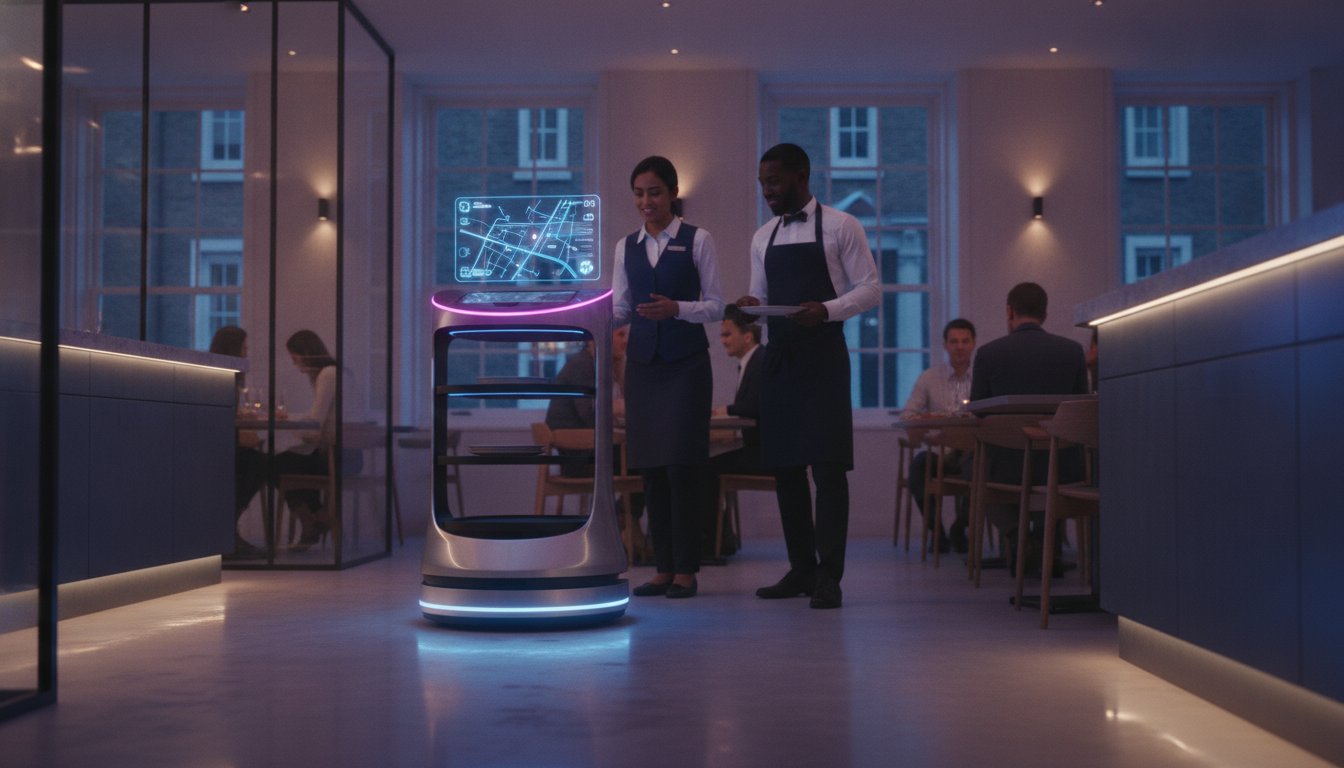
Robot food runners navigate busy dining rooms by combining light detection and ranging (LiDAR sensors, which use laser light to detect obstacles) with simultaneous localisation and mapping (SLAM, the mapping technology that lets a robot build a picture of its surroundings and navigate).
When you evaluate hardware, focus on real clearance needs. The Keenon T8 is a compact delivery robot that can navigate very narrow passages (55cm) and supports contactless self-pickup. Operating at maximum capacity still needs extra margin: treat clearance like door frames in an old pub, because dynamic obstacles such as moving chairs quickly alter the available path.
For reliable performance, review hire and purchase options so chassis dimensions match your layout. A model that fits your narrowest aisle prevents operational bottlenecks. On-site surveys verify these physical routing requirements before deployment, which helps you keep service running without mid-shift collisions.
Tip: Always measure your tightest service pinch points at tray height rather than floor level before choosing a chassis.
A commenter in the forum.arduino.cc thread "Recommendations for Arduino Robotics Kit, Education":
"My school has been looking into buying Arduino robotics kits but I know from my own experience in buying these kits on amazon that most of them are just junk boxes with missing/broken parts." (source)
This quote highlights the frustration buyers face with unreliable components, reinforcing why commercial operators need professionally surveyed and supported robotic hardware.
Are Restaurant Robots Worth It? A 2026 ROI Guide
You decide financial viability by comparing upfront capital expenditure with subscription options, not by guessing at headline Prices.
Direct capital expenditure gives you outright ownership, whereas a Robots-as-a-Service model spreads cost as a continuous operating charge. Components such as industrial grippers quietly shape long-term maintenance overheads, so monthly rental can protect you from unexpected component failures.
| Acquisition Model | Financial Impact | Service Coverage |
|---|---|---|
| Capital Expenditure | Asset purchase on balance sheet | Standard warranty |
| RaaS subscription | Predictable monthly operating expense | Full repairs and software updates included |
The Food Standards Agency 2024 report outlines how automated systems improve traceability across kitchen operations. RaaS fits busy operators who need predictable cash flow, while outright buying suits established venues with free capital. You gain by cutting idle staffing delays during peak dinner rushes. Request a personalised quote so you can review accurate numbers for your venue.
Service Robot vs Waiter: Where Does the ROI Come From?
Direct financial return comes from floor efficiency and higher tip yields for waitstaff rather than replacing your human team. Where Humans Lead & Robots Assist is the working model: people host, machines carry.
In field operations, running heavy trays across a large room drains energy fast. Taking away those repetitive trips helps staff stay fresh and focus on guest hospitality.
At MazalaDosa in Gloucester, UK, tiring, repetitive tray runs were wearing down the serving team. Two food-runner robots were installed to ease that load. The owners in Gloucestershire moved to faster service and a more memorable guest experience, and the doubled efficiency fed straight back into stronger floor work.
Service units keep your team on the floor with guests. You gain faster table turns without increasing headcount, because a runner can take the kitchen trip while your best host stays at the table. Ask for a quote built around your covers and peak windows.
Safety and UK Compliance Standards Explained
You must verify that service robots meet strict safety rules before you place them alongside public diners. Client deployments in crowded venues show that thorough testing reduces liability risk. Each unit supplied is UKCA and CE compliant for public-facing environments.
Safety standards take priority over aesthetic design. Units are built to UKCA, CE, FCC, TÜV SÜD, and GDPR compliance standards, so your contacts can trust the hardware before they pick up the phone. Those certifications protect physical space and relevant data handling obligations.
Moving trays through tight spaces still needs disciplined route design. Site layout reviews lock in secure paths before go-live. Contact the team when you want to review compliant models for your venue.
5 Steps to Integrating Runners into POS and Floor Plans
You can integrate food runners into your UK venue with a structured rollout. Planning paths before you freeze furniture positions avoids jams once service starts, and careful layout design keeps staff and automation working together.
- Map the floor layout: Chart physical pathways, service passes, and narrow gangways.
- Set table nodes: Assign precise drop-off points within your point of sale (POS) network.
- Connect software interfaces: Link the runner system directly to kitchen display screens.
- Conduct live service testing: Run mock meal services before opening doors to customers.
- Train floor staff: Show your team how to load trays and dispatch units quickly.
One detail managers often skip: re-check assistant passage space while seats are occupied during rush periods, so you catch pinch points before they cause delays. Book a site survey when you want this sequence applied to your floor plan.
A commenter in the forum.arduino.cc thread "Recommendations for Arduino Robotics Kit, Education":
"The great deal with the new technic LEGO is that prototyping is really fast, the new motors and big frames make conceptual building an awesome experience." (source)
Fast physical prototyping helps operators quickly test layout ideas before running live trials on the dining floor.
When Autonomous Service Runners Are the Wrong Choice
Deploying a robot food runner fails when your physical layout or service style creates impassable barriers, so you should rule those cases out early.
Venues struggle when aisle widths drop below standard clearance limits. Compact spaces block dynamic mapping systems and leave units stranded during busy services. Steep ramps, thick carpet transitions, and outdoor gravel paths stop these machines instantly.
Heavy outdoor machinery demands different engineering entirely. For instance, the Titan cutting deck width = 730mm, designed for commercial mowing turf rather than indoor hospitality floors. Venues running high-volume, multi-course fine dining often find automated runners disrupt the guest experience; in those settings, traditional human service remains the right choice.
If you wonder whether tight tables will block deployment, request a site survey before you choose equipment.
Case Studies: Commercial Fleet Results in British Dining
Floor automation only pays off when daily workflow and aisle clearance support it. Narrow floor layouts create tight bottlenecks during service, so speed follows the path you can actually clear.
At DosaPark in Cirencester, waitstaff were struggling to balance long carrying trips with customer care. GO Robotics supplied a delivery robot that runs orders directly to tables, handing the physical running to the machine. The restaurant kept fast, friendly service while staff gained more time to connect with guests.
Site layout still determines success. Contact the team when you want a personalised quote against your floorplan.
Frequently asked questions
How do I match a robot food runner to a narrow UK dining room?
Choosing a robot food runner in the UK depends on your venue size and layout. Compact models like the T8 navigate narrow passages down to 55 cm (550 mm). Larger commercial machines such as the Titan, with a cutting deck width of 730 mm, suit wide-open outdoor work rather than tight indoor hospitality floors. Review clear technical specifications before you decide on a model.
Can a robot completely replace waiters?
No robot replaces human front-of-house staff entirely. Where Humans Lead & Robots Assist. Your team handles guest interaction while machines manage repetitive transport tasks. For example, a case study from MazalaDosa in Gloucester shows that deploying two robots supported staff to double efficiency with faster service and enhanced guest experience.
How long is the payback period on a robotic food runner in the UK?
Payback periods vary based on venue operating hours, model selection, and whether you choose outright purchase, leasing, or monthly rental. Because static financial figures are not published, the layout is evaluated first. Contact the team for a personalised quote tailored to your venue requirements.
What is the hourly cost of a human waiter versus a robot?
Overall operating costs depend on your chosen contract type, support package, and venue setup. Each unit supplied is built to UKCA, CE, FCC, TÜV SÜD, and GDPR compliance standards, and UKCA and CE compliance supports strict safety expectations for public-facing environments. Direct operational costs vary, so ask for a tailored breakdown.
Next Steps for Your Venue
A robot food runner UK operators can trust still turns on the same decisions you met at the start: Does the chassis fit your tightest aisle? Does the commercial model (capital purchase or RaaS) match your cash flow? Do UKCA and CE certifications and a surveyed route keep guests safe? And is your service style one where runners help, rather than get in the way?
Certified service hardware supports safe operation alongside your front-of-house staff in busy dining rooms. The GO Robotics team helps you select, configure, and maintain the right system for your floor plan under UKCA and CE standards across hospitality environments in 2026. Hardware choice depends on layout, aisle width, and total daily tray passes.
Red Dot Design Award recognition highlights the quality of modern commercial units. To evaluate your site and receive a deployment quotation, contact our engineering team. Geoff Stillman and the engineering staff assess your space to ensure integration. See also the Digital Ipswich Innovation Showcase 2025.