
Technology to help with labour shortages in the UK: uses and limits
UK job vacancies fell by 8.3% between January and March 2026 compared with the previous year, according to the Office for National Statistics. Technology to help with labour shortages in the UK can ease pressure on teams by taking on repetitive tasks, but it won’t remove the need for people to supervise systems, handle exceptions and provide human judgement.
When recruitment is difficult, automation can help teams handle routine work and create more capacity. The practical question is which tasks it can support without adding safety risks or disrupting the work your team already does.
This article explains how automation, robotics and AI may support businesses across the UK, including in hospitality, logistics, manufacturing and construction. You’ll see which tasks could suit these technologies, where their limits matter, and what to consider about worker involvement, workplace safety and regulation before putting them into use.
Key Takeaways
- Automation can take on repetitive tasks, but its value depends on how well it fits the work and supports the people doing it.
- Different sectors have different opportunities, from service robots in hospitality to drones and scheduling tools in construction.
- Ageing workforces and skills gaps make staff training and thoughtful task redesign important parts of adopting new technology.
- Plan for safety, worker involvement and the effects on day-to-day roles before introducing workplace automation.
- Explore how Pudu service robots could support routine delivery, hospitality or floor-care tasks in your venue.
Automation and robotics as ways to address labour shortages
UK businesses can use robotics, artificial intelligence (AI), workflow software and automation to handle repetitive tasks. Robots can move goods or complete routine physical work, while AI software can help staff sort information and plan schedules. According to the Office for National Statistics, UK job vacancies fell by 8.3% between January and March 2026 compared with the previous year. That change does not remove recruitment pressures in every role or sector.
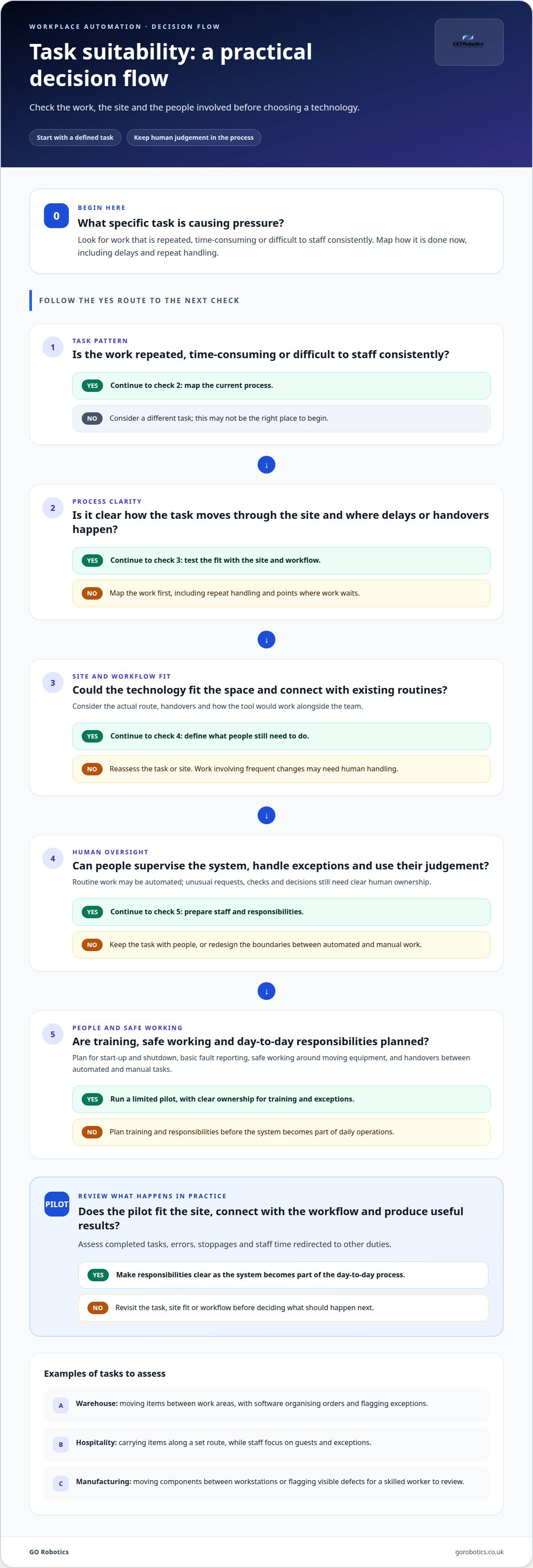
Start by identifying work that is repeated, time-consuming or difficult to staff consistently. In a warehouse, automation might move items between work areas, while software organises orders and flags exceptions for a person to resolve. In hospitality, a service robot can carry items along a set route, leaving staff to focus on tasks requiring direct customer attention. The useful question is whether the technology fits the task and the site.
AI and workflow tools address different parts of a process. Scheduling software can organise shifts and task lists, while AI tools can help staff review information or spot patterns in routine records. Neither replaces human judgement: staff still need to handle unusual requests, check outputs and decide what action is appropriate.
Robots also need people who can operate them safely and respond to routine problems. Training can cover start-up and shutdown, basic fault reporting, safe working around moving equipment and the handover between automated and manual tasks. Educational support can include workplace training, apprenticeships and collaboration with colleges or industry groups. A warehouse worker, for example, could learn digital stock systems as part of a move into a more technical role.
Integrating automation calls for practical skills across the workforce. Operators need to understand the changed process; supervisors need to plan staffing and deal with exceptions; and technical staff may need to connect equipment with existing systems. Skills gaps can delay adoption when no one owns training, maintenance or data quality. Involve the people who do the work early, then make responsibilities clear before a new system becomes part of daily operations.
Investment should begin with a defined task, not a technology purchase. For businesses considering technology to help with labour shortages in the UK, map how the work happens now, identify delays or repeat handling, and decide what the system should do. A limited pilot can reveal whether equipment fits the space, connects with the workflow and produces useful results. Assess practical measures such as completed tasks, errors, stoppages and staff time redirected to other duties.
Plan for the work that remains after automation starts. A robot may handle routine deliveries, but people still manage the service, respond when conditions change and oversee the wider process. Easing staffing pressure also means deciding who handles each step and how staff will use any time freed up. This keeps technology in service of the workforce, rather than treating it as a replacement for skilled people.
Potential uses across UK sectors
Automation opportunities depend on the work, site and workforce in each sector. A factory, building site and care home face different staffing pressures. Human augmentation means technology that helps people perform work, rather than simply replacing them. Manufacturing, construction, logistics, health and social care have all been identified as possible areas for these tools. For each organisation, start with a specific task, such as moving stock, inspecting equipment or handling routine records.
In manufacturing, robots can handle repeated operations such as moving components between workstations. Automated inspection systems can also flag visible defects for a skilled worker to review. That division leaves decisions about quality and unusual faults with people. The practical opportunity is strongest where work follows a consistent process; tasks involving varied parts or frequent changes may need human handling. A production team can map each handover before deciding which activity is suitable.
Construction offers different examples. Drones can inspect a site, survey areas and record progress, reducing the need for staff to access some difficult locations. Artificial intelligence tools can analyse project timelines and help plan schedules and resources. Building Information Modelling (BIM) creates detailed digital models of projects, helping teams coordinate plans and identify possible errors or rework. These tools support site teams, but do not replace trade skills or decisions made on the ground.
In health and social care, assistive technology may support tasks around information, movement of supplies or routine administration. Staff still need to provide care, respond to individual needs and make clinical decisions. In hospitality, service robots can carry items along planned routes, while staff focus on guests and exceptions. The positive case depends on practical fit: routes must suit the venue, and the remaining work must be clearly assigned.
Logistics operations can use automated equipment to move goods through warehouses, while software can sort orders and flag delays. Retail organisations might use digital tools to track stock or schedule replenishment, with staff handling customer requests and discrepancies. Across these examples, technology works best when it connects with existing routines instead of adding separate tasks. Map the process, identify where work waits or repeats, then assess whether a tool addresses that specific point.
Training matters across every sector. Construction teams need to interpret digital plans; warehouse staff may need to work with automated systems; and care teams need clear guidance on when technology supports, rather than directs, their work. Involve employees in planning and test the process in its actual setting. To explore where robotics may fit your operation, see commercial robotics for workplace tasks.
Demographic shifts
In construction, an ageing workforce, retirements and too few young entrants contribute to skills shortages. This changes the staffing challenge: employers need to retain experience whilst preparing new workers to take on skilled roles. A vacancy may represent more than an unfilled pair of hands. It can also mean the loss of practical knowledge about materials, sequencing and safe site routines.
Start by identifying which tasks depend on knowledge held by a small number of experienced staff. A supervisor might know how a venue’s service routine changes during busy periods, while an experienced team member may spot a guest need before it becomes a problem. Record key procedures and build handovers into normal work, rather than waiting until someone is about to leave.
Technology can support knowledge-sharing when it captures useful information in a form colleagues can use. For example, digital work instructions can show the order of a task, while shared records can keep decisions and changes visible to the team. These tools do not reproduce experience or judgement, but they can make established processes easier to find and learn.
Automation also offers a way to review how work is divided across different roles. If a robot handles routine movement, a team member may be able to focus on tasks that need judgement or personal attention. The aim is to support productivity without removing opportunities for new staff to gain practical experience. Pairing digital instructions with supervised practice keeps learning connected to real workplace conditions.
Recruitment and retention need attention alongside equipment. Hospitality employers can work with training providers to create routes into service roles. A placement, for instance, can give a learner experience of coordinating deliveries, understanding service routines or supporting a team before taking on more responsibility. Clear progression helps connect training with the skills a business needs.
Design tasks with different workers in mind. A role that relies on repeated manual handling or extensive walking may be harder to sustain for some employees, so review the task, equipment and work sequence together. Mechanised handling or digital inspection records may help reduce avoidable strain or repeated travel, depending on the job. Keep the worker involved in assessing whether the change makes the task more practical.
Plan for continuity before retirements create gaps. Map which roles carry specialist knowledge, decide how colleagues will learn those tasks, and identify where automation can assist without taking away essential training. In a construction workplace, that might mean pairing an experienced tradesperson with a learner while digital records capture key project decisions. Demographic change makes people, skills and technology part of the same workforce plan.
Health, safety and regulation
Technology can reduce exposure to some repetitive or hazardous tasks, but it can also introduce new risks. The main limitations are safety, worker trust, changing work practices and the need to meet relevant standards.
Risks include injury around moving equipment, health effects that emerge over time, and disruption when a system behaves unexpectedly. The right approach depends on the task, workplace and people affected.
Health and safety risks
Health and safety risks are possible harms to workers or others when technology changes how a task is performed. A robot moving items, for example, may create new interactions between people, equipment and walkways. Assess the actual task and working environment, including what happens when equipment stops or a person needs to intervene.
Introduce workplace augmentation after dialogue with workers and their consent, considering who benefits and who may be adversely affected. That matters because a system that eases one task could create pressure elsewhere, such as extra monitoring or unfamiliar procedures. Build staff feedback into trials and review incidents and near misses as work changes.
Regulatory considerations
Regulatory considerations are the rules, standards and workplace responsibilities that apply when an organisation introduces technology. Requirements depend on the equipment and its use, so a government announcement alone does not explain how a specific system should operate at a particular site.
Before deployment, identify the relevant duties and standards for the task, equipment and workplace. For instance, a manufacturer using automated machinery must consider how staff interact with it during normal work and maintenance. Keep responsibility clear across managers, operators and technical teams. This helps prevent gaps between formal procedures and changing day-to-day practice.
Technology risks and limitations
Technology risks and limitations are problems that can reduce a system’s usefulness or create unwanted effects. Adoption can be held back by lack of awareness, low trust, safety concerns, regulation and uncertainty about standards. Those barriers matter because buying equipment does not, by itself, resolve a skills shortage or improve an economic outcome.
Integration also depends on people with the skills to operate and manage systems. If staff lack training, automation may shift work rather than reduce pressure. Plan who handles exceptions, routine upkeep and staff guidance before changing the workflow. Assess whether the new task allocation remains workable for the team.
There are also limits to what current evidence can show. Longitudinal studies are needed to understand the effects of human augmentation over time, including possible health-related problems. A short trial may reveal immediate workflow issues, but it cannot establish every longer-term effect on workers.
Past implementation choices show why oversight matters. UK manufacturers have used contractors across multiple sites to address labour shortages, but this approach has been associated with quality compromises, compliance breaches and incidents. For any changing process, assign responsibility for consistent procedures and safe handovers across locations.
Make the introduction a shared workplace decision, not simply an equipment installation. Explain what the technology will do, which tasks remain with people and how workers can raise concerns. Review its effects as conditions change, then adjust procedures when the work, equipment or people involved require it.
Which UK sectors have the most severe labour shortages?
Construction and supply chain and logistics stand out in the available UK figures, but the measures describe different pressures. Construction data tracks vacancies and employers’ difficulty finding skilled staff. A Descartes workforce study reports shortages among logistics leaders. Neither measure alone provides a direct comparison across every UK sector.
Construction employers advertised an average of 38,000 vacancies per month in 2023. In the UK, 31% said finding suitably skilled staff was their biggest challenge. These figures point to both demand for workers and difficulty recruiting people with the right capabilities. For a construction business, the pressure may be clearest in roles where work cannot proceed without specific trade skills or site experience.
Logistics reports show a different but substantial challenge. In Descartes’ workforce study, 76% of UK supply chain and logistics leaders reported notable workforce shortages. Within that group, 61% identified transportation operations as significantly affected by resource shortages, whilst 56% identified warehouse operations. The figures distinguish pressure on moving goods from shortages inside warehouses, helping businesses assess where capacity is most constrained.
These results are not directly interchangeable. A vacancy count records advertised roles, while a survey captures leaders’ views about workforce pressure. A business deciding where to act should look at its own bottlenecks: a hotel might struggle to keep service moving during busy periods, while a restaurant may face pressure around routine deliveries. The issue can vary between sites within the same organisation.
For a hospitality business, review which roles are difficult to fill and what work depends on them. A service robot may support routine delivery tasks, but it cannot supply the personal attention of an experienced team member. Examine whether delays arise during service, movement of items or order processing. Automation may assist with repeatable tasks, while staff continue to deal with exceptions and changing priorities.
Hospitality, health and social care also face tasks that could suit assistive technology, but the figures above do not rank these sectors against construction or logistics. A hotel might assess routine delivery work; a care provider might review supply movements separately from direct care. In both cases, the distinction matters: automating a supporting task does not fill a shortage of skilled staff providing personal service.
Use sector data as context, then compare it with your own recruitment difficulties, delayed tasks and service demands. That points to whether the main need is hiring, training, workflow changes or automation. Discuss automation for your operation when routine tasks are adding pressure to existing teams.
GO Robotics
GO Robotics can help you assess whether service robots suit routine tasks that are putting pressure on your team. Its commercial range includes the Pudu BellaBot, Pudu KettyBot and Pudu HolaBot for hospitality and delivery work. The right model depends on the tasks, layout and working conditions at your site, so GO Robotics surveys the venue before recommending an option.
That assessment helps you consider how a robot would fit existing workflows, where staff remain responsible, and whether purchase, lease or robots-as-a-service (RaaS), a monthly rental arrangement, suits your plans. Automation is most useful when it addresses a clear, repeatable task rather than a shortage requiring specialist human judgement.
If you’re considering service robots for your operation, request a demo or get a quote from GO Robotics.
Choose a practical next step
Before choosing technology to help with labour shortages in the UK, decide what a better working day would look like for your team. That might mean keeping service moving during busy periods, reducing repeated journeys, or giving experienced staff more time for tasks that need their judgement. A clear aim helps you assess whether automation supports the way your business wants to serve customers and staff.
Bring the people who manage the work and those who do it into the discussion early. Their experience can reveal practical constraints that a high-level plan misses, such as how exceptions are handled or what must happen during a handover. Agree how you’ll review the change once it is in use, including whether it fits the work and remains safe for the team.
There’s no need to automate every task at once. A focused discussion can help you decide whether robotics belongs in your plans and what to consider next. Contact GO Robotics to discuss your needs, and take a considered next step towards work that better supports your team.
Frequently Asked Questions
How can automation and robotics reduce labour shortages in UK industries?
Automation can increase the amount of routine work a team completes without requiring every task to be done manually. For example, software can handle repeat data entry, while a robot takes on predictable movements between work areas. People remain responsible for decisions, exceptions and service requiring judgement. The aim is to ease pressure on hard-to-fill roles, not assume machines can replace every skill or worker.
How can UK businesses choose labour-shortage technologies?
The right technology depends on the task, site layout, integration needs and staff training required. A venue assessing a service robot, for example, needs to consider its routes and how staff will manage handovers. Define the work the technology should support, then compare options against that practical requirement. This helps you focus on whether a system fits your operation, rather than choosing equipment by its features alone.
What UK grants or tax incentives support investment in automation and workforce technology?
UK businesses may be able to use grants or tax relief, depending on the project and eligibility criteria. The annual investment allowance (AIA) can apply to qualifying capital assets, but not every purchase or organisation will qualify. Check the current scheme rules and discuss the proposed equipment with your accountant. They can consider your business circumstances, the asset’s intended use and the relevant tax treatment.
How can small UK businesses adopt technology to address staff shortages?
Choose one contained task that causes regular pressure, then assess whether a tool can handle it without complicating other work. A small venue might begin with a routine internal process rather than changing customer-facing service. Set clear measures, such as completion, errors and staff time redirected, and involve affected employees. A limited trial can help the team understand how the technology fits its working routines before wider adoption.
What are the UK legal and safety rules for workplace automation and AI?
There isn’t one rule that covers every workplace system. Requirements depend on the equipment, its purpose and how staff interact with it. Assess hazards in the actual setting, define who supervises the system and set out what workers should do when it stops or produces an unexpected result. Involve affected staff before implementation, explain how their roles may change, and review arrangements as working practices evolve.
Which UK regions and sectors are investing most in workforce technology?
The sector evidence discussed here identifies construction and supply chain and logistics as areas facing notable workforce pressures, but this does not establish which sectors invest most in technology. Nor does it provide a regional spending comparison. For your organisation, distinguish investment activity from recruitment difficulty, then assess the technologies being used in your sector and the tasks they support. That gives a more useful basis for planning than assuming one region leads.