Robot That Follows a Person: Examples of Tracking Approaches
Person-following tasks can rely on very different tracking methods. A robot that follows a person may use camera-based visual tracking, distance sensors or identity recognition to keep track of its target. Each approach behaves differently as people move around it.
Following does not simply mean staying close. The robot must detect the person, estimate their position and adjust its movement as the surroundings change. A method that works when one person is clearly visible may be less suitable when others cross the route.
This article explains how these approaches work and how basic person detection differs from tracking a chosen individual. It also covers indoor following, including how sensors and navigation help a robot respond to people and obstacles in a venue.
Use these examples to assess which capabilities matter for your setting, whether that is a hotel, restaurant, care environment or another busy indoor space. The aim is to make the technology easier to evaluate in practical terms, without assuming every robot follows people in the same way.
Key Takeaways
- Separate basic person detection from tracking a chosen individual; they solve different following tasks.
- Compare camera, distance-sensing and identity-based approaches against the people and movement in your venue.
- Identity-specific tracking can combine anonymous person tracking with face recognition to maintain a target.
- Indoor following depends on sensing both the person and nearby obstacles, then adjusting the robot’s movement.
- Match a robot’s stated purpose to the work you need done rather than assuming every service robot can follow people.
Human-following robot overview
A robot that follows a person detects movement, estimates a position and changes direction. Its design may combine cameras with distance sensors, while some prototypes use simpler components. The choice affects how the robot responds when a person turns, pauses or moves behind an object.
Imagine a hotel trolley moving along a clear corridor. The robot needs to detect the person, track their changing position and avoid nearby objects. Its usefulness depends on how well it handles that task. A demonstration in an empty room will not show how it performs during normal activity.
A small Arduino project illustrates the basic principles. It uses an ultrasonic sensor to measure distance and infrared sensors to help detect movement. Its code commands forward movement when the measured distance is greater than 10 and less than 30. That simple rule demonstrates how sensor readings can trigger movement.
What UK rules apply to using an autonomous robot in public places? The setting matters. For a UK venue, define where the robot can travel, who supervises it and how staff can stop it. If cameras are involved, decide what information they capture and who can access it.
How much do person-following robots cost in the UK? This overview does not give a price. First define the task, tracking method and intended setting. Those details help identify the type of robot you need.
How do you set up and pair a robot with its user? Follow the model’s setup process, select its follow mode and identify the intended user if pairing is supported. Then test the controls and stopping procedure in the planned area before use.
What are the safety and privacy risks? A robot may lose sight of its target, misjudge an obstacle or enter a busy area. Cameras may also capture identifiable people. Consider camera placement, access to recorded information and clear instructions for staff.
Consider an indoor delivery task near a reception desk, where visitors cross the route. Mark the robot’s working area and make the staff stopping controls clear. This defines the task instead of assuming the robot can follow people anywhere.
A prototype and a commercial deployment serve different purposes. An Arduino example shows how distance readings can trigger movement. A workplace also needs a defined task, a suitable route and a clear operating procedure. Assess these elements together before deciding whether following is the right function.
The human-following robot project’s baseboard measures 13x9.5 cm, and it uses 3 18650 lithium-ion batteries. These details describe the project’s physical build, not a guarantee of performance in a venue. A compact baseboard and battery supply do not, by themselves, establish how reliably a robot tracks a person or responds to interruptions.
When assessing a prototype, consider the complete assembly and how it will be tested on its intended route. Check that the sensor arrangement, movement and stopping controls work together under expected conditions. The project’s stated dimensions and power source can help identify what is being built, while task-specific trials are still necessary before relying on it around other people.
Comparing person-following approaches
Compare systems by the job they perform, not by their feature count. A hotel porter may need a robot to keep pace through a corridor. A warehouse picker may need one to carry items between work areas. The first task centres on following; the second may suit a robot that travels between set destinations instead.
For each option, identify what starts and ends the following task. In a staff-led task, the user might select a follow mode before walking. In a delivery task, the operator might choose a destination instead. This distinction affects daily use: staff need to know whether they lead the robot or send it ahead.
Consider a busy restaurant entrance with staff, guests and frequent crossings. Observe a test route during service, noting when tracking pauses and what happens when the route clears. This provides practical evidence about that environment, rather than a judgement based only on a product description.
Which person-following robots have the best reviews and features? Compare documented tracking behaviour, user controls and the intended working setting. A short hotel corridor and a busy shop floor, for example, call for different assessments.
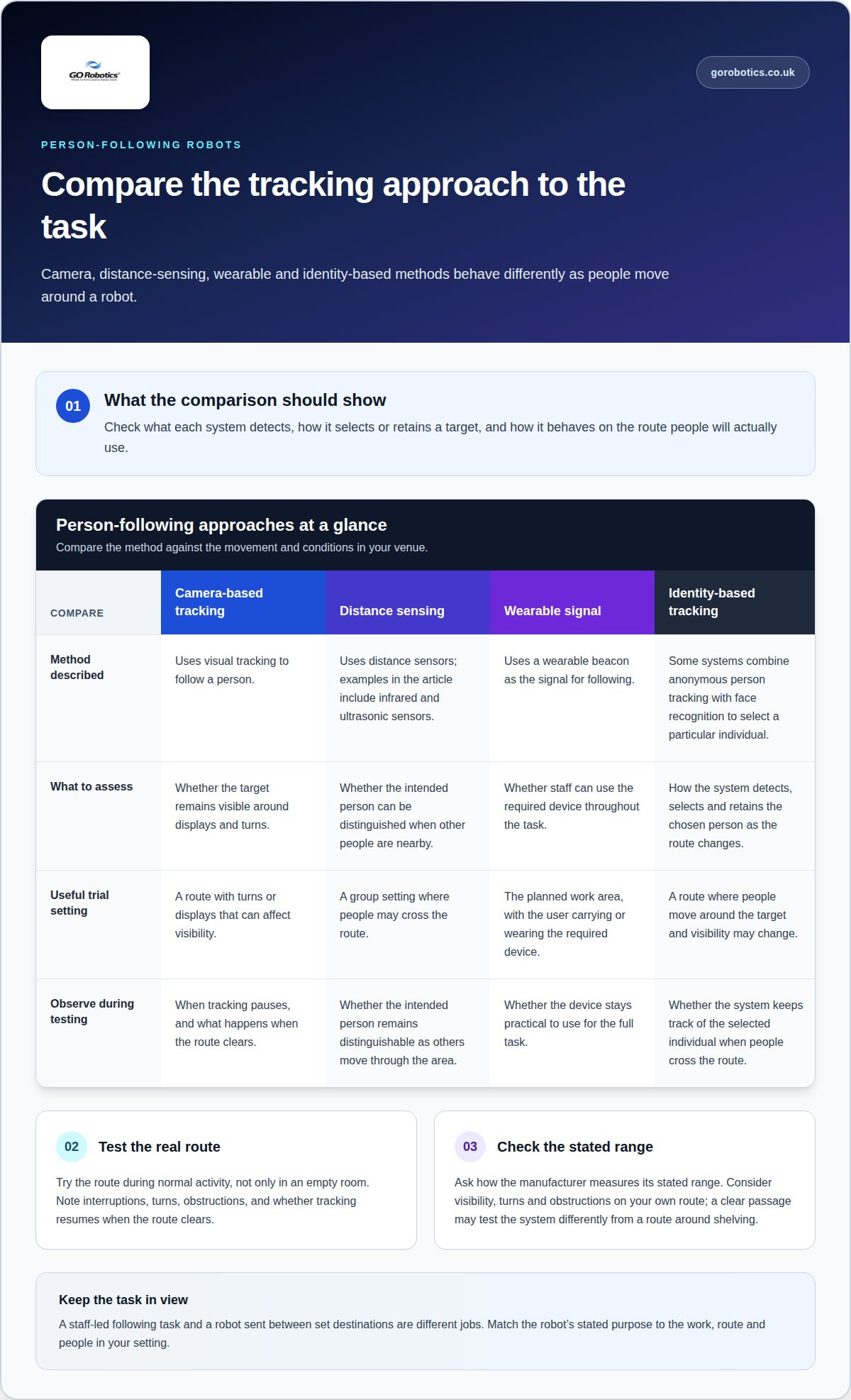
How far away can a robot reliably follow someone? There is no single range that applies to every model. Ask how the manufacturer measures its stated range, then consider visibility, turns and obstructions on your route. A clear straight passage may present a different test from a route around shelving.
What sensors and technology do follow-me robots use? Designs may use cameras, infrared or ultrasonic sensors, or a wearable beacon. Some systems combine person tracking with face recognition to select a particular individual. Compare how each design detects, selects and retains its target.
Use a warehouse aisle as a separate test case, especially where shelving can interrupt a clear view. Observe the robot approaching a turn and then regaining sight of its user. This shows whether the route suits the approach, without assuming performance will be the same at another site.
- Camera-based tracking: assess target visibility around displays and turns.
- Distance sensing: assess whether the intended person can be distinguished in a group.
- Wearable signal: assess whether staff can use the required device throughout the task.
Keep a simple trial record for each approach. Note the location, route, interruptions and whether the intended user remained selected. Comparing the same observations across a hotel, warehouse or retail space helps you judge suitability without relying on unsupported claims of a universal “best” robot.
Following a target individual
Following one chosen person requires a clear handover between selection and movement. In a hotel, a staff member may lead a robot through a service corridor. The key question is what happens when someone else steps into the route. A useful setup keeps the intended user distinct from nearby passers-by.
Start by defining who selects the target and when that selection ends. For a stockroom task, a worker could begin following from a marked starting point. Identify that worker before movement begins. This creates a clear starting procedure, rather than relying on staff to assume the robot selected the right person.
Plan for changes during the task. A team member may hand work over to a colleague, leave the route or pause to speak with someone. Decide whether the robot should stop, wait or be reassigned. At a hotel service desk, for example, a supervisor can end one staff member’s task before another takes over. This avoids an unclear handover.
A target-following trial should include more than a clear walk. In a care setting, test the intended route with normal staff movement and routine interruptions. Observe whether the selected person remains the focus, and record when the robot pauses or needs help. This provides a practical account of how the task fits the environment.
Set out the operating procedure before the trial. Staff should know how to start and end following, pause movement, and respond if the intended person leaves. These are process decisions for the venue, not features that every model automatically provides.
- Target selection: define who starts the task and how staff recognise that it has begun.
- Handover: decide who ends one task before another person takes over.
- Interruption: agree what staff do when the target stops or leaves the area.
- Review: record target changes, pauses and staff interventions during a trial.
Consider a retail stockroom where a worker leads a robot towards the shop floor. The situation changes if the worker is called away. Pause the task and assign responsibility for restarting it. This creates a controlled process, with staff clear about who is leading and when the task has ended.
Review the trial with the people who would use the system. Ask staff to describe moments when target selection felt unclear. Then adjust the procedure or route before wider use. This gives managers concrete observations about a specific job, rather than relying on a demonstration with one person in an empty space.
One technical approach combines an anonymous person tracker with a face recogniser using a Sequential Nearest Neighbour with Thresholding Selection algorithm. This identity-specific tracker provides a way to assess whether the system keeps following the selected person when others are present, rather than treating movement alone as proof of correct selection.
During the trial, assess whether the system keeps following the selected person when others are present. Observe it in the intended setting, including pauses, handovers and staff interventions. Record what happens when the target leaves the route or another person crosses it. Use these observations to decide whether the approach suits the task and what procedures staff need to follow.
Indoor person following
A busy indoor route tests more than basic target detection. In a hotel corridor, a person may pass through doorways, turn sharply or disappear behind a trolley. The robot needs to keep track of that person, notice obstacles and choose a suitable path through the same space.
Start by looking at the route, not just the robot. A restaurant dining room has moving chairs, staff carrying trays and guests crossing between tables. Conditions change throughout service. Map the intended route, identify pinch points and observe whether the person remains visible around corners.
Lighting and surfaces can also affect indoor operation. A glass wall can complicate camera-based detection, while reflective floors can affect some sensor readings. Test the robot near the venue’s entrance, where daylight changes, and beside reflective surfaces. Record where tracking pauses or the robot changes its route.
A practical indoor trial can follow these steps:
- Choose a representative route: include a corridor, a turn and a busy doorway.
- Set the following mode: begin with one user in a clear space.
- Add realistic movement: walk at different speeds and cross behind an obstacle.
- Observe the response: note whether it stops, resumes tracking or follows another person.
- Repeat during normal activity: include staff, visitors and everyday equipment.
A practical trial shows how a robot behaves during a real task. In a care home, for example, a staff member might lead it along a corridor while residents move between rooms. Test the route with normal foot traffic. This gives a clearer picture of where supervision or route changes may be needed.
How well do person-following robots work indoors and outdoors? Indoor performance depends on visibility, obstacles, lighting and the route. Outdoors, changing light, weather, uneven ground and open spaces create different demands. Do not assume a model intended for indoor use is suitable for outdoor following.
For an indoor deployment, set boundaries around lifts, stairs and public entrances. Do not send a robot into an area its sensors or navigation cannot handle. Staff also need a clear stopping procedure, especially where visitors can approach from several directions.
Use a test route that reflects the intended job. In a hotel, this might mean following a staff member between a service area and a corridor, then checking behaviour when guests cross the path. In a retail setting, it could mean tracking around displays during normal trading. Compare what happens in each location before choosing the operating area.
Which person-following robots are available in the UK?
In the UK, “person-following robot” can describe different equipment. A dedicated follow-me platform is designed to keep pace with a person. A commercial service robot may instead focus on carrying items or completing another task. Do not assume a robot can follow people simply because it moves autonomously.
Start with the job. In a warehouse, a worker might want a mobile platform to carry items while they pick stock. In a hotel, a staff member might need a robot to accompany them along a corridor. These situations call for different designs, loads and movement patterns. Suitability depends on matching the robot’s stated purpose to the task.
Equipment may be supplied in different ways. Some models are sold as specific products, while others may be sourced to order. For a UK buyer, first identify the type of operation, then assess models against that use. This avoids treating a demonstration robot as suitable for everyday commercial work.
Consider three broad categories:
- Follow-me platforms: suited to tasks where a person leads and the robot carries or accompanies them.
- Autonomous delivery robots: designed around moving items between locations, rather than necessarily following an individual.
- Research or educational builds: useful for demonstrating sensors and movement, but their purpose differs from a commercial deployment.
A university demonstration, for example, may use a simple sensor-equipped build to follow a person in a controlled room. The situation is a supervised trial, the action is to test basic tracking, and the result is a learning project. A hotel or care setting has different demands, including visitors, staff movement and changing routes, so do not assume the same build suits that work.
Before selecting a model, write down the intended user, route and task. Note whether the robot must carry anything, follow one named person or simply travel between set points. Then compare its documented purpose and tracking method with those requirements. If following a specific individual matters, ask how the robot selects and retains that target.
Also consider where the robot will operate. A retail shop floor has displays and passing customers; a warehouse has stock, equipment and staff moving between aisles. The setting shapes the route. Assess the intended space to create a more relevant shortlist.
To discuss which robot category fits your workplace, talk through your intended use.
GO Robotics
GO Robotics can help match a commercial robot to the task and setting. A site survey informs the recommendation, including whether your priority is following a person or moving items around a venue.
Pudu BellaBot, Pudu KettyBot and Pudu HolaBot are among the models you can discuss with GO Robotics. Assess them against your intended work rather than assuming every service robot can follow a person. Share the route, who the robot needs to follow and what it must do, so the recommendation reflects your operating environment.
If following a specific person is essential, explain that requirement clearly. This helps distinguish target tracking from other forms of robot movement. Contact GO Robotics for guidance on choosing a model for your workplace.
Put person-following into a practical plan
Before choosing equipment, define the job you need it to do. Is the priority keeping pace with one staff member, carrying items along a route, or moving between set destinations? A clear use case helps distinguish person tracking from other forms of robot movement.
GO Robotics offers Pudu BellaBot, Pudu KettyBot and Pudu CC1 for commercial use. These are service robot options, not a claim that each model follows a person. If you need a robot that follows a person, make target tracking central to the discussion and consider the route, interruptions and people moving through the space.
A site survey can help match a model to your venue and intended work. Bring the practical details: who the robot should follow, where it needs to travel and what else it must do. GO Robotics can also discuss support and warranty arrangements for the model you choose.
Contact GO Robotics to discuss your needs and plan a suitable next step for your workplace.
Frequently Asked Questions
What is a person-following robot and how does it work?
A person-following robot tracks a moving person and adjusts its direction to stay with them. Depending on its design, it may use cameras, distance sensors or a wearable signal to identify the target. In a stockroom, for example, a worker could lead a mobile platform between shelves. Before using one, define who it should follow and what it should do if that person disappears from view.
What types of robots can follow a person, such as luggage, delivery or companion robots?
Follow-me platforms, luggage carriers and some delivery robots can be designed to travel with a person, but their main purposes differ. A luggage carrier moves bags, while a delivery robot generally transports items along a route. A companion robot may accompany someone, but that label alone does not explain how it tracks people. Check the intended task and target-selection method rather than assuming every mobile robot can follow you.
How far away can a robot reliably follow someone?
There is no single reliable range for every model. Check how the manufacturer measures its stated range, then consider visibility, turns and obstructions on your route.