
Automated Facility Inspection UK: A 2026 Business Guide to Autonomous Monitoring
Sending a member of staff into a high-voltage zone or a freezing warehouse at 3am is no longer just a logistical headache; it is an avoidable safety risk. While manual patrols have been the standard for decades, they often result in gaps in data and rising operational costs that are difficult to justify. Implementing an automated facility inspection UK strategy allows businesses to move away from these inconsistencies. By using autonomous robots like the Unitree Go2, companies can maintain a constant, high-fidelity presence across their sites without putting human teams in harm's way.
You likely recognise that keeping a site secure and compliant requires more than just occasional spot checks. It demands precise, timestamped logs that a person with a clipboard cannot produce reliably during a long shift. This guide explores how adopting robots-as-a-service (RaaS), a monthly rental arrangement that includes the hardware and support, provides your business with monitoring technology while keeping long-term costs predictable. We will examine the practical requirements for deployment, from floor surfaces to network needs, and show how these tools help your staff focus on high-level tasks whilst robots handle the repetitive rounds.
Key Takeaways
- Learn how automated facility inspection UK systems use mobile platforms to handle repetitive patrols, keeping your human teams away from hazardous or high-risk areas.
- Understand the role of LiDAR and SLAM technologies, which allow robots to map their surroundings and steer around obstacles safely using laser light sensors.
- Compare the advantages of quadruped robots for uneven terrain against wheeled models to determine the best fit for your specific site layout and payload needs.
- Identify the critical operational requirements, such as corridor widths and floor surfaces, that ensure your robotic fleet operates reliably within your facility.
- Explore how the robots-as-a-service (RaaS) model allows you to access monitoring technology via a monthly subscription that includes professional installation and UK-based support.
Understanding Automated Facility Inspection in the UK
Automated facility inspection UK involves deploying mobile robotic platforms, such as the Unitree Go2, to observe and report on site conditions autonomously. These systems follow programmed routes to capture environmental data, check for security breaches, or monitor equipment health. While the technology has roots in large-scale Automation in Construction and nuclear decommissioning, its application is shifting. UK businesses are moving these tools into commercial facility management to handle the repetitive, high-frequency patrols that often lead to human error or fatigue.
This transition relies on a "human-in-the-loop" model. The robot acts as the primary data collector, but a human supervisor remains responsible for high-level decisions. If a robot detects an unusual heat signature or a blocked fire exit, it flags the issue to a human manager rather than attempting to fix it. This partnership ensures that expert judgement stays at the heart of the operation while the machine handles the legwork.
The 'Where Humans Lead & Robots Assist' Philosophy
Robots excel at tasks that are dull, dirty, or dangerous. By taking over these specific roles, they allow human staff to focus on high-level problem-solving and providing expert advice. In a UK security context, a robot can perform the hourly perimeter checks around a cold, dark warehouse. This frees the security officer to monitor multiple sites from a central hub or respond to complex incidents that require a person's nuance. It's about using technology to remove the drudgery from the workday.
Key Benefits of Autonomous Inspection
Adopting an automated facility inspection UK model provides three primary advantages for site managers:
- Consistency: Robots don't get bored or distracted. They follow the exact same path every time, ensuring that every checkpoint is visited and every sensor reading is logged without fail.
- Safety: You can send a robot into confined spaces, high-voltage areas, or zones with chemical risks. This removes the need for staff to put themselves at risk just to perform a visual check.
- Data Accuracy: Every patrol produces a timestamped, high-definition log. Whether it's visual footage or thermal imaging, the data is objective and ready for compliance audits or maintenance planning.
Essential Technologies: LiDAR, SLAM, and Multi-Sensor Fusion
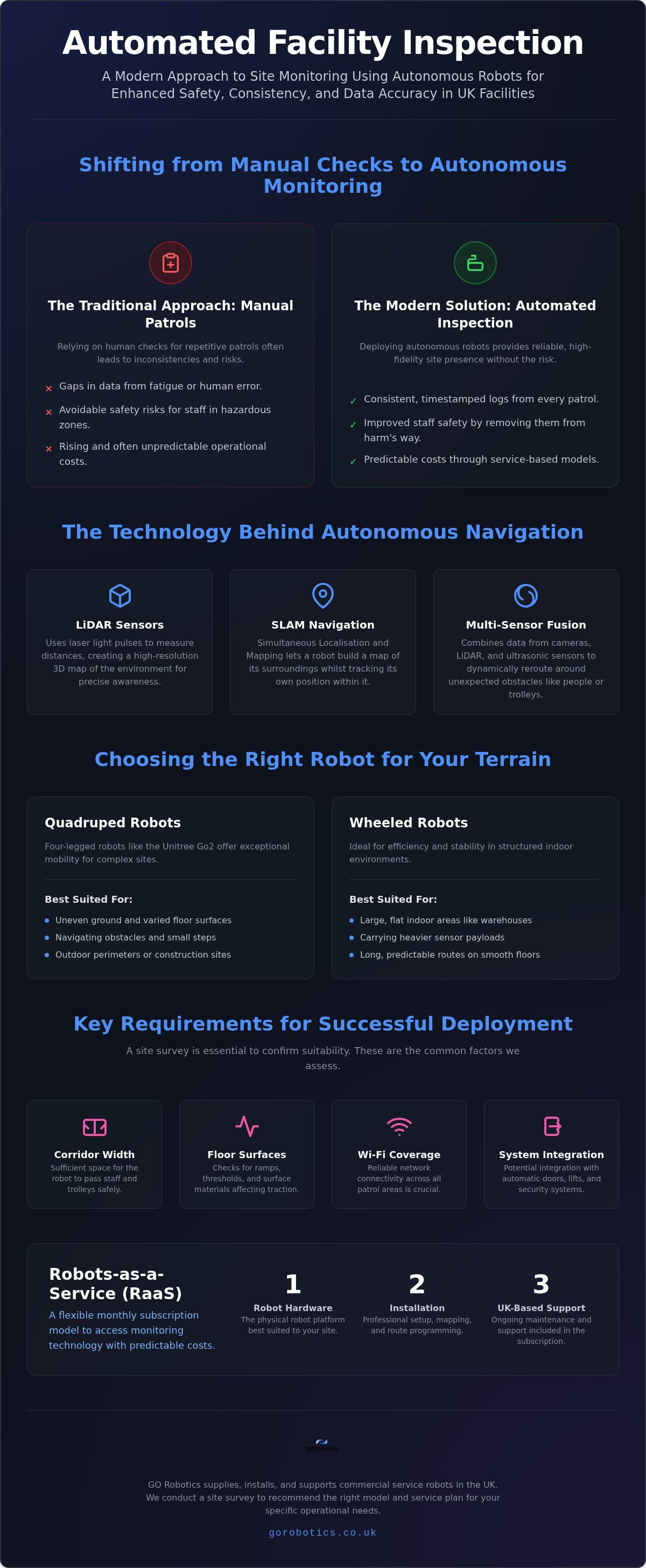
Modern autonomous monitoring relies on a detailed stack of hardware and software working in unison. At the heart of an automated facility inspection UK deployment is LiDAR. These sensors use laser light pulses to measure distances, creating a high-resolution 3D picture of the environment. By combining this with SLAM (Simultaneous Localisation and Mapping), a robot can build a map of its surroundings whilst simultaneously tracking its own position within that map. This level of technical capability aligns with the broader UK government position on automation, which highlights how connectivity and autonomous systems are becoming integral to national infrastructure.
How Robots Navigate UK Facilities Without Markers
Deploy robots without the need for magnetic strips or ceiling markers. Today's systems use marker-free SLAM to operate without expensive building modifications. These units achieve centimetre-level positioning accuracy. They traverse narrow corridors and dock precisely at charging stations with ease. If a staff member or a trolley moves into the robot's path, multi-sensor fusion kicks in. Merge data from cameras, LiDAR, and ultrasonic sensors to perform dynamic rerouting. The robot steers around obstacles safely and continues its patrol without human intervention.
Sensor Payloads: Beyond Standard Video
Capture more than just visual footage to enhance your automated facility inspection UK strategy. Specialised payloads offer deeper insights into site health. Spot overheating electrical components or heat loss in a building's envelope using thermal imaging sensors. Detect the high-frequency hiss of a gas leak or a failing bearing with acoustic sensors. Monitor air quality, temperature, and humidity across vast sites using environmental sensors. These robots share data in real-time via various communication protocols. Use Wi-Fi for indoor venues or 4G and LoRa wireless technology for larger outdoor yards. If you aren't sure which sensors your site requires, a professional site survey can help identify the most effective configuration for your monitoring needs.
Choosing the Right Form Factor: Quadruped vs Wheeled Robots
Selecting the correct physical build is the most critical decision in an automated facility inspection UK project. Your site layout, whether it is a multi-level construction project or a single-storey retail space, determines the chassis required for reliable operation. This alignment of hardware with specific industrial needs reflects the goals of the UK's national robotics strategy, which aims to integrate autonomous systems across diverse commercial sectors to improve productivity and safety.
Payload capacity and agility are the two primary trade-offs when choosing a form factor for an automated facility inspection UK strategy. Quadruped robots offer agility over obstacles but often have lower payload limits for heavy sensor arrays. Wheeled robots provide a stable base for larger equipment and generally move faster in open areas. However, speed must be balanced against safety in high-traffic UK environments like busy offices or shopping centres. It's essential to evaluate these factors during a site survey before committing to a specific model.
Quadruped Robots for Complex Terrain
Legged systems are designed for environments where wheels would fail. The Unitree Go2 UK can traverse slopes, climb stairs, and step over thresholds that would stop a wheeled unit. These models are effective for estate security, agricultural monitoring, and construction site inspections where the ground is often uneven or cluttered. While they offer unmatched mobility, legged systems typically have shorter battery runtimes than wheeled counterparts because of the energy required to maintain balance and movement.
Wheeled Systems for Internal Commercial Environments
Wheeled robots remain the standard for internal commercial spaces with predictable, flat flooring. They offer superior stability and extended runtimes on polished floors or carpeted corridors. These systems are ideal for data centres, shopping centres, and large corporate offices where they can patrol for hours on a single charge. In these settings, the focus is on navigating tight aisles and corridors smoothly without disrupting staff or visitors. They provide a cost-effective way to maintain a constant presence across large, single-level footprints.
Not sure which form factor suits your facility? GO Robotics can assess your site requirements through a professional site survey to ensure you select the most capable robot for your monitoring needs.
Operational Realities: Terrain, Connectivity, and Integration
Successful deployment of an automated facility inspection UK strategy depends on the physical and digital architecture of your site. While robots are highly capable, they require specific environmental conditions to operate at peak efficiency. Aisle and corridor widths must allow for safe passage and turning, especially in high-traffic zones. Floor surfaces also play a significant role. Thick carpets can increase resistance and reduce battery life, whilst large lift gaps or uneven tiled joints can pose challenges for certain wheeled form factors. Identifying these hurdles early ensures you select a chassis that won't get stuck during a routine patrol.
Reliable connectivity is the backbone of autonomous monitoring. Your facility needs robust Wi-Fi or 4G coverage to facilitate real-time data uploads and remote oversight. If a robot enters a signal dead zone, it may continue its path but won't be able to alert human teams to an immediate issue. Planning for docking stations is equally vital. These charging hubs must be placed in accessible areas that don't obstruct staff movement but provide enough space for the robot to manoeuvre and dock without assistance.
Navigating Lifts and Automatic Doors
Modern robots use IoT integration to move between floors and through secure areas independently. By communicating directly with building management systems, they can call lifts and open automatic doors without human help. Many platforms are compatible with major providers like KONE and OTIS. This usually involves hardware lift control that operates without mechanical modifications to the lift itself. Safety remains the priority during these transitions. If a power cut occurs or a fire door is closed, the robot follows strict safety protocols to stop safely and wait for instructions rather than attempting to force a path.
Preparing Your Staff for Automation
Introducing robotics to a shared workspace requires clear communication and thorough training. It's essential to manage staff expectations and explain that these tools are here to support their roles. This is a clear instance where humans lead and robots assist. On-site teams must be familiar with daily operations, such as checking the robot's sensors for dust or ensuring docking areas are clear. Every implementation includes detailed emergency procedures. Staff should be trained on manual override functions and the location of physical 'stop' buttons to ensure total control in any situation. If you're ready to assess your site's readiness for autonomous monitoring, contact GO Robotics for a professional site survey.
Procuring Inspection Robotics: The GO Robotics Approach
Begin your transition to automated facility inspection UK with a structured deployment process designed for commercial reliability. GO Robotics coordinates every stage from the initial assessment to long-term technical assistance. Manage your fleet effectively using a cloud dashboard that provides real-time oversight of task scheduling and robot status. This centralised platform ensures you maintain full visibility of your monitoring operations across multiple sites. We provide nationwide support, covering diagnostics and warranty requirements to ensure your equipment remains operational. Our UK-based team handles the technical details, so your staff can focus on high-level decision-making.
The Importance of a Professional Site Survey
Evaluate your site's specific challenges before any equipment is commissioned. A professional site survey identifies the corridor widths, floor transitions, and connectivity requirements discussed in previous sections. We develop a written recommendation detailing the exact quantity and configuration of robots needed to meet your monitoring goals. This document outlines the expected throughput and identifies any necessary IoT integrations for lifts or doors. If you need to see the technology in action, we offer optional on-site demonstrations. This allows you to observe how a quadruped or wheeled unit handles your specific environment before making a commitment. It is the most reliable way to confirm that a robot fits your operational workflow.
RaaS vs. Capital Purchase: Choosing the Right Model
Access the latest monitoring technology through flexible financial arrangements tailored to your operational budget. Many UK businesses choose robots as a service UK (RaaS) to avoid high upfront costs. This monthly subscription model typically includes the robot, software licensing, maintenance, and remote technical support. It provides a predictable cost structure while ensuring your fleet stays updated with the latest features. For organisations preferring full ownership, we offer outright purchase and finance options. Both models benefit from our comprehensive support package, which includes staff training and regular maintenance checks. We ensure your team feels confident managing the equipment during daily operations. Not sure which model fits your business? Contact GO Robotics to discuss a site-specific assessment and recommendation.
Secure Your Site with Autonomous Monitoring
Integrating autonomous technology into your daily operations is a practical step toward a safer and more consistent monitoring strategy. By deploying platforms like the Unitree Go2, you remove human staff from hazardous zones and eliminate the gaps often found in manual patrols. These systems provide the objective, timestamped data necessary for modern compliance and maintenance. Whether you choose a quadruped for complex terrain or a wheeled unit for internal corridors, the focus is clear: humans lead and robots assist.
Adopting an automated facility inspection UK model is now more accessible through our robots-as-a-service (RaaS) monthly rental options. This approach allows you to scale your fleet without heavy upfront capital, supported by our specialist knowledge in Unitree and Pudu systems. Every deployment is backed by our UK-wide technical support and professional installation team. We handle the technical complexities so you can focus on high-level site management.
Not sure if your site is ready for an inspection robot? Contact GO Robotics to book a site survey. We'll help you evaluate your layout and connectivity to ensure a seamless transition into a more efficient future.
Frequently Asked Questions
What is the typical runtime for an inspection robot in a UK facility?
Typical runtime varies between 8 and 15 hours depending on the specific model and its configuration. For example, the PuduBot 2 offers up to 15 hours when fully loaded, while the FlashBot Max provides around 9 hours. It's important to remember that real-world performance depends on the load, floor surface, route length, and ambient temperature. Most units use autonomous docking to return to their charging station before the battery runs low.
Can inspection robots operate outdoors in the UK weather?
Some models are designed for semi-outdoor environments, such as garden corridors, poolside areas, and covered walkways. Quadruped robots like the Unitree Go2 are particularly capable on uneven ground found in outdoor estates. However, most service robots are primarily indoor machines. We assess the specific IP ratings and ingress protection of a model during your site survey to ensure it can handle your site's specific environmental conditions safely.
Do inspection robots replace existing security or maintenance staff?
Robots don't replace your people; they assist by handling repetitive and physically demanding tasks. By using an automated facility inspection UK strategy, your existing team is freed from the drudgery of routine patrols. This allows staff to focus on high-level problem-solving and expert advice where human judgement is essential. The goal is to provide your team with better data and a safer working environment rather than reducing headcount.
How wide do corridors and aisles need to be for an inspection robot?
The required width depends on the robot's chassis, with minimum passage requirements ranging from 600mm to 800mm. The FlashBot Max can navigate gaps as narrow as 600mm, while the PuduBot 2 requires 800mm for safe movement. We measure your tightest aisles and doorways during our initial site mapping. This ensures the robot can manoeuvre smoothly without bumping into furniture or obstructing the flow of people in your facility.
How do inspection robots navigate between different floors in a building?
Multi-floor robots use IoT integration to communicate directly with your building management system. They can call lifts and open automatic doors without human intervention. These systems are compatible with major lift brands like KONE and OTIS and require no mechanical modifications to your existing lifts. This allows a single robot to monitor several floors independently, navigating between levels to complete its scheduled inspection rounds across your entire site.
Is a site survey necessary before hiring or buying an inspection robot?
Yes, a professional site survey is a mandatory first step in our deployment process. We evaluate your layout, floor surfaces, and connectivity to ensure the technology will work reliably in your specific environment. Following the survey, we provide a written recommendation covering the ideal model, quantity, and charging dock locations. This prevents the mistake of ordering equipment that isn't suited to your site's unique operational challenges.
What happens if the robot loses its Wi-Fi or 4G connection?
Many of our robots use redundant connectivity options to ensure they remain coordinated even if the main signal drops. For instance, the CadeBot L100 features LoRa wireless technology for an offline mode when Wi-Fi is unavailable. Robots generally continue their programmed tasks using on-board maps and sensors, then sync their data once the connection is restored. This prevents a temporary network glitch from halting your entire automated facility inspection UK operation.
Are inspection robots safe to operate around the general public?
Modern inspection robots are designed with multiple safety layers to operate safely in crowded spaces. They use 360-degree LiDAR and depth cameras to detect people, trolleys, and even small obstacles like chair legs. Some models also project safety patterns onto the ground to alert people at blind corners. These sensors allow the robot to perform dynamic rerouting, steering around pedestrians smoothly rather than making sudden stops that could cause an accident.