Employee reaction to service robots: benefits and concerns
A useful robot can still meet resistance. Employee reaction to service robots often hinges on whether staff can influence or override the robot’s actions: employees may value help with repetitive, physically demanding, hazardous or time-consuming tasks, yet be very unwilling to work alongside a robot they can’t control. The concern isn’t only whether the technology works, but what it means for people’s roles.
It’s reasonable for employees to ask whether automation will support their work or replace it. A successful introduction addresses those concerns openly and gives staff a clear role in how people and robots work together.
This article explores what employees may value, what can cause concern and what influences their willingness to collaborate. It also explains how managers can introduce robots gradually, clarify responsibilities and choose tasks that support employees rather than sideline them.
Key Takeaways
- Employees may value robots that take on repetitive, physically demanding, hazardous or time-consuming tasks, leaving more room for work that relies on human judgement and interaction.
- A sense of control matters: clear roles and the ability to influence or override a robot’s actions can affect employees’ willingness to collaborate.
- Introduce robots gradually and explain how they fit into daily work so staff can build familiarity and understand their responsibilities.
- Position robots as support for existing employees, not as a substitute for their skills, to help protect service quality and staff confidence.
- Assess how a proposed robot could change workload and stress in practice, then match its role to a task employees see as useful.
Employee benefits and perceived risks
Employees may welcome service robots when they take on repetitive, demanding or time-consuming duties. Their response also depends on whether the technology supports their work or feels like a threat.
Stress, workload and job satisfaction
Robots can affect stress, workload and job satisfaction by changing the tasks employees handle and how their work is assessed. In a hotel, for example, a robot carrying items between areas could reduce routine trips, leaving staff more time for guest requests that call for judgement and conversation.
That shift can ease one pressure while creating another. If employees must monitor the robot, deal with interruptions and still complete their usual duties, the overall workload may feel heavier. Before deciding whether a robot genuinely helps, managers should map the whole task, including handovers and exceptions.
When a robot records completed tasks or reports delays, employees may see the data as a form of monitoring or assessment. Explain what is recorded, who reviews it and how staff can flag errors. Without that clarity, routine performance data can feel like individual surveillance.
UK employee attitudes
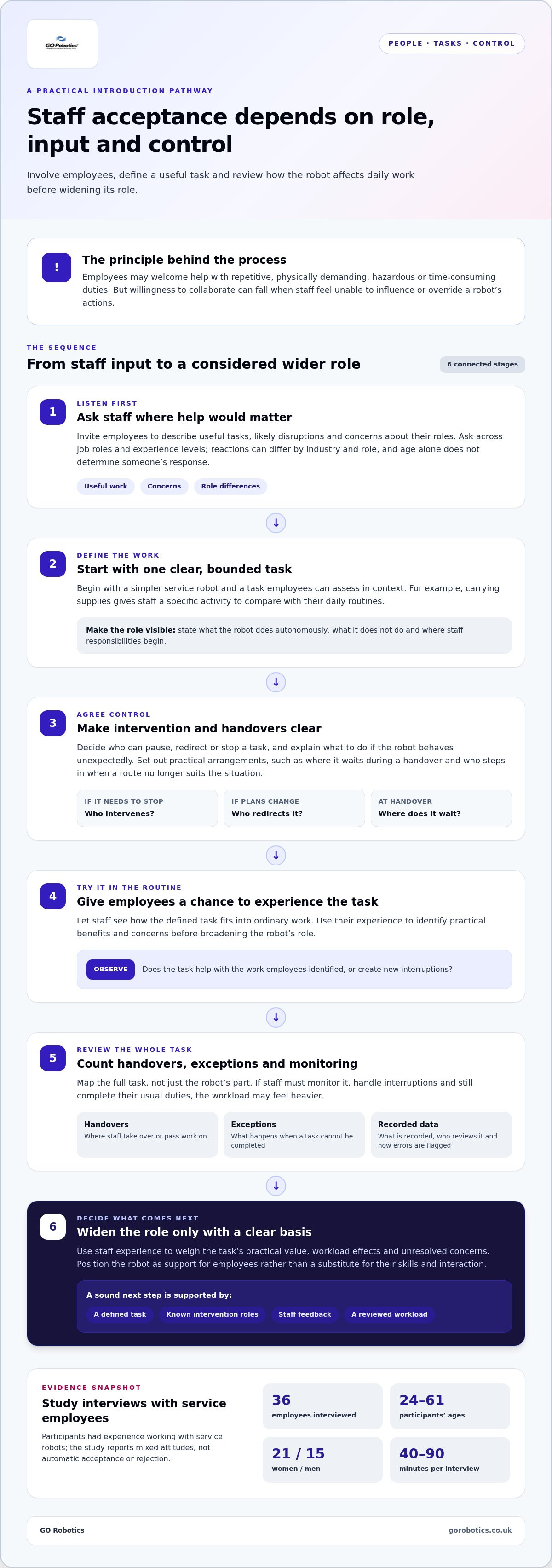
For UK managers, the available study findings point to mixed attitudes rather than automatic acceptance or rejection. The study interviewed 36 service employees aged 24 to 61, including 21 women and 15 men; interviews lasted between 40 and 90 minutes.
The study’s participants had experience working with service robots, so their views were based on workplace contact, not speculation alone. The findings highlight an important distinction: employees may value help with repetitive, physically demanding, hazardous or time-consuming tasks while remaining concerned about control and the implications for employment.
The study recommends starting with simpler service robots, giving employees a chance to experience a clearly defined task before adoption expands. For instance, staff can assess a robot assigned to carry supplies against their daily routines. Managers can then use that experience to identify benefits and concerns before broadening its role.
Risks of excluding employees
Introducing service robots without consulting employees means changing their work without their input. Staff may oppose a system they see as a threat, especially if managers have not explained its purpose or given workers a say in how it operates.
The risk goes beyond initial resistance. The study warns that treating robots as replacements for talented employees can harm service quality and reputation, as well as provoke opposition. In a restaurant, for example, replacing staff interaction with automated delivery could change the service customers experience.
Consultation can surface practical issues before they become routine problems. Ask staff where a robot could help, what should happen if it cannot complete a task and who can intervene. Clear responsibilities help employees retain a sense of control and give managers a sounder basis for deciding whether the robot fits the work.
Employee willingness to collaborate with service robots
Employees’ willingness to collaborate depends on the robot’s role and whether they can influence how it operates. Useful technology may not be enough if staff feel they have no control.
Differences in employee reactions
Reactions can vary by industry, role and experience with robots. A retail worker may be concerned about a robot navigating changing displays, while a care-home employee may focus on how it fits into residents’ routines. Understanding these differences helps managers address the concerns that matter to each team.
Age alone does not determine how someone will respond. Ask employees across age groups and roles what they expect from the robot, what might disrupt their work and what would help them feel confident using it. Even someone familiar with automation may object if the system interferes with established responsibilities.
Factors supporting acceptance
Acceptance is easier to build when employees understand the robot’s purpose and have a say in how it fits into their work. Explain what it does autonomously, what staff can change and who is responsible if a task needs to stop. For example, employees should know who can redirect it if a temporary change makes its route unsuitable.
Make the robot’s role specific and visible. A broad instruction to “help the team” can mean different things to different people; a defined task gives staff something concrete to assess. Ask employees what practical arrangements are needed, such as where the robot should wait during a handover or how its work fits with other staff duties.
Managers should also consider whether influential decision-makers support collaboration or oppose it. A supervisor who doubts the robot’s value may shape the team’s experience of its introduction. Discussing those views early can bring concerns about responsibilities to light and help managers address them before they affect day-to-day use.
Trust and collaboration
Trust influences whether employees are willing to work with a robot, particularly when it acts autonomously. Employees are very unwilling to collaborate if they feel unable to influence or override its actions, regardless of their initial view of its usefulness. Clear controls and a well-understood intervention process therefore matter.
Explain what employees can do if the robot behaves unexpectedly, and make sure the process works during ordinary shifts. For example, staff need to know whether they can pause a task themselves or should contact a supervisor. A rule mentioned only in a briefing is of little help if no one knows how to apply it in practice.
Set expectations for what happens after an intervention. Employees should know who reviews the issue and how changes to the robot’s task are communicated. If you’re planning a workplace trial, mapping staff roles alongside robot tasks can help make collaboration expectations clear.
Gradual adoption and workplace education
Introduce service robots in stages so employees can understand what will change before their use expands. The study recommends starting with a simpler robot, giving staff a manageable way to experience its role.
Before deployment, prepare a brief explanation of the robot’s purpose, expected working arrangements and limitations. For example, clarify whether it handles one routine activity or supports several teams. This helps employees distinguish its intended role from assumptions about what it can do.
Training should go beyond basic operation. Explain how the robot’s decisions relate to staff responsibilities, what it cannot handle and where human judgement remains essential. In healthcare, for example, employees need to understand how its routine movements fit around work that requires direct attention to people.
Managers should also plan for different levels of readiness. A decision-maker who supports the introduction can help explain its purpose, while a sceptical supervisor may raise concerns shared by the team. Discussing these views before rollout can reveal gaps in the explanation and help managers plan appropriate learning support.
Use several forms of communication to reach employees with different roles and schedules:
- Briefings: explain why the organisation is introducing the robot and what staff can expect to change.
- Demonstrations: show the robot performing its intended activity, so employees can see its behaviour in the work setting.
- Written guidance: give staff a clear reference for responsibilities and how to raise operational questions.
- Team discussions: invite employees to describe how the new equipment fits with existing routines.
Keep explanations consistent as the rollout develops. If managers initially describe the robot as support for a specific activity but later give it a broader role, staff need to understand the change and its effect on their work. Clear communication helps teams avoid developing conflicting expectations.
Education should continue after the initial introduction. Managers can revisit guidance when staff raise recurring questions or team arrangements change. For instance, a new supervisor may need the same explanation as employees who attended the original briefing. Treating learning as part of adoption helps people understand the robot’s place in the workplace, rather than seeing its arrival as a one-off announcement.
The study recommends educating employees and integrating robots gradually so staff can feel in control and adopt the technology. This principle can guide every stage of the rollout: make changes understandable, explain what employees can expect and give them time to become familiar with the robot’s role before expanding its use. When staff can connect the technology to their responsibilities, the transition is less likely to feel imposed.
Employee questions can also help shape the next stage of education. If staff are unsure how a robot fits into their work, address that uncertainty before expanding its use. Focus on what employees need to know to work alongside it and where they can get clarification. A gradual approach is not simply a slower launch; combined with education, it helps employees understand the change and take part in adapting to it. In this way, adoption can grow through understanding rather than expectation alone.
Job replacement concerns
Employees may see a robot assigned to routine work and wonder whether their own role will change next. The study advises managers not to treat service robots as replacements for talented employees, warning that this approach can provoke opposition and harm service quality and reputation. Address concerns by explaining automation in terms of actual duties, not broad promises about jobs.
Start by distinguishing a task from the role it belongs to. A hotel employee, for example, may move supplies, check room requirements and respond to guest requests. If a robot supports one routine activity, explain what remains the employee’s responsibility and how the team’s duties fit together. This makes the proposed change easier to discuss concretely.
Before choosing a task, map the work employees currently do around it. Include preparation, handovers, exceptions and decisions that depend on experience. In a care setting, moving items may seem straightforward, but staff still need to decide when and where a delivery fits into residents’ routines. That context helps managers avoid reducing an entire role to one repeatable activity.
Use a role-impact discussion to clarify the proposal:
- Task: name the activity the robot is intended to assist with.
- Human judgement: identify decisions that remain with employees, such as responding to an unusual request.
- Responsibility: state who handles exceptions and how work passes between people and the robot.
- Role changes: explain any expected changes to duties directly, rather than leaving staff to infer them.
Give employees a way to raise specific concerns before the task begins. A cleaner might point out that a proposed route conflicts with a room’s preparation sequence; a supervisor might flag an unclear handover. Such feedback helps managers assess whether the robot will support staff in practice, rather than simply removing a task from a job description.
Review the arrangement once the robot is in regular use. Compare the original task plan with what employees actually do, including any new checks or exceptions. If the robot creates extra duties or disrupts service, adjust the allocation before extending the same approach to another team. Candid, clear communication about the task and its effects gives employees a sounder basis for assessing the change.
How does robot adoption affect employee stress, workload and job satisfaction?
Robots can ease pressure by taking on routine tasks, but they can also add supervision and problem-solving duties. The effect depends on how the robot fits into a shift: a delivery robot might reduce repeated trips, or create extra work for staff managing delays.
Assess the whole task, not just the part assigned to the robot. In a hotel, carrying linen may be only one step: an employee still needs to load it, arrange the handover and respond if the route is blocked. If these steps add interruptions without changing other duties, the workload may increase rather than fall.
Uncertainty about responsibility can also cause stress. If a robot stops in a busy corridor, staff need to know who can pause it and who handles the delivery. A clear handover process means employees do not have to guess during a shift, especially when several teams share the area.
Job satisfaction depends in part on whether employees retain meaningful work and see a practical benefit. A cleaning team may welcome a machine taking on repetitive floorcare while valuing its own role in checking difficult areas and responding to specific requests. Make these responsibilities clear in the work design.
Before and after introducing a robot, managers can review the same practical indicators with staff:
- Task load: note whether the original duty has reduced or whether staff now spend time loading, monitoring and assisting the robot.
- Interruptions: record examples such as blocked routes, missed handovers or repeated calls for help during a shift.
- Control: ask whether employees know how to pause the robot and whom to tell when a problem recurs.
- Work quality: discuss whether staff have more time for guest requests, patient support or detailed cleaning checks.
Compare feedback across roles, not just departments. A supervisor may notice fewer manual trips, while the employee preparing items reports extra steps. A short shift debrief can reveal the difference and show whether the task needs adjusting.
Use the findings to change the work arrangement, rather than assuming the robot has improved the day. If staff spend more time resolving exceptions than completing the task, revise the route, handover or assigned responsibility. To discuss which workplace task a robot could support, talk with GO Robotics about your team’s needs.
GO Robotics: Pudu BellaBot
GO Robotics supplies Pudu BellaBot for businesses considering a service robot for hospitality tasks. If you are assessing whether it could support your team, start by defining the task, staff responsibilities and how employees will work alongside it. A clear use case makes it easier to discuss the robot with those affected and set realistic expectations.
GO Robotics can survey your site and recommend a model, helping you consider whether Pudu BellaBot suits your venue and intended use. Pudu KettyBot and Pudu HolaBot are also options to discuss, depending on the task you want to address.
Contact GO Robotics to discuss Pudu BellaBot and your workplace requirements.
Plan a people-first introduction
Choose the task before choosing the robot. Define where support is needed, which employees the change affects and how staff feedback will shape day-to-day use. This gives your team a practical role in planning, rather than leaving workplace concerns until after installation.
Employee reaction to service robots can support a more grounded assessment when staff feedback is linked to specific duties, handovers and decisions. Turn those observations into clear priorities for your site: the task to address, the working conditions that matter and the control employees need. This keeps the discussion focused on how the technology will fit your operation.
GO Robotics offers Pudu BellaBot, Pudu KettyBot and Pudu CC1. Discuss your intended use and workplace priorities to consider which model fits the task. Contact GO Robotics to discuss service robots and take a considered next step with your team.
Frequently Asked Questions
How do employees react to service robots in the workplace?
Employee reaction to service robots varies with the task, role and workplace. A porter may welcome help moving supplies, while a receptionist may focus on how a change affects guest enquiries. Some staff may be curious; others may worry about control or changes to their jobs. Invite feedback from each affected role instead of assuming the workforce shares one view.
What are the main benefits employees see in working alongside service robots?
Employees may value support with routine movements or tasks that take time away from other duties. In a hotel, for example, carrying items between work areas could leave staff better placed to respond to guest requests. The benefit depends on the actual workflow: if employees spend extra time preparing, supervising or correcting the robot, it may not ease pressure. Assess the whole task, including handovers and exceptions.
What concerns do employees have about service robots replacing jobs?
Employees may worry that automating a task signals their role could disappear or change without their input. Explain what the robot is assigned to do, which responsibilities remain with staff and whether managers expect roles to change. Avoid broad assurances. A written role description, discussed with affected employees, gives everyone a clearer basis for raising questions about duties, development and future staffing decisions.
What training and communication help employees adapt to service robots?
Effective preparation combines a plain-language briefing with hands-on practice. Explain the robot’s assigned task, demonstrate its controls and give staff a simple way to report problems. Include temporary and cover staff who may miss the initial briefing, and keep written instructions near the relevant work area. A short team discussion after use can surface practical questions formal training may not address.