Automating Cleaning Tasks Without Hiring More Staff: A Practical Guide
Automation works best when it takes a repeatable task off a busy team’s list, not when it tries to replace the people who keep rooms ready. For hotels, automating cleaning tasks without hiring more staff can mean using a commercial cleaning robot to assist with guest-room floor cleaning, while housekeepers remain responsible for room checks and details that need human attention.
It’s understandable to be cautious. Cleaning often competes with other duties, and a robot that interrupts room turnover could create more work rather than less. The key is to choose a clearly defined task and fit the robot around the way your team already works.
This guide explains how to identify suitable cleaning work, assess where a robot could help, and plan a practical evaluation before choosing equipment. It covers how robot-assisted floor cleaning can fit into a housekeeper’s workflow, what to check during a site assessment and how staff involvement works. The goal is added capacity without cutting headcount or disrupting service.
Key Takeaways
- Start automating cleaning tasks without hiring more staff by identifying repeatable floor-cleaning work that fits around your team’s existing duties.
- Map the guest-room workflow first, including floor types, furniture, access, cleaning areas and the point where staff hand over to the next task.
- Keep housekeepers responsible for room checks, guest interaction and decisions that need judgement. Use a robot to assist with defined cleaning tasks.
- Plan a pilot around room access and staff routines, and agree what you will measure before the trial begins.
- Use the J20’s documented role and specifications to assess whether robot-assisted floor cleaning could fit your UK hotel’s rooms and workflow.
Automating cleaning tasks without hiring more staff starts with the right workload
Keeping guest rooms clean and ready puts pressure on the team you already have, especially when floor care competes with room checks, guest requests and other duties. The first step in automating cleaning tasks without hiring more staff isn’t choosing a robot. It’s finding a recurring task that equipment can assist with without disrupting the work around it.
Task automation means assigning a defined, repeatable job to equipment while staff retain oversight and judgement. In a hotel, that could mean a robot assisting with guest-room floor cleaning. Housekeepers remain responsible for the wider room clean, checking that the room is ready and responding to guests. The aim is added capacity, not fewer roles.
Which cleaning tasks are repeatable enough to assess?
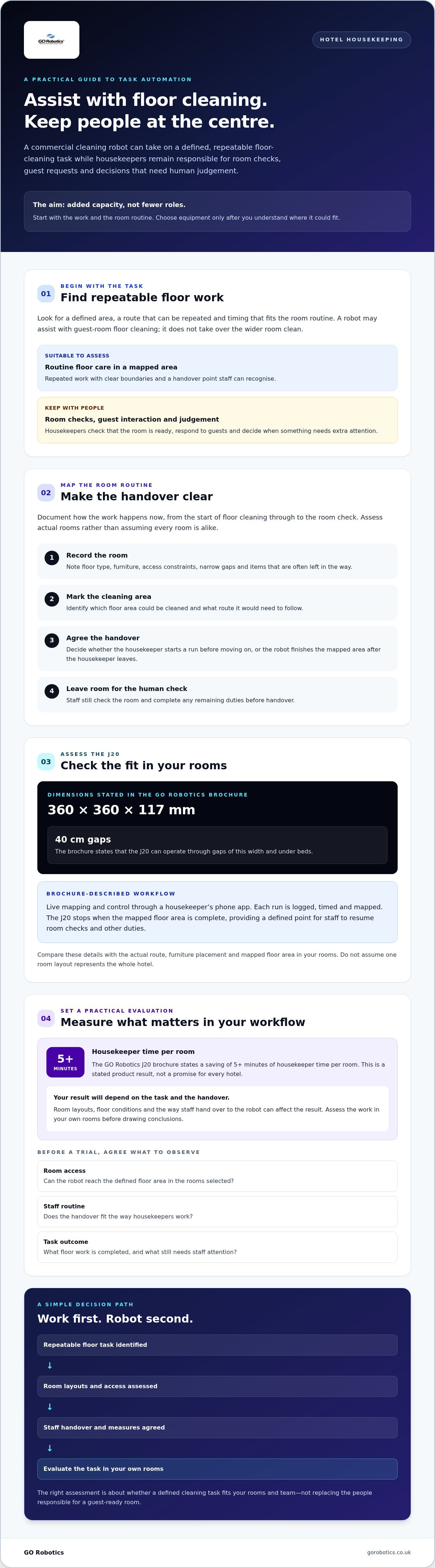
Look for floor work with a clear area to clean, a route that can be repeated and timing that fits the room routine. Separate that work from tasks that depend on a person’s judgement, such as checking the room, handling a guest request or deciding whether something needs extra attention.
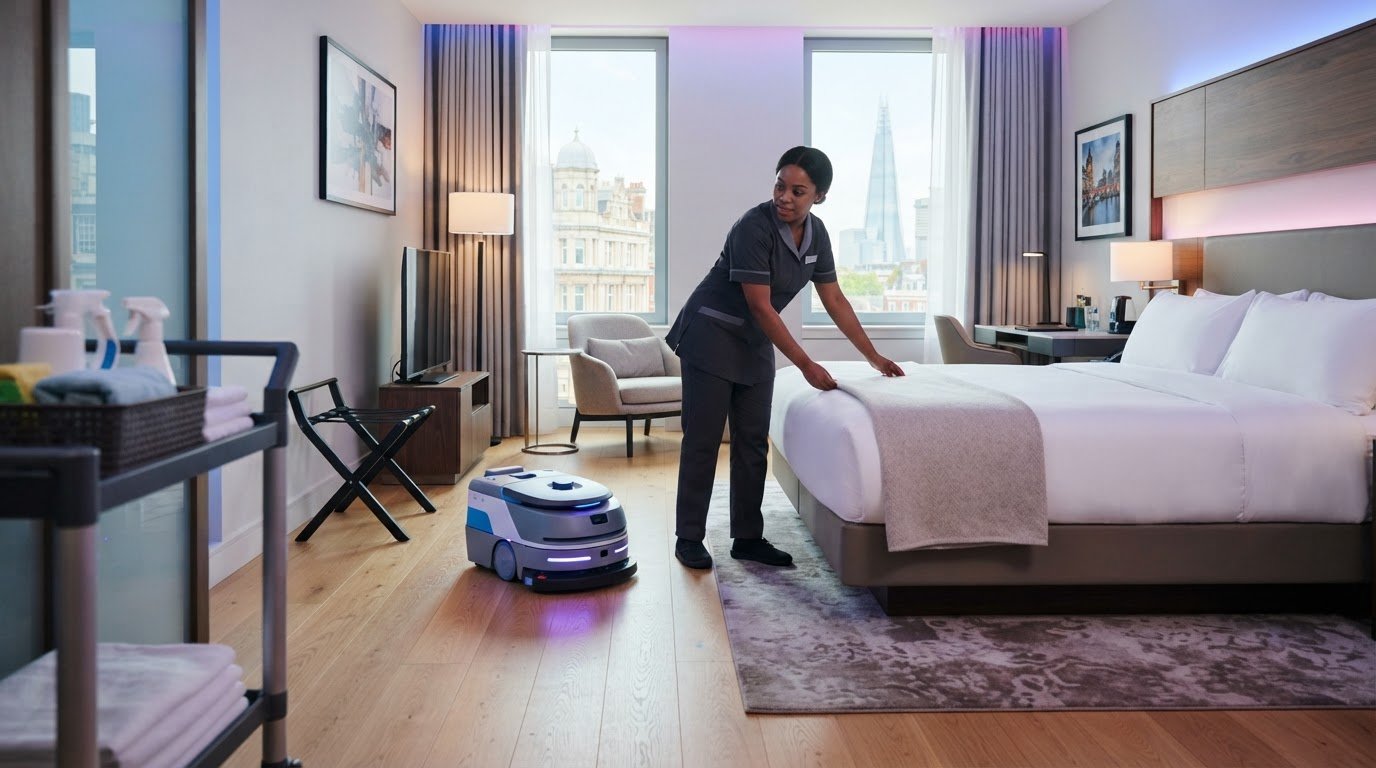
Guest-room floors are one task to assess for the J20. Its brochure describes it as working alongside a housekeeper or finishing a mapped floor area after the housekeeper leaves. If you’re new to mobile robots, Wikipedia’s overview of the Automated guided vehicle (AGV) explains the wider category of vehicles that follow routes or use navigation systems. It’s useful background, but your assessment should focus on the specific robot and your hotel’s rooms.
What does capacity gain mean for the existing team?
Capacity gain means giving staff time to focus on other duties, not reducing headcount. For example, time spent on routine floor care could be reassigned to room finishing or other tasks in the housekeeping schedule. The practical benefit depends on your workflow and how the robot fits into it.
The GO Robotics J20 brochure states that the model saves 5+ minutes of housekeeper time per room. Treat this as a stated product result, not a promise for every venue. Room layouts, floor conditions and the way staff hand over to the robot can affect the result, so assess the task in your own rooms before drawing conclusions.
Begin with a task audit. Record which floor areas are cleaned repeatedly, what interrupts the current routine and which duties must stay with staff. This gives you a practical basis for deciding whether a robot could assist before you consider equipment or plan a pilot.
Map the guest-room cleaning workflow before automating any task
A robot should fit the room routine your team actually follows, not an idealised version of it. Before automating cleaning tasks without hiring more staff, document the current process from the start of floor cleaning to the point where the room is checked and handed over. This helps you spot access issues and decide where the robot could assist.
How should a hotel document its current cleaning process?
Start with a task audit. Record which floor areas are cleaned, when the work happens and who starts it. Note the room layout, floor type, furniture and access constraints, such as narrow gaps or items that are usually left in the way. Don’t assume every room is identical, even within the same room category.
Then mark the area a robot would clean and the current handover point. For example, does a housekeeper start the cleaning run before moving on, or would the robot run after the housekeeper has finished other work in the room? A clear handover helps staff know what has been cleaned and what still needs their attention.
Where can the J20 fit into a room-turnover routine?
The GO Robotics J20 brochure gives its dimensions as 360 × 360 × 117 mm and states that it can operate under beds and through 40 cm gaps. Compare those details with the rooms you’ve recorded rather than assuming one layout represents the whole hotel. Check the actual route, furniture placement and mapped floor area as part of the assessment.
The brochure also describes live mapping and control through a housekeeper’s phone app, with each run logged, timed and mapped. In a suitable workflow, a housekeeper can start a run or leave the J20 to finish the mapped area after they leave the room. The J20 stops when that mapped floor area is complete, giving staff a defined handover point before they carry out room checks and any remaining duties.
Keep the evaluation practical: audit the task, document room variations, agree who starts the run, map the intended floor area, then review how the process fits the room-turnover routine. Cornell University’s automating hospitality processes course also considers how automation can support hospitality operations without replacing staff.
If you’d like to assess how this workflow could fit your rooms, discuss a guest-room cleaning assessment.
Compare staff-led and robot-assisted cleaning without treating them as substitutes
Automation should change who or what handles a specific task, not remove housekeepers from the room-turnover process. For hotels considering automating cleaning tasks without hiring more staff, the useful comparison is between how floor cleaning is done now and how a robot could assist with that part of the work. Room inspections, guest interaction and decisions about exceptions still belong with staff.
| Work | Staff-led approach | Robot-assisted approach |
|---|---|---|
| Routine floor cleaning | A housekeeper cleans the floor as part of the room routine. | A robot may handle a defined, mapped floor area, with a housekeeper starting the run or leaving it to finish after they leave. |
| Room inspection | Staff check the room and decide whether anything needs further attention. | Staff retain responsibility. A cleaning robot does not replace the room check. |
| Guest requests and exceptions | Staff respond to guests and use judgement when something unexpected needs attention. | These remain staff duties; they sit outside a repeatable floor-cleaning task. |
Which work stays with people, and which work may be automated?
Assess repeatable floor cleaning separately from the wider room clean. A robot such as the J20 is intended to assist with guest-room floor care, not to complete every task required to prepare a room. Housekeepers still manage room checks, guest-facing decisions and work that changes from one room to another.
This distinction matters for staff planning. The purpose is to give the team more capacity for other duties, not to cut headcount or remove human oversight from the room-turnover process.
How much supervision does a cleaning robot need?
There is human input before and at the start of a run: the area needs to be mapped, the task needs to fit the room routine, and staff need to get the robot running. The J20 brochure states “0 supervision needed once running”. In context, this refers to the run after setup, not to zero human involvement across the cleaning process.
The GO Robotics J20 brochure also states 25% less time to turn a guest room. This is a stated product result, not a guaranteed outcome for every hotel. Room layouts, staff handovers and operating routines can affect the result. Assess the robot in the workflow you’ve documented and review whether staff gain useful capacity without compromising room checks or service.
Plan a cleaning robot pilot around access, staff routines, and measurable tasks
A pilot should test a defined job in the conditions your hotel actually operates in. Before deployment, agree what the robot will clean, who will start each run, how staff will hand over the task and when you’ll review the results. This gives you a clear basis for deciding whether the equipment fits your working routine.
What should the pilot test in a working hotel?
Choose a guest-room floor-cleaning task and rooms that reflect the layouts you want to assess. Check the access route and mapped cleaning areas, including whether furniture or room differences affect the planned run. Agree who starts the robot and what the housekeeper does next, so the trial tests a workable handover rather than an idealised process.
Ask housekeepers to record practical observations as they work. Did the run fit their routine? Was the intended area completed? Did staff need to change the room set-up or take on extra steps? Their feedback can reveal disruption or useful adjustments that task records alone may not show.
How should managers review results before expanding use?
Set a review point before the pilot begins. Compare the tasks you planned with the mapped areas completed and the run information available. Consider staff feedback alongside those records: a completed run is useful only if it fits room access and leaves the team clear about what still needs attention.
Review the actual mix of rooms included rather than assuming one result applies across the hotel. Note limitations such as a route that doesn’t fit a particular layout, a handover that interrupts the routine or an area that needs a different cleaning approach. Adjust the pilot scope and test the revised process before considering additional rooms.
Use the findings to decide whether the robot adds practical capacity without disrupting room readiness. Don’t base the decision on an assumed saving; assess task completion, staff experience and fit with your operating routine. If you’d like to discuss how to assess your venue, talk to GO Robotics about a site assessment.
Assess GO Robotics and the J20 for UK hospitality guest-room cleaning
The J20 is relevant to hotels assessing whether repeatable guest-room floor care can be handled differently. It’s intended to work alongside a housekeeper or finish a mapped floor area after they leave, not to clean a room from start to finish. For managers considering automating cleaning tasks without hiring more staff, the key is to match its documented role to the rooms and handovers identified in your task audit.
What J20 details matter when assessing guest-room floor cleaning?
The GO Robotics J20 brochure describes a single-pass sweep, vacuum and mop function. It lists suction at 10,000 Pa and a cleaning rate of 200 m²/h. These are brochure specifications, not a promise of the result you’ll see in every room. Assess them against your floor types, mapped areas and operating routine.
The brochure lists separate clean-water and dirty-water tanks, with capacities of ≤ 490 ml and ≤ 420 ml respectively. The J20 never mops with dirty water. During an assessment, consider how tank handling fits staff routines and whether the mapped floor area is an appropriate task for the robot. Housekeepers remain responsible for room checks and other work requiring judgement.
Also check whether the cleaning schedule fits the J20’s stated 180 min runtime and charging time of ≤ 180 min (from 20% charge). The brochure lists a removable 6,400 mAh LiFePO₄ battery and a cleaning rate of 200 m²/h. These specifications can help frame the assessment, but the actual mapped area and room routine should guide the trial.
What should a supplier discussion cover before proceeding?
Bring practical details to the discussion: room layouts, floor types, access constraints, the areas you’d map, and the point where a housekeeper would start or hand over a run. Be clear about the task the robot would assist with and which duties must remain with staff. This keeps the conversation grounded in your venue rather than a general product demonstration.
GO Robotics provides UK-wide installation, staff training and ongoing technical assistance. Ask how installation and training would fit your hotel’s working routine, and what staff would need to know before using the robot. You can also discuss how to assess the mapped area and review task completion during a pilot. Treat brochure results as product information rather than guaranteed outcomes; the room mix and actual workflow matter.
Use the discussion to decide whether the J20 is suitable for further assessment, not to commit to a particular result. To explore the fit for your venue, speak to GO Robotics about the J20.
Build capacity with a practical first step
Automating cleaning tasks without hiring more staff starts with choosing a repeatable job, then checking how it fits your rooms and staff routines. A task audit and a focused pilot help you assess access, handovers and task completion before deciding whether to expand use. Housekeepers remain responsible for room checks, guest interaction and work that calls for judgement.
For UK hospitality guest rooms, the J20 is designed to assist with floor cleaning alongside a housekeeper. The GO Robotics brochure states 5+ minutes of housekeeper time saved per room. Treat this as a stated product result, not a guarantee for every venue. GO Robotics provides UK-wide installation, staff training and ongoing technical assistance to support evaluation and use.
If you’re ready to explore whether the J20 suits your room layouts and cleaning routine, speak to GO Robotics about the J20. A carefully planned assessment can help you make a confident decision and give your team a practical way to build capacity.
Frequently Asked Questions
Can a cleaning robot help a hotel avoid hiring more staff?
It may help your existing team handle repeatable floor-cleaning work without adding headcount, but it can’t guarantee that you won’t need to recruit. The aim of automating cleaning tasks without hiring more staff is to add capacity, not reduce roles. Housekeepers still manage room checks, guest requests and work that needs judgement. Assess the robot in your own rooms and routines before deciding what difference it could make.
How much time can the J20 save when cleaning a guest room?
The GO Robotics J20 brochure states that the robot saves 5+ minutes of housekeeper time per room. Treat this as a stated product result, not a guaranteed saving for every hotel. Room layouts, floor types and staff handovers can affect how the task works in practice. A focused pilot can help you assess whether the stated result fits your rooms and how any time returned could support other housekeeping duties.
Does a J20 cleaning robot work without any staff involvement?
No. Staff input is needed to prepare and start a run, and housekeepers remain responsible for room checks and other tasks requiring judgement. The GO Robotics J20 brochure states “0 supervision needed once running”, which applies after the robot has been set up and is operating on its mapped floor area. It doesn’t mean the entire room-cleaning process happens without people.
Can the J20 clean under beds in hotel rooms?
The GO Robotics J20 brochure states that the robot can operate under beds. Its listed dimensions are 360 × 360 × 117 mm. Check the actual clearance beneath beds and around furniture in the rooms you plan to include, as layouts can vary. Mapping the intended floor area during an assessment helps establish whether the route fits your room and cleaning routine.
How should a hotel decide which cleaning tasks to automate first?
Start with a task audit rather than selecting equipment. Look for repeatable floor-cleaning work with a defined area, a route that can be mapped and a handover point that fits the housekeeping routine. Keep room inspections, guest requests and decisions about exceptions with staff. Then assess room layouts and access, and test a clearly defined task in a pilot before considering wider use.
Will a cleaning robot replace housekeepers?
No. The J20 is intended to assist with repeatable guest-room floor cleaning, either alongside a housekeeper or by finishing a mapped area after they leave. Housekeepers continue to handle the wider room clean, inspect the room, respond to guests and deal with anything that needs human judgement. The intended benefit is added capacity for the existing team, not cutting headcount.