Automating Repetitive Tasks with Robots: UK Venue Guide
Every hour your team spends carrying trays back to the kitchen or pushing a floor scrubber is time taken away from your guests. Automating repetitive tasks with robots takes that dull, physical transit off the rota so your staff can focus on customer service. With the UK hospitality sector recording a 52% turnover rate in a 2024 analysis, running lean rotas without burning out reliable workers has become a serious operational priority.
It's natural to wonder whether commercial units can cope with tight gangways, busy corridors, and unpredictable foot traffic. You want dependable support, not an awkward novelty that gets stuck in doorways or requires constant supervision from your duty managers.
This guide sets out clear criteria for selecting the specific cleaning and clearing workflows suited to robotic help, alongside a practical testing roadmap for your venue. You'll learn how to trial autonomous units safely, protect your daily service, and return your team's energy to genuine hospitality where humans lead and robots assist.
Key Takeaways
- Understand which venue workflows benefit most from automating repetitive tasks with robots, shifting heavy tray running and floor cleaning off your daily rotas.
- Discover how marker-free navigation and multi-sensor fusion help commercial units steer safely around diners, luggage, and narrow gangways without floor tracks or ceiling tags.
- Follow a practical four-step implementation plan, starting with a walking audit and a structured site survey to assess doorways, ramps, and flooring transitions.
- Compare outright equipment purchase against monthly Robots as a Service subscription packages to protect operating cash flow and avoid upfront capital risk.
What Automating Repetitive Tasks with Robots Means for UK Venues
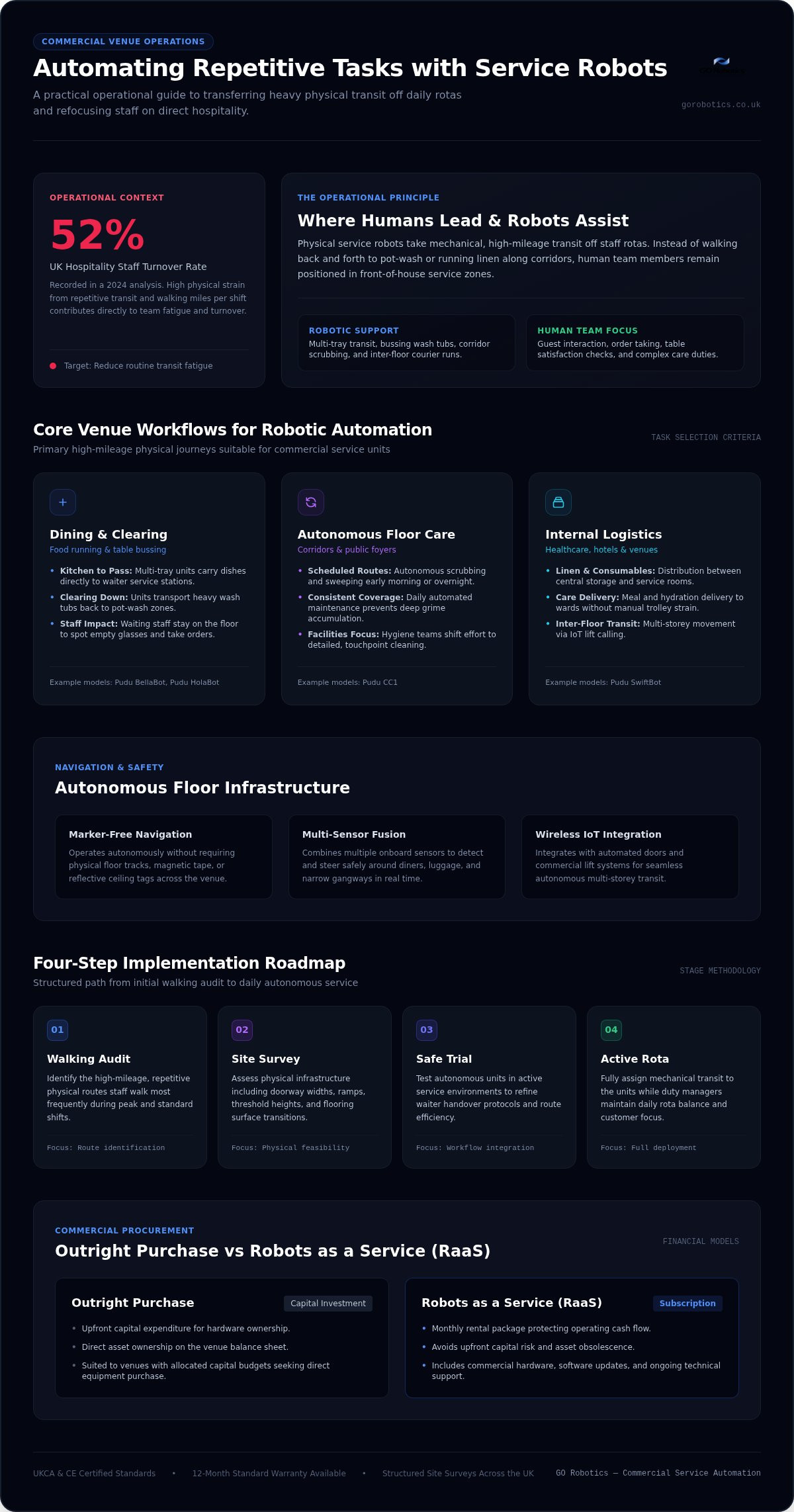
Most commercial discussions around automation focus on digital software processing invoices or handling online bookings. For physical sites like hotels, pubs, and retail stores, the operational bottleneck is rarely on a computer screen. It happens directly on the floor. In a physical venue, automating repetitive tasks with robots means assigning mechanical, high-mileage transit to wheeled service units so your staff can remain present with customers.
Physical Autonomous Units Versus Digital Process Automation
Software bots manipulate data, but physical service robots carry physical items. A digital tool cannot run a heavy tray of cutlery across a dining room or scrub a tiled lobby floor. Wheeled commercial units carry dish tubs, guide guests, and wash corridors. Instead of buying hardware outright, many venues access these machines through the Robot as a Service (RaaS) model, a monthly rental arrangement that includes hardware, software updates, and ongoing support.
Why Commercial Venues Target Routine Floor Chores First
Venue operators start by targeting workflows that consume physical effort without adding personal service value:
- Food running and table clearing: Waiters often walk several miles during a single shift simply shuttling used crockery to the wash area.
- Internal supplies transit: Housekeeping teams routinely push heavy linen carts back and forth along accommodation corridors.
- Daily floor maintenance: Facilities crews spend hours operating manual scrubbers across wide public entryways.
Continuous walking and lifting cause physical fatigue, which contributes directly to workplace injuries and high staff turnover. When a robot handles the transit between the restaurant floor and the kitchen, serving staff remain stationed in their dining sections. They can spot empty glasses, check on table satisfaction, and take additional orders. Robots do not replace human workers; they handle the mechanical transit, leaving your team free to deliver attentive hospitality.
Core Tasks Suitable for Service Robot Automation
Identifying which manual jobs to hand over requires looking at daily staff routines. In commercial venues, the best candidates are simple, physical journeys repeated dozens of times per shift. While early UK government automation initiatives focused on removing administrative screen work, venue operators see the fastest operational return by automating repetitive tasks with robots on the ground floor.
Dining and Room Service Floor Deliveries
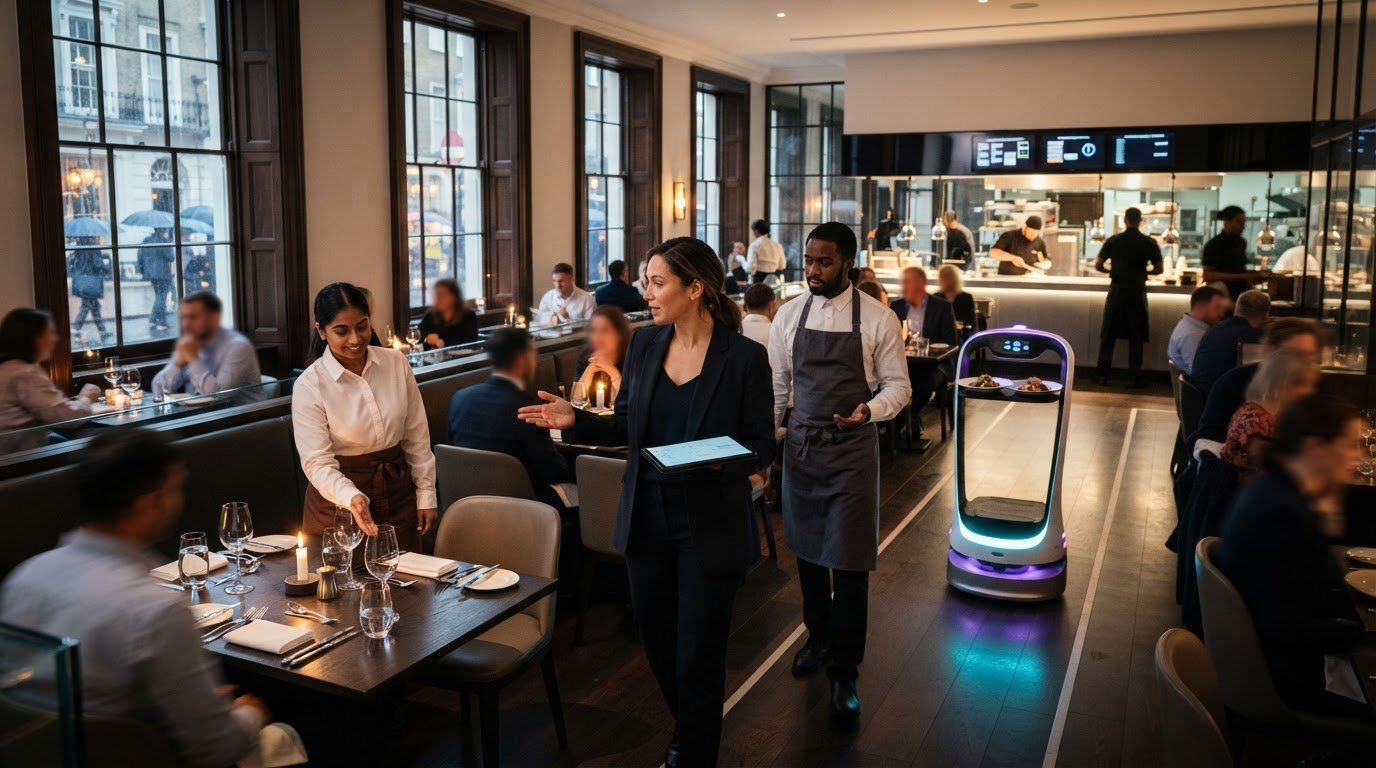
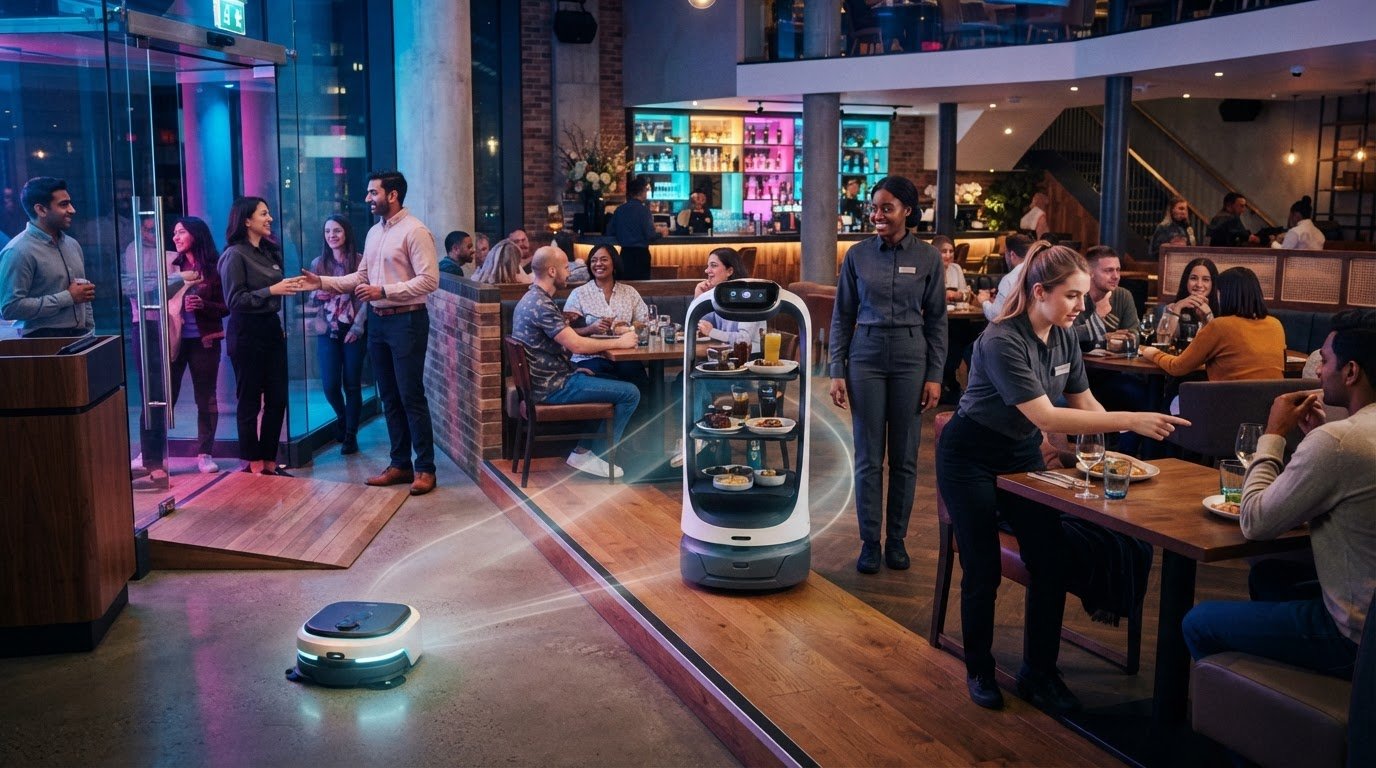
In high-turnover restaurants and hotels, carrying plates back and forth consumes hours of labour. Multi-tray delivery units like the Pudu BellaBot transport food directly from the kitchen pass to front-of-house waiter stations. Waiting staff collect the dishes and serve the table personally. When clearing down, the Pudu HolaBot carries dirty wash-tubs back to the pot-wash area. Exploring practical hospitality robots UK venues use shows how keeping staff on the dining floor speeds up table turnover.
Autonomous Floor Cleaning and Surface Maintenance
Cleaning wide floors manually ties up facilities staff who could handle detailed hygiene tasks. Units such as the Pudu CC1 handle autonomous scrubbing and sweeping along expansive tiled foyers and public corridors. Commercial cleaning robots run scheduled routes early in the morning or overnight, leaving hard floors clean before foot traffic builds. Reviewing a dedicated commercial cleaning robot UK guide highlights how consistent daily scrubbing prevents dirt build-up without stretching night-shift teams.
Internal Logistics and Healthcare Supply Transit
Care homes, clinics, and large corporate facilities lose productive hours to basic internal courier runs:
- Linen and consumable distribution: Wheeled units move clean bedding, towels, and clinical items between central storage and service rooms.
- Meal and hydration delivery: Units bring food trays to residential wards, reducing physical back strain for care workers.
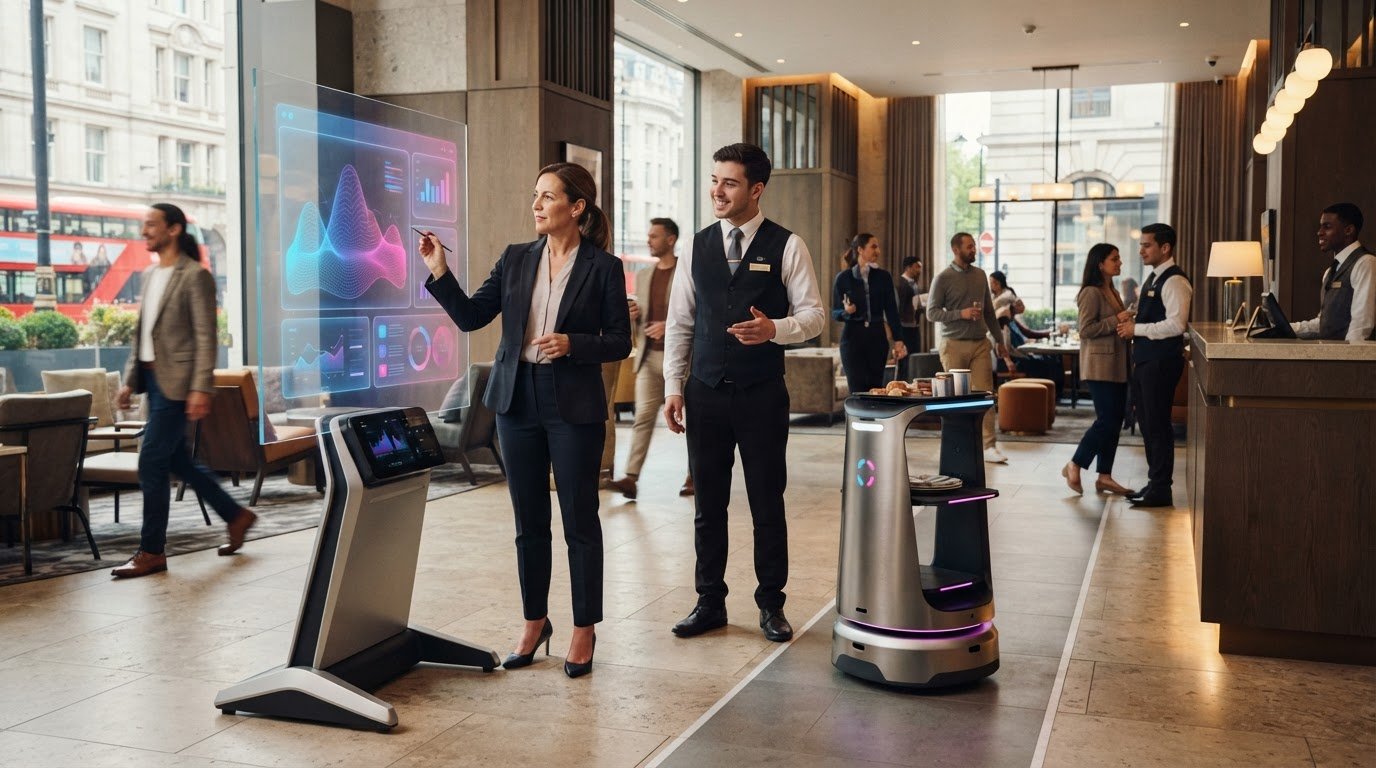
- Inter-floor transit: Enclosed delivery runners like the Pudu SwiftBot use wireless IoT integration to call lifts and open automated doors, moving supplies across multi-storey venues.
Adopting a specialised hospital delivery robot UK model keeps clinical staff focused on patient care. If your team spends too much time walking corridors, you can book a free site survey with GO Robotics to see which tasks match autonomous support.
How to Implement Robots for Repetitive Tasks in Four Steps
Bringing autonomous machines into an active workplace does not require months of structural renovation or disruptive IT consultancies. With UK operators increasingly turning to technology and innovation to manage rising operational costs, introducing physical automation can be achieved through four methodical stages. Following a structured roadmap ensures you succeed at automating repetitive tasks with robots without interrupting regular guest service.
Step 1 & 2: Task Auditing and Venue Surveying
Start by auditing daily rotas. Track where your staff spend the most time walking back and forth without interacting with customers. Peak dining services or early-morning public cleaning runs usually reveal the largest transit bottlenecks.
Next, carry out a structured site survey before picking hardware. A specialist engineer examines your physical environment to ensure smooth daily operation:
- Corridor and aisle widths: Measure primary transit paths, checking pinch points around pillars and service stations.
- Thresholds and ramps: Check floor joins, carpet trims, and ramp gradients between service kitchens and public dining areas.
- Lift mechanisms: Assess whether passenger or service lifts can connect to wireless protocols for multi-floor routes.
Step 3 & 4: Virtual Mapping and Floor Team Training
Once you verify the floor layout, an engineer completes site mapping. Commercial units rely on marker-free SLAM navigation, combining laser light and visual sensors to build an internal layout of your premises. This process requires no overhead reflectors, ceiling stickers, or tracks cut into your flooring. Tables, collection points, and charging docks are simply designated as virtual coordinates on a digital floorplan.
The final step centres on practical staff training. Teach your floor team how to dispatch units via simple touchscreen menus, load carrying trays securely, and guide machines manually when needed. Run initial trial shifts during quiet trading periods, allowing staff to build confidence in calling and loading the units. Once your team sees the robot carrying heavy loads back to the pot-wash, using autonomous assistance becomes second nature.
Evaluating Navigation, Safety, and Floor Infrastructure
Bringing wheeled machinery into busy public areas raises practical safety questions. Venue managers must know how autonomous units interact with foot traffic, low furniture, and building entry points. When automating repetitive tasks with robots across public spaces, safe transit relies on multi-sensor fusion, which combines optical cameras, physical touch bumpers, and LiDAR sensors that use laser light to detect people and obstacles.
LiDAR and Vision-Based Obstacle Avoidance
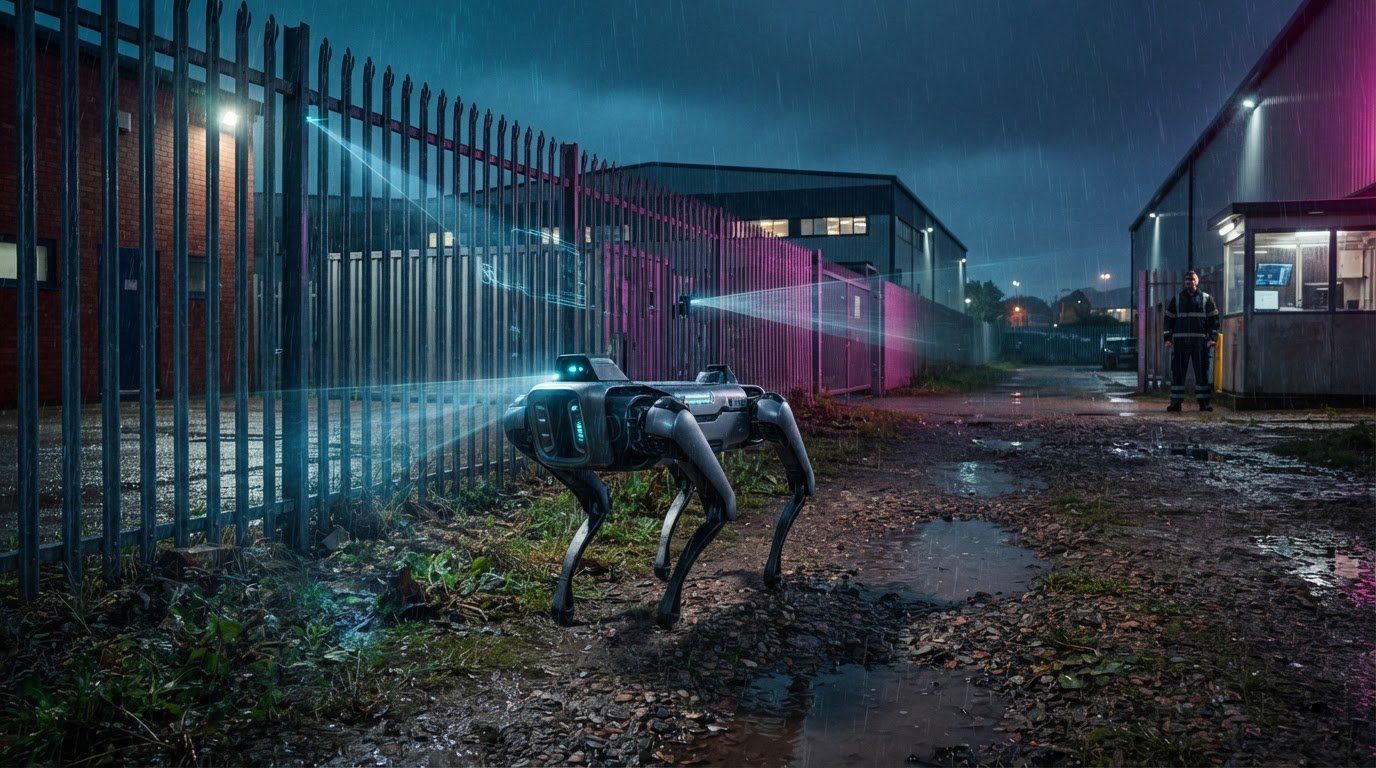
Modern commercial service robots do not blindly follow fixed paths. Instead, they scan their surroundings constantly, processing distance data multiple times per second. If a diner pushes out a chair, a guest leaves a shopping bag in a walkway, or a toddler dart into an aisle, the unit detects the obstruction immediately.
The robot responds by slowing its speed or stopping entirely. If space allows, its navigation system calculates a detour around the blockage before resuming its journey. This active sensing ensures safe movement around moving crowds without jolting or sudden turns that might spill drinks or alarm visitors.
Connecting to Lifts and Automatic Access Doors
Multi-floor buildings require units to move between levels without staff escorting them. Autonomous models achieve this through wireless IoT integration, which connects the robot directly to your building management system, automatic door controllers, and passenger lifts without requiring mechanical changes:
- Automatic door calling: As a unit approaches a service kitchen or corridor divider, it signals the door to open via secure local network protocols.
- Lift summoning: The robot calls the lift, enters the car when empty space allows, selects its destination floor, and exits smoothly upon arrival.
- Transit compliance: All commercial service machinery must carry clear UKCA or CE certification marks to verify compliance with British safety standards for electrical and mechanical machinery.
Ensuring your floor thresholds, lift networks, and service routes support autonomous hardware is straightforward when planned in advance. Talk to an automation engineer at GO Robotics to evaluate your building infrastructure and verify transit feasibility.
Choosing Between Capital Purchase and Robots as a Service
Deciding how to fund commercial robotics comes down to cash-flow strategy, venue requirements, and the total cost of ownership. When automating repetitive tasks with robots across hospitality, retail, or healthcare sites, UK operators choose between direct asset acquisition and flexible monthly subscriptions. What drives total investment isn't just the machine itself; it includes site mapping, network configuration, and ongoing mechanical upkeep.
Outright Purchase Versus Monthly RaaS Agreements
Buying machinery outright appeals to operators who prefer complete asset ownership on their balance sheets. Direct capital expenditure works well for established premises with stable, multi-year operating layouts. In Britain, qualifying equipment may be offset against taxable trading profits using the annual investment allowance (AIA).
Many venues prefer avoiding large upfront outlays altogether. Choosing robots as a service UK businesses rely on converts commercial automation into an operating expense. A RaaS agreement bundles the hardware, fleet software, and preventative maintenance into one fixed monthly fee. This subscription format eliminates upfront capital risk, protects cash reserves, and lets managers adjust fleet sizes up or down to match seasonal footfall shifts.
Support, Maintenance, and Warranty Considerations
Autonomous machines operate under demanding conditions, clocking dozens of miles every week. Purchasing hardware without domestic technical backing creates severe operational risk. If a wheel motor falters or a sensor misaligns, waiting weeks for overseas replacement parts brings workflows to a sudden halt.
A reliable supplier must provide local UK technical assistance, replacement parts held domestically, and clear warranty terms. Look for providers offering 12-month warranties on capital purchases or full coverage for the duration of a subscription contract. Modern units also feature remote diagnostics, which monitor battery health and sensor telemetry to catch maintenance issues early. Over-the-air software updates ensure route calculation and obstacle detection improve continuously without requiring manual engineer visits.
Taking Routine Floor Transit Off Your Daily Rotas
Delegating heavy dish clearance and routine floor scrubbing lets your team spend their shifts where it matters most: with your guests. Successfully automating repetitive tasks with robots doesn't require altering your architecture or installing disruptive floor tracks. Commercial units rely on marker-free SLAM navigation to map your venue cleanly, while multi-sensor obstacle detection ensures safe, dependable transit through crowded dining rooms and public corridors.
Every deployment carries full UKCA and CE compliance, backed by UK-based technical diagnostics, preventative servicing, and domestic replacement parts. Whether you opt for direct capital purchase or a flexible monthly subscription, starting with a practical site evaluation removes the guesswork. Book a free venue survey with GO Robotics to inspect your floor transitions, review your layout, and discover how autonomous support can strengthen your daily operations.
Frequently Asked Questions
Do commercial service robots replace existing venue staff?
No, commercial service robots assist existing staff by handling mechanical transit rather than replacing human workers. When automating repetitive tasks with robots, your team hands over heavy tray carrying, bussing dirty crockery, and routine floor scrubbing. This shift keeps hospitality and retail workers on the floor where they can welcome guests, take additional orders, and resolve issues. It cuts physical fatigue and helps retain reliable staff.
Can delivery robots navigate narrow aisles in older UK buildings?
Yes, compact commercial units can navigate passages as narrow as 600 mm to 650 mm. A structured site survey evaluates specific pinch points, table layouts, and door clearances across your property before any deployment. While broad open spaces are ideal, models with independent suspension and multi-sensor navigation handle uneven floors, low thresholds, and snug corridors safely. If an aisle is too narrow for comfortable two-way transit, engineers adjust virtual routing zones accordingly.
Do service robots require building alterations or ceiling stickers?
No, modern service robots operate entirely without ceiling stickers, reflective markers, or floor tracks. Units use marker-free SLAM mapping, combining laser LiDAR sensors and visual cameras to build a digital map of your building. During installation, an engineer walks the robot through your venue to log walls, furniture, and fixed corridors. The entire setup is digital, meaning you can update floor plans, table layouts, or cleaning routes instantly without touching your property's architecture.
How do multi-floor delivery robots travel between levels?
Multi-floor delivery robots travel between levels by integrating wirelessly with your existing lift control systems. Using secure IoT protocols, the robot calls the lift, holds the doors open, and selects its target floor without requiring mechanical alterations to the lift motor or car. Once the lift arrives at the designated floor, the robot exits autonomously to complete room service deliveries. This allows a single delivery unit to service multiple storeys smoothly across commercial buildings.
What happens if a customer or child steps in front of the robot?
The robot instantly slows down or stops completely to prevent any contact. Commercial service units use multi-sensor fusion, combining 360-degree LiDAR and optical depth cameras that detect moving obstacles in real time. If a child runs into a gangway or a guest steps backwards, the machine senses the change immediately. It waits for the path to clear or calculates an alternative route around the obstruction without abrupt movements, ensuring public safety throughout your venue.
Is it better to purchase a service robot outright or choose a subscription?
The choice depends on your accounting preferences, cash flow, and operational flexibility. Outright purchase suits established venues wanting asset ownership and potential tax deductions through the Annual Investment Allowance. Conversely, a Robots as a Service subscription bundles hardware, cloud software, and maintenance into one predictable monthly fee. Choosing subscription simplifies automating repetitive tasks with robots by eliminating capital risk and allowing you to adjust fleet sizes to match seasonal demand.
How long does it take to install and map a service robot?
Initial site mapping and setup typically take less than a single day. Because commercial units rely on marker-free SLAM navigation, an engineer creates the virtual floor plan in just a few hours. The remaining time is spent designating service points, integrating automated doors or lifts if required, and training your team on touchscreen dispatching and tray loading. Most venues begin supervised trial runs during the very same week without disrupting ongoing customer service.