Can a Robot Help Solve Staff Shortages in UK Care Homes?
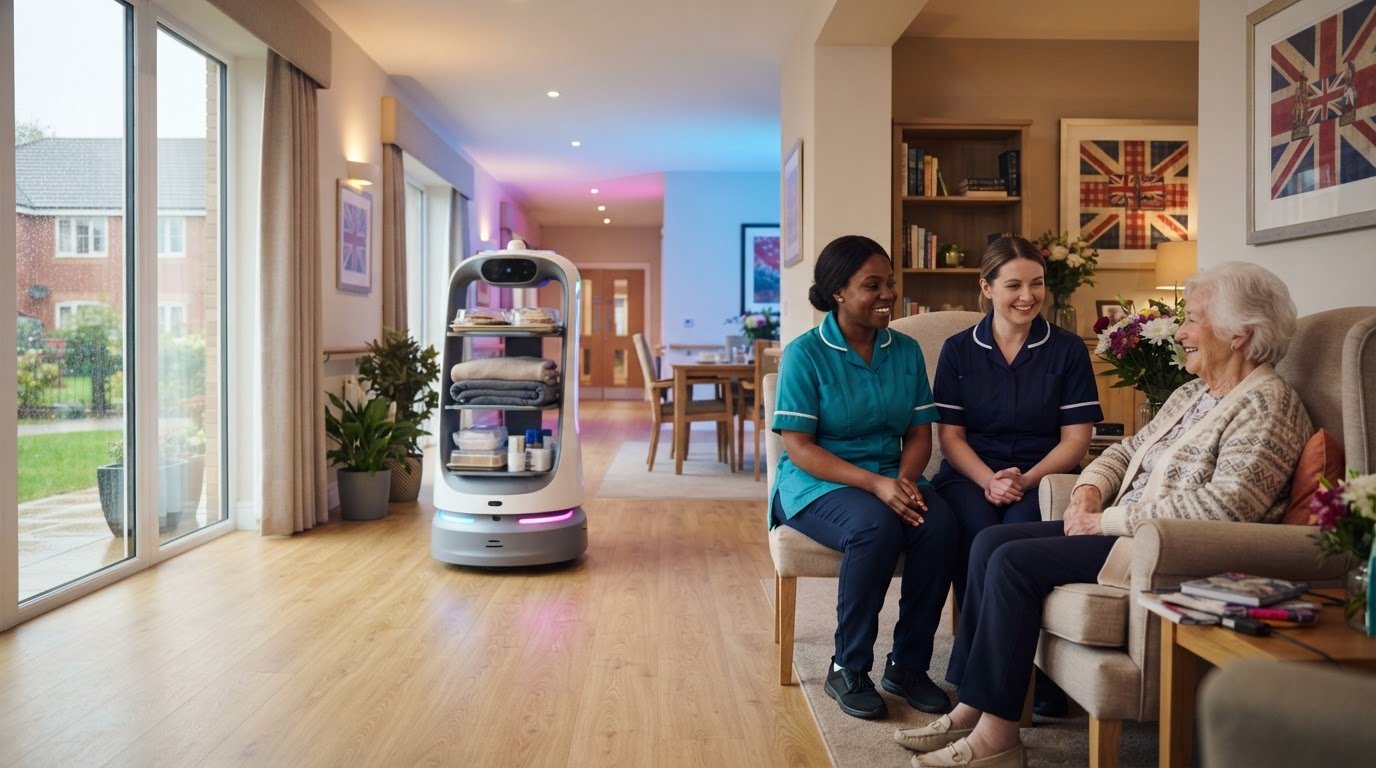
A robot to solve staff shortages should take routine movement off a care team’s workload, not take the place of human care. When staff are balancing resident-facing responsibilities with moving meals, linen and supplies around the home, support with those journeys may help address one part of the daily workload.
Staff acceptance and day-to-day operation matter as much as the robot itself. A delivery robot can support repetitive transport while care staff remain responsible for residents, make decisions and respond to needs or unexpected situations. Technology should assist the team, not reduce the personal attention residents receive.
This article looks at tasks that may suit automation, where people must remain in control, and what to consider before introducing a robot. The home’s layout and routines affect suitability, so planning should include site mapping, commissioning and staff training. A site survey and written recommendation can help you assess whether a robot fits your home and how it could work alongside your team.
Key Takeaways
- Start with a repeatable movement task that takes staff away from other duties, then assess whether a service robot could support it.
- A robot to solve staff shortages can assist with a defined workflow, but it cannot replace carers or take responsibility for residents.
- Trace the proposed route and consider doorways, shared spaces, handovers and resident activity before selecting a robot.
- Prepare staff for normal operation and agree how they’ll handle exceptions if a route or task changes.
- A site survey and written recommendation can help you assess fit. Installation, commissioning, training and UK-based support are also part of implementation.
How can a robot help with staff shortages in a care home?
Care-home staff balance resident care with moving meals, linen and supplies around the building. These journeys are necessary, but they can take staff away from other duties. A service robot can support a defined transport task, such as carrying items between agreed points on a planned route. Its role is practical and limited: it can assist with routine movement, not provide care.
That distinction matters when assessing a robot to solve staff shortages. Consider it support for a specific task, not a substitute for a team member. Staff remain responsible for personal care, clinical judgement, decisions about residents and the relationships that make care personal. Technology and older people’s care are also considered within Gerontechnology, a field concerned with how technology can support ageing and care.
Which routine tasks could a service robot support?
Start with items that move regularly from one place to another. Depending on the home’s workflow and the route, a robot may support internal delivery of meals, clean linen or supplies. PuduBot 2, for example, is listed for care-home dining service and repeat deliveries. Whether a particular task is suitable depends on where items start and finish, how often the journey occurs and how handover works.
Make the task specific before considering equipment. “Move prepared items from the designated starting point to an agreed handover point” is easier to assess than a general request to help staff. Note who prepares the items, who receives them and what happens if a resident needs help while staff are handling the delivery.
Delivery is not the same as care. A robot can carry an item, but it cannot decide what a resident needs, provide personal care or build a relationship with them.
What does staff support look like in practice?
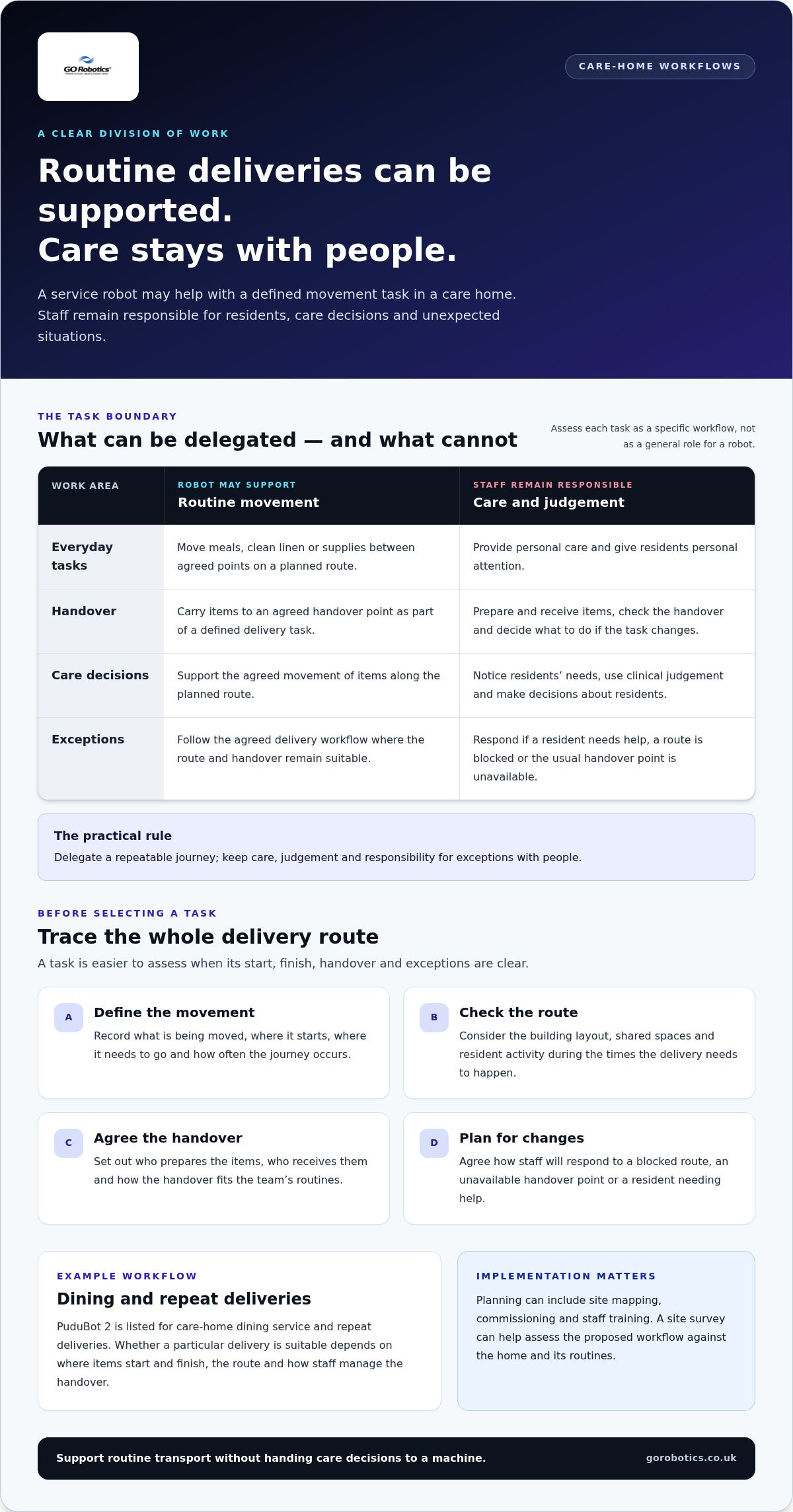
Staff define the task and decide how it fits into the home’s routines. They prepare items for delivery, manage handovers and respond if a resident needs help or the usual route cannot be followed. The robot supports the agreed movement of items; it does not make care decisions or take responsibility for exceptions.
That division is a useful test: delegate a repeatable journey, keep care and judgement with people. Before introducing a robot, consider whether the task and route work around residents and staff. The aim is to support a routine without drawing attention away from residents’ needs.
Where can care-home robots support everyday work?
Look at the flow of items through the home, not at a robot as a general-purpose member of staff. Care-home delivery workflows may include moving meal trays, linen, supplies and consumables between designated points. The suitability of each task depends on the item, its handover arrangements and the route. Samples may also be part of a workflow where the home’s process and the selected equipment make that appropriate.
The UK Parliament report on robotics considers robotics in UK social care, including potential effects and challenges. For your home, the practical question is more specific: which repeat delivery task can be clearly defined without handing care decisions to a machine?
Supporting dining and repeat deliveries
Meal delivery may follow a regular pattern between a food service area and agreed handover points. A robot could support the movement of items along a planned route, while staff remain responsible for checking the handover, supporting residents and responding to individual needs. Before trialling the workflow, write down where the delivery begins and ends, who prepares it and who takes responsibility at the receiving point.
The same approach applies to repeat deliveries of supplies. Check whether the route remains practical during the times the task needs to happen, and whether staff can manage handovers without disrupting resident care. Automate the transport only where it fits the way your team works.
Moving linen and supplies around the home
Planned deliveries of linen and supplies are different from care that depends on conversation, personal attention or judgement. A consistent route can make a task easier to assess, but the home’s layout and daily activity still matter. Staff need a clear process for changes, such as a blocked route, an unavailable handover point or a resident who needs assistance.
Before choosing a task, trace its full route: where the item is prepared, where it needs to go and who receives it. Consider how that movement fits around shared spaces and the home’s routines. A site survey can help assess the proposed workflow against the building and identify practical questions for implementation.
A robot to solve staff shortages should support a defined delivery task, not be expected to adapt independently to every change in care. If you’re considering automation for internal deliveries, explore GO Robotics’ service robots as a starting point for assessing what may fit your home.
Do robots solve care home shortages by replacing carers?
No. Robots can support care teams with defined, repetitive tasks, but they do not replace care-home staff or remove the need for people to provide care. A robot to solve staff shortages should be considered for a specific part of the workload, not as a way to reduce headcount or staffing requirements.
The distinction is straightforward: a robot can move an item along an agreed route; a person provides care, notices changes and decides what to do. The extent of any practical support depends on the task, the home’s routines and how staff oversee the process. Introducing a robot does not guarantee time savings or a change in staffing needs.
- Suitable for routine support: moving items between agreed points when the task and route are clearly defined.
- Requires a person: personal care, clinical decisions, observing a resident’s needs and building trusted relationships.
Which parts of care must remain person-led?
Personal care and clinical decisions depend on a resident’s individual circumstances. So do conversation, reassurance and the judgement to respond when someone’s needs change. A robot must not be treated as able to assess residents or decide what care they need. Staff remain responsible for those decisions and for responding when a resident needs help during a routine task.
This is not a boundary to work around. It defines what the technology is for: support with a task, while people remain accountable for care.
How can staff acceptance be supported?
Involve staff before selecting a task. Ask which repeated movements interrupt their routines, then review whether a robot could support that workflow without making handovers or resident interactions harder. Explain what the robot will do, what remains staff-led and what to do if the usual process cannot continue.
Training should cover normal operation, practical questions and exceptions. Agree how staff can raise issues, review the workflow after introduction and adjust the process where needed. GO Robotics includes on-site staff training and documentation as part of implementation, helping your team understand the robot’s intended role and how it fits into daily work.
How should you assess a robot for your care home?
Start with a task, not a model. A site assessment should establish whether a robot suits that task and your home’s layout. Care homes differ, so do not assume a route that works in one building will work in another. Consider the route, doorways, shared spaces, resident activity and staff routines before deciding how the robot might fit.
A practical assessment follows a clear sequence:
- Select a repeatable task: define what needs to move, where it needs to go and why it may suit automation.
- Trace the route: note the start point, destination, handover and any changes in conditions during busy periods.
- Assess the site: review doorways, shared areas, resident movement and the route’s effect on daily routines.
- Prepare the team: agree who sets tasks, monitors operation and responds to exceptions.
- Review the workflow: check whether the robot supports the task without disrupting residents or staff.
Map the task and the care-home environment
Follow the task from preparation through to handover. A route that looks straightforward on a plan may cross a busy shared space or conflict with staff routines at certain times. Site mapping means creating a digital layout of the home to support the robot’s navigation on its intended route. It helps inform the assessment, but does not remove the need to account for changing activity and residents’ needs.
During the assessment, identify the route’s decision points: entrances, turns, shared spaces and handover locations. Consider when those areas are busiest and who will step in if the planned route cannot be used. These questions help the team judge whether the proposed workflow is workable, rather than treating a map as a complete answer.
Prepare staff and review the workflow
Before use, agree who is responsible for setting and monitoring tasks, and what staff should do if a route is blocked or a handover changes. Training should cover normal operation and how to raise practical questions. After introduction, review whether the task is working as intended and whether residents’ experience remains central. Commissioning, which means preparing the robot for use at your home, should be planned alongside installation and staff training.
GO Robotics’ site survey and written recommendation can help assess the task against your home’s layout and routines. For support assessing a service robot for your care home, arrange a site survey with GO Robotics.
How GO Robotics supports care homes considering a service robot
Choosing a robot for a care home starts with the work it needs to support and the environment it will operate in. GO Robotics supplies, installs and supports commercial service robots UK-wide. The aim is to connect the equipment to your team’s actual routines rather than assume every home has the same needs.
What happens during an initial assessment?
A site survey is the starting point. It gives the team a chance to review your proposed task alongside the home’s layout and day-to-day workflows. The assessment can consider the route, handover points, shared spaces and how the task fits around residents and staff.
After the survey, GO Robotics provides a written recommendation to help you assess whether a robot is suitable and which option fits the task. This keeps the decision grounded in your home’s requirements. For wider background on the setting, you can also read our healthcare service robot guide.
What support helps teams get started?
Once you’ve selected a suitable option, implementation can include installation, mapping and commissioning. Mapping creates a digital layout to support the robot’s navigation. Commissioning prepares it for its intended use in your home. On-site staff training and documentation help the team understand how to operate it and where to raise practical questions.
UK-based support is also part of GO Robotics’ service. The work does not stop at delivery: your team can get support with the implementation and the robot’s intended task. Where Humans Lead & Robots Assist. captures the intended balance: a robot supports repetitive work, while staff retain responsibility for residents, care decisions and exceptions.
A robot to solve staff shortages should be selected for a clear, suitable task, with the people who will work alongside it involved in the decision. If your home is considering a service robot, start a conversation with GO Robotics about a care-home task and how a site survey could help assess its fit.
Assess the task, then plan your next step
A robot to solve staff shortages should support a clearly defined, repeatable task, such as moving items along an agreed route. It does not replace carers: personal care, judgement, resident relationships and responses to changing needs stay with your team.
Fit depends on your home’s layout and routines. A site survey and written recommendation can help you assess whether a robot suits the task. Installation, mapping, commissioning and on-site staff training help prepare your team for day-to-day use.
GO Robotics provides UK-wide supply, installation and support, with staff training and documentation as part of implementation. If you’re considering a service robot, discuss a service robot for your care home with GO Robotics and explore whether a practical first step fits your home. Choose a specific task, involve the staff who will manage it and arrange a site survey to assess the fit.
Frequently Asked Questions
Can a robot help solve staff shortages in a care home?
Yes. A service robot can support a care team with a defined, repeatable task, such as moving items along an agreed route. This may address one part of the daily workload, but it does not guarantee time savings or change staffing requirements. A robot to solve staff shortages should be assessed as practical assistance, with care decisions and responsibility for residents remaining with staff.
Do service robots replace care-home staff?
No. Service robots support specific routine tasks; they do not replace carers or provide personal care. Staff continue to make care decisions, observe residents, respond to changing needs and build relationships. The distinction is between moving an item along a planned route and deciding what a resident needs. If circumstances change, people remain responsible for responding and managing the situation.
What tasks can a robot do in a care home?
A service robot may support internal delivery of meals, linen and supplies, as well as consumables or samples where the home’s process, equipment and route make that suitable. These are transport tasks, not care decisions. Consider where each item starts and finishes, how handover works and whether the route fits staff routines and resident activity. Define the robot’s role separately for each task.
Are robots safe to use around care-home residents?
Safety depends on the robot, its intended task, the home’s layout and how staff oversee its use. Before introduction, assess routes around doorways and shared spaces, and consider resident movement and busy periods. Set clear procedures for a blocked route or a resident needing help. Staff should remain available to manage exceptions; a site assessment can help identify practical risks before use.
How do you decide whether a care home is suitable for a service robot?
Start with a repeatable task, then assess its full route, handover points and fit with the home’s daily routines. Review doorways, shared areas, resident movement and how staff would manage changes. A site survey and written recommendation can help match the proposed task to the building. Suitability depends on the individual home, so do not assume one layout or workflow will suit every setting.
What support is involved when introducing a robot to a care home?
Introducing a robot can involve a site survey, written recommendation, installation, mapping and commissioning, followed by on-site staff training and documentation. Mapping creates a digital layout to support navigation on the intended route. GO Robotics provides UK-wide supply, installation and support, including UK-based support. Training helps your team understand the robot’s role and how to raise practical questions during day-to-day operation.