Can Robots Cut Labour Costs? A Guide for UK Businesses
Robots can ease staffing pressure without being used to cut headcount. If you’re looking to reduce staffing costs with robots, the practical question is where they can return time to your team. In a hotel, GO Robotics states that the J20 saves “5 + min” of housekeeper time per room and takes 25% less time to turn a guest room.
That time can support other work, but it doesn’t automatically reduce staffing or employment costs. The J20 can work alongside a housekeeper or finish the floor-cleaning task after they leave. Its stated “0” supervision need applies once it’s running, not to the whole cleaning process.
This guide explains which cleaning tasks may suit robotic support, how to compare a robot with contract cleaning, and what to assess against your own workload and service requirements. It also covers the practical steps involved in fitting a robot into an existing routine, including site mapping, installation and staff training.
Key Takeaways
- Separate time returned to your housekeeping team from any change to headcount or staffing expenditure.
- Map your room-cleaning routine to see where the J20 could work alongside a housekeeper or finish a task after they leave.
- Compare robotic support with contract cleaning by looking at task allocation, flexibility and the oversight your team still needs.
- Use your room volumes, staff routines and cleaning standards to judge whether the J20 fits your operation.
- Assess the venue layout, workflow and staff involvement before deciding how robotic support could work in practice.
Can robots reduce staffing costs without cutting headcount?
In a hotel, reducing staffing pressure doesn’t automatically mean employing fewer people. A robot can support a defined, repetitive task and return time to the housekeeping team while the hotel keeps its existing headcount. Whether that time affects rota planning or the scope of contract cleaning is a separate management decision, not an automatic result of introducing a robot.
GO Robotics states that the J20 saves “5 + min” of housekeeper time per room. Treat this as time made available for other work, not as a guaranteed reduction in staffing or employment costs. To reduce staffing costs with robots in a measurable way, a business must decide how to use that capacity and assess the outcome against its own service requirements.
What does reducing staffing pressure mean in practice?
Keep four outcomes distinct: staff capacity, rota planning, contractor scope and headcount. Time returned can give a housekeeper more room during a shift for guest requests, quality checks or other housekeeping duties. Managers still need to plan that work; saved minutes don’t automatically create a staffing or financial saving.
A hotel might keep its team and use the available time to manage busy periods or maintain service standards. Any change to rotas, contractor tasks or staffing numbers requires a separate decision based on the venue’s needs. The wider debate about technological unemployment concerns how technology can affect jobs, but it doesn’t establish what will happen in a particular hotel.
Which cleaning work can a robot support?
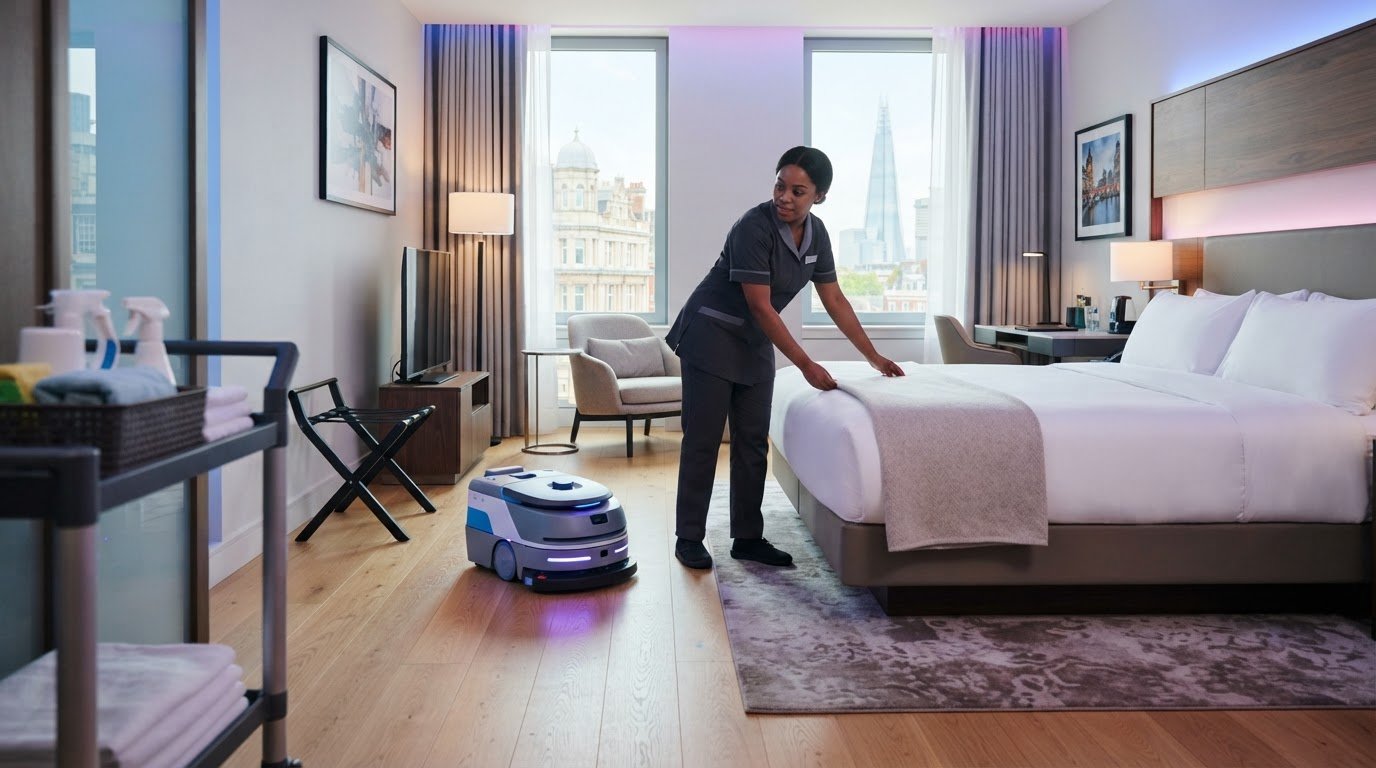
For UK hospitality, the J20’s stated role is guest-room floor cleaning. A housekeeper can work alongside it or leave it to finish the floor after they move on to another duty. The “5 + min” figure is the relevant stated time saving; it should not be treated as a promise that every room or workflow will produce the same result.
The housekeeper remains responsible for the rest of the room and for coordinating the task. The J20’s floor-cleaning role doesn’t include making beds, cleaning bathrooms, replenishing supplies or checking the room. Managers should assess whether the venue layout and cleaning routine suit this task, then define staff involvement and oversight. A site assessment helps establish that fit before adding the robot to the routine.
How can a cleaning robot return time to a hotel housekeeping team?
Room turnover involves several duties, and floor cleaning is only one part of the sequence. A housekeeper may prepare the room, clean and check surfaces, make the bed, replenish supplies and complete a final inspection. The J20 supports the floor-cleaning part of that routine, while staff remain responsible for the other work and for meeting the hotel’s standards.
Where does the J20 fit into room turnover?
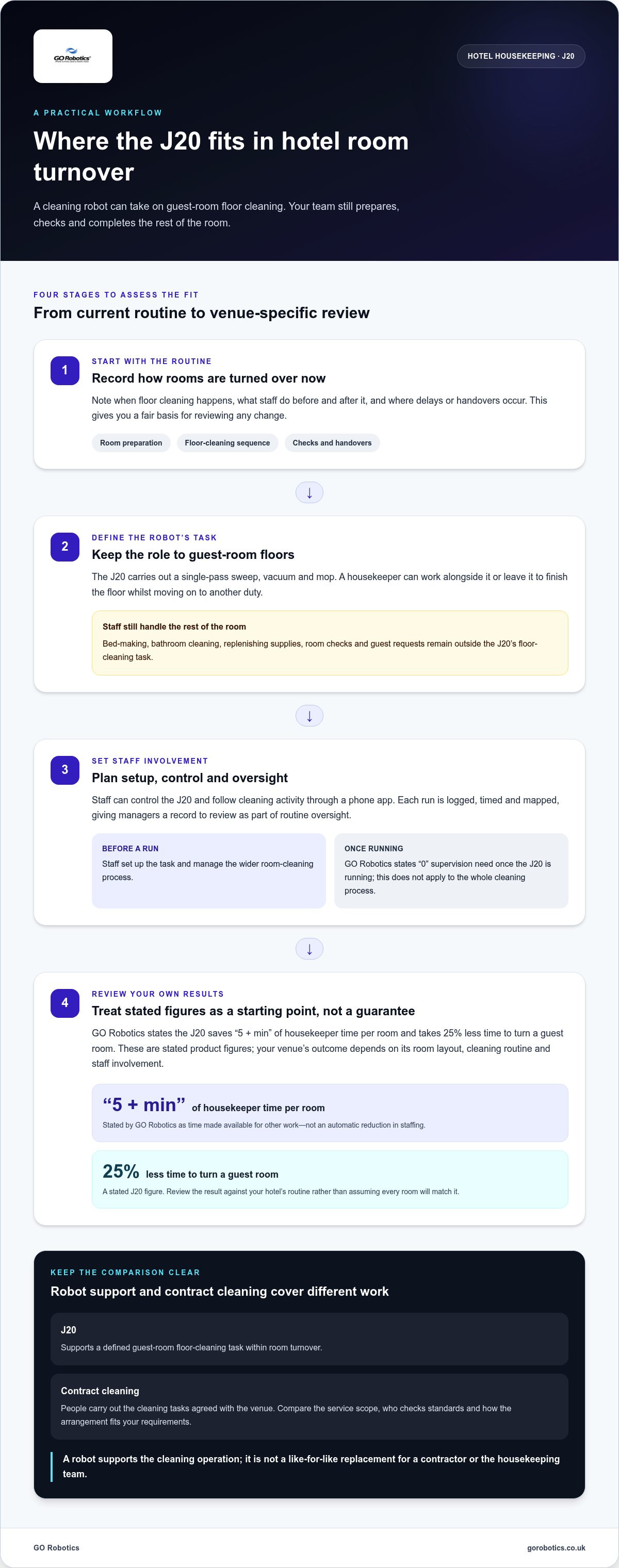
The J20 carries out a single-pass sweep, vacuum and mop. A housekeeper can work alongside it or leave it to finish the floor after moving on to another duty. That may help the team organise its work differently, but it doesn’t remove the need for room preparation, checks or guest-service responsibilities.
Staff can control the J20 and follow cleaning activity through a phone app. Each run is logged, timed and mapped, giving managers a record to review as part of routine oversight. GO Robotics states that the J20 needs “0” supervision once running. Staff still need to set up the task and manage the wider room-cleaning process.
How should managers judge time returned?
Start with the routine you already have. Record how staff prepare rooms, when floor cleaning takes place, what work happens around it and where delays or handovers occur. Then define the precise task the robot would support. This gives you a fair basis for comparing the workflow before and after it is introduced.
GO Robotics states that the J20 takes 25% less time to turn a guest room. Treat this as a stated product figure, not a guarantee that your hotel will see the same result. Room layouts, cleaning routines and staff involvement affect how the robot fits into the work, so review results at your venue rather than assuming every room will follow the same pattern.
For wider UK context on robotics and smart machines, see the government’s UK's Smart Machines 2035 Strategy. A site survey can help establish whether the J20’s floor-cleaning task fits your layout and housekeeping routine. You can discuss a J20 site assessment with GO Robotics.
Robots vs contract cleaners: what changes for the team?
A cleaning robot and a contract cleaning service do different work. The J20 supports a defined guest-room floor-cleaning task; a contractor may provide people to carry out cleaning work set by the venue. Compare the work each arrangement covers, how it fits your routine and who remains responsible for checks. A robot supports a cleaning operation, but it isn’t a like-for-like replacement for a contractor.
What can robotic support change in an existing cleaning arrangement?
You can assess the J20 within your current housekeeping or contracted workflow without assuming that other arrangements must change. Its stated role is guest-room floor cleaning, not every cleaning duty. Staff still prepare rooms, inspect the finished room, respond to guest needs and handle work outside the robot’s task.
Use these prompts to compare arrangements for your venue:
- Robot support: The J20 supports a defined floor-cleaning task within room turnover. Identify which duties remain with staff.
- Contract cleaning: People carry out the tasks agreed with the venue. Consider how the service scope fits your requirements.
- Venue workflow: Compare how each arrangement fits your room schedule, who checks standards and who handles exceptions.
When might a human-led arrangement remain the better fit?
Tasks that depend on judgement, guest interaction or work beyond floor cleaning still call for people. A robot may also be a poor fit if the venue layout or room-preparation routine makes it difficult to include floor cleaning. Start the assessment with the work as it happens, not with an assumption that automation belongs in every room.
A blended arrangement is one option: people retain responsibility for the broader cleaning service, while the J20 supports its specific floor-cleaning task. If you’re assessing whether to reduce staffing costs with robots, separate that from the question of whether a robot can return time or ease workload pressure. Compare task allocation, staff responsibilities and oversight first. Any change to staffing or a contract is a separate decision for the venue.
How should you assess whether a robot could ease staffing pressure?
Start with the task, not the robot. To judge whether you could reduce staffing costs with robots, first identify a real pressure point in your housekeeping routine and assess whether the J20 fits it. Then consider the venue, involve staff and review the results against your own standards.
What should you measure before a site assessment?
Record how guest-room floor cleaning fits into room preparation, checks and shift patterns. Note room volumes, how staff move between rooms, what interrupts the routine and when rooms need to be ready. Be clear about the cleaning result you expect and who signs off the room handover.
These details help define the task and give you a useful basis for comparing routines. Include staff involvement before and during a J20 run. GO Robotics states that the J20 needs “0” supervision once running, but that doesn’t mean there is no human involvement in preparing the task or managing the wider cleaning process.
What happens during a practical deployment assessment?
GO Robotics can survey your site and discuss whether the J20 fits the floor-cleaning task and venue layout. The assessment should account for the spaces and routes involved, along with how the robot fits around room preparation and the staff responsible for cleaning standards.
GO Robotics provides installation, mapping, staff training and ongoing technical support. After the robot is introduced, compare observed runs with your recorded routine. Review whether the task fits the shift, whether staff can manage room handovers as required and whether the cleaning result meets your standard. Product information is a starting point, not a promise of a particular venue outcome.
- Map the task: Define the floor-cleaning work the robot would support.
- Observe the workflow: Record current routines, room volumes and shift patterns.
- Assess the site: Consider the relevant spaces, routes and room handover process.
- Review results: Compare the observed routine with your standards and staff requirements.
For broader context, you can also read GO Robotics’ commercial cleaning robot guide and its separate guide to the Robots-as-a-Service model. To discuss whether the J20 suits your housekeeping workflow, arrange a J20 site assessment.
Put robots to work alongside your staff, not in place of them
For a hotel, assess the J20 as support for a defined housekeeping task, not as a way to cut headcount. The aim is to see whether guest-room floor cleaning fits your workflow and returns staff time for other duties, while your team remains responsible for room standards and service.
A useful assessment should establish whether the task suits the J20, whether your venue layout accommodates the planned work, how it fits the room-turnover routine and what staff involvement it requires. These points help you decide whether robotic support has a practical place in your operation.
What should a responsible roll-out look like?
Start with site mapping, installation and staff training, then agree clear operating procedures. Staff need to know how the robot fits into room preparation, who starts and manages a run, and how the team handles room checks and handovers. The J20’s stated “0” supervision need applies once it is running, not to the full cleaning process.
Mapped, timed and logged runs can help managers review cleaning activity. Use that information alongside staff feedback and your existing standards. The robot supports floor cleaning; people remain part of the process.
What is the next step for a UK hospitality venue?
Bring your current room-cleaning workflow to the discussion: how floor cleaning fits between other duties, what the venue layout is like and what staff need to achieve during each shift. GO Robotics can survey the site, discuss the J20’s fit, and provide installation, training and ongoing technical support.
If you’re exploring how to reduce staffing costs with robots, focus the assessment on workload and capacity rather than assuming headcount will change. Discuss whether guest-room floor cleaning suits the J20 and arrange a site survey with GO Robotics’ J20 site assessment team.
Assess the task, then plan your next step
Robots can support housekeeping without being introduced to cut headcount. The useful question is whether one fits a specific, repetitive task and returns time your team can put to good use. That’s a practical way to assess whether you could reduce staffing costs with robots.
GO Robotics states that the J20 saves “5 + min” of housekeeper time per room. It can work alongside a housekeeper or finish a room after they leave, but that figure isn’t a guarantee of a particular result at your venue. Room layout, cleaning routines and staff involvement all matter.
Compare the robot’s role with your current workflow, including the cleaning standard, room handover and work staff still need to complete. GO Robotics can assess your site and provide installation, staff training and ongoing technical support.
Ready to explore whether guest-room floor cleaning suits the J20? Discuss your housekeeping workflow with GO Robotics and take a practical next step with your team.
Frequently Asked Questions
Can robots reduce staffing costs without replacing staff?
A robot can reduce time spent on a defined repetitive task without replacing staff, but that doesn’t automatically lower headcount or overall staffing expenditure. GO Robotics positions the J20 as support for hotel housekeeping, with no extra headcount required. Managers decide how to use the time returned, while keeping room checks, wider cleaning duties and staff responsibilities clear.
How can a cleaning robot help hotel housekeeping?
A cleaning robot can support a specific floor-cleaning task within the room-turnover routine. The J20 can work alongside a housekeeper or finish the floor after they leave. Staff still handle wider room preparation, checks and guest-service duties. Whether this fits your team depends on the venue layout, working practices and cleaning standards you need to maintain.
Does the J20 reduce headcount?
No. The J20 supports housekeeping capacity, not headcount reduction. GO Robotics states that no extra headcount is required and that the robot can return time for other work. Managers can decide how to use that capacity within the existing operation. Staff remain responsible for room checks and duties outside the J20’s guest-room floor-cleaning role.
Does a cleaning robot need staff supervision?
GO Robotics states that the J20 needs “0” supervision once it’s running. That refers to supervision during an established run, not to the whole cleaning process. Staff still have a role in site preparation, setup, operating procedures and other room-cleaning duties. Before introducing the robot, agree who prepares and starts runs, how they fit into room handovers and who checks the finished room.
Can a robot replace a contract cleaning team?
A cleaning robot isn’t automatically a like-for-like replacement for a contract cleaning team. The J20 is specified for guest-room floor cleaning, while people may carry out other tasks that need judgement or fall outside that role. Compare the tasks covered, responsibilities and oversight your venue requires. Robotic support can be assessed alongside your existing in-house or contracted cleaning arrangements.
How do I assess whether a cleaning robot suits my hotel?
Start by recording your room-cleaning workflow, venue layout, cleaning standards and staff responsibilities. Identify the floor-cleaning task the robot would support, then consider how runs fit into existing routines and room handovers. GO Robotics can assess the site and discuss the J20’s fit, with installation, mapping and staff training as part of deployment. Judge results against your own venue’s requirements.
Can a cleaning robot work alongside hotel staff?
Yes. The J20 can work alongside a housekeeper or finish the floor after the housekeeper leaves. Its role is the specified floor-cleaning task; staff continue to manage wider room preparation, checks and work that needs human judgement. Agree how the team will coordinate around runs and how to use any time returned to housekeeping.