Service Robots in Private Healthcare and the Tasks They Support
Robots can be most useful in private healthcare when they support the tasks around care, rather than replace the people providing it. Service robots in private healthcare can help with routine work, including carrying medicines and supplies, giving reminders and guiding people around a facility.
Personal attention and clinical judgement remain central to healthcare. By supporting practical tasks, robots can help staff spend less time on routine movements and more time on work that needs their expertise and human connection.
This article explains how these robots support everyday tasks, medication delivery and reminders, and wayfinding in care facilities. You’ll also learn where their role has limits, what to consider when introducing them, and how delivery, hospitality and cleaning robots from GO Robotics may fit the needs of a private healthcare setting.
Key Takeaways
- See how robots can support medication collection, delivery and reminders without taking over clinical decisions.
- Understand where automation may ease routine work and help staff focus on tasks requiring human judgement and care.
- Learn what autonomous navigation involves in busy healthcare settings and why the layout and movement of people matter.
- Compare the kinds of service robots used in UK private healthcare, from delivery and cleaning to assistance with wayfinding.
- Explore how GO Robotics’ Pudu models may support practical tasks in a care facility.
Medication collection, delivery and reminders
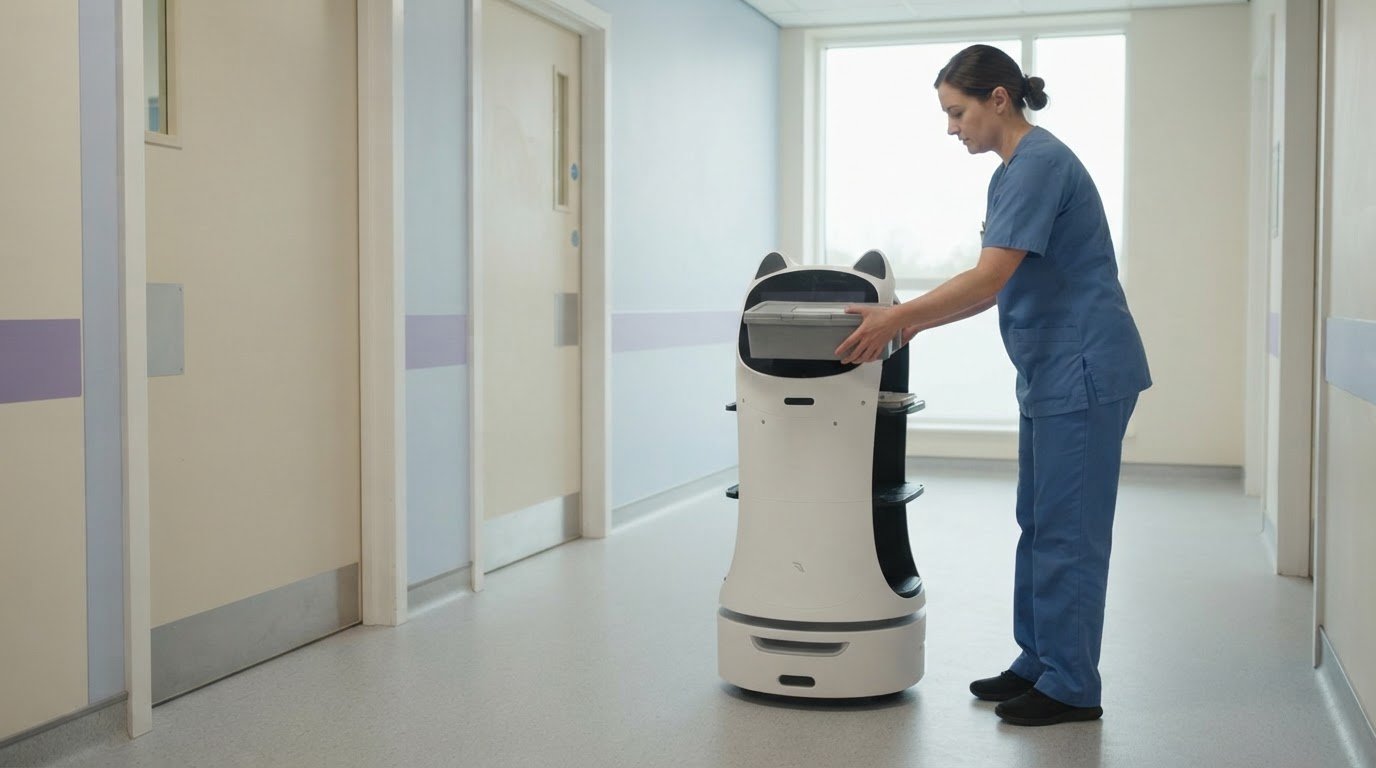
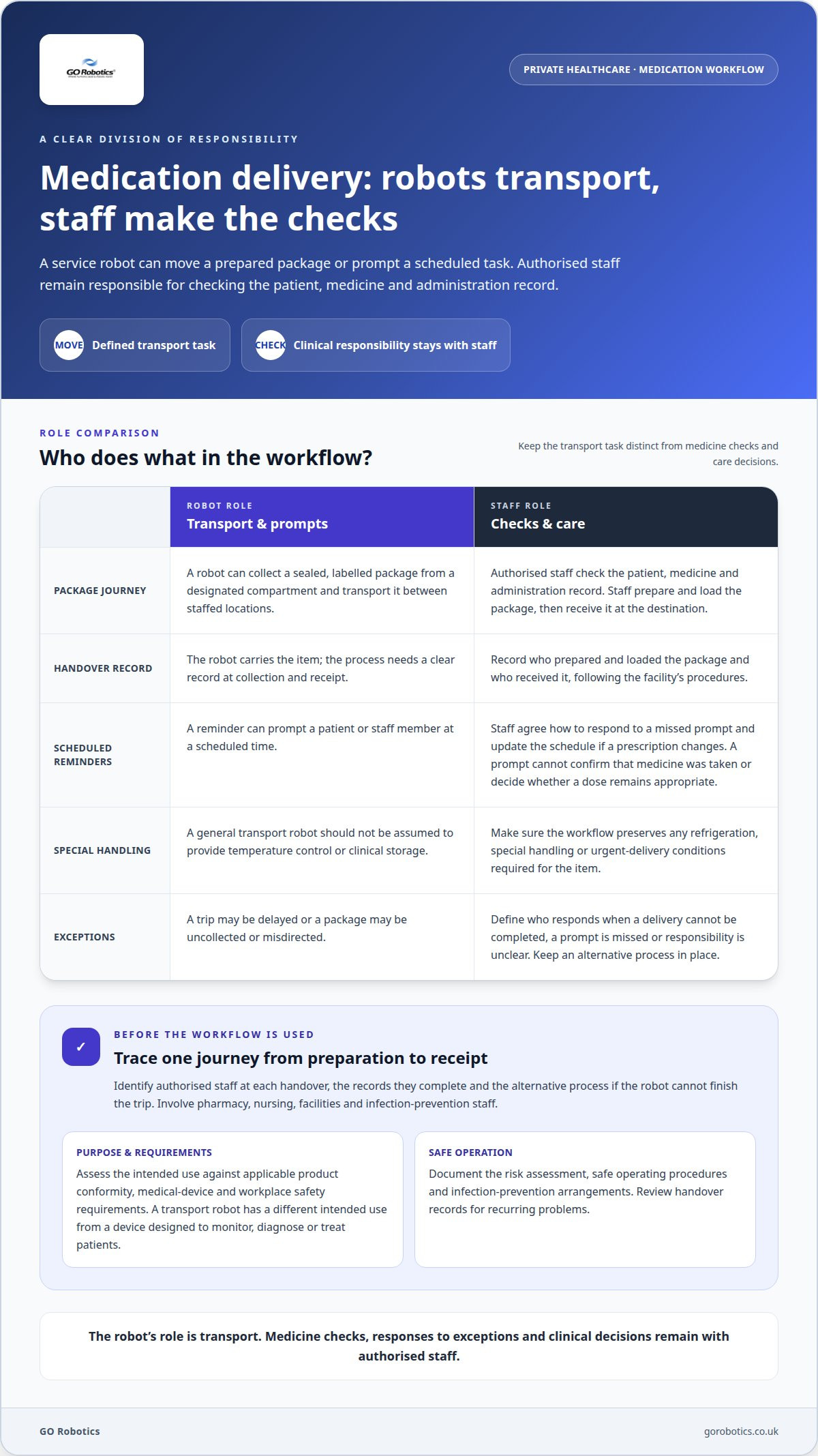
Medication support can involve moving prepared items, prompting a scheduled task or recording a handover. For example, pharmacy staff could place a sealed, labelled package in a designated compartment for collection by ward staff. The robot’s role is transport; authorised staff remain responsible for checking the patient, medicine and administration record.
A clear handover process matters as much as the route. Record who prepared and loaded the package and who received it, following the facility’s procedures. If an item needs refrigeration, special handling or urgent delivery, the workflow must preserve those conditions. Do not assume a general transport robot provides temperature control or clinical storage.
Reminders can prompt a patient or staff member at a scheduled time, but they cannot confirm that medicine was taken or decide whether a dose remains appropriate. Agree on a staff response to missed prompts. If prescriptions change, update the reminder schedule to match the care plan.
For UK facilities, assess the robot’s intended purpose against applicable product conformity, medical-device and workplace safety requirements. A robot transporting sealed items has a different intended use from a device designed to monitor, diagnose or treat patients. Before use, document the risk assessment, safe operating procedures and infection-prevention arrangements.
The commitment involved in buying, leasing and maintaining a robot depends on its role, configuration, site preparation, integration and support arrangements. Compare these factors with expected use and the work required to maintain the system. No single arrangement suits every medication workflow.
Private hospitals and clinics can use service robots for defined internal tasks such as moving prepared medicines, supplies or samples between staffed locations. The appropriate task depends on the facility’s workflow and the item being transported. A robot should not make clinical decisions or take responsibility for medicine administration.
Assess a deployment by tracing one journey from preparation to receipt. Identify authorised staff at each handover, the records they complete and the alternative process if the robot cannot finish the trip. Involve pharmacy, nursing, facilities and infection-prevention staff so the workflow accounts for clinical handling and movement through the building.
Risks include a delayed or misdirected package, an uncollected delivery, a missed reminder or uncertainty about responsibility. Busy corridors and changes to a care plan can also interrupt the process. Maintain human oversight, define who responds to exceptions and review handover records for recurring problems.
For each proposed workflow, assess whether automating a routine task such as medication delivery or vital-sign monitoring is appropriate. Define what staff must check, how they will verify handovers and respond to missed prompts. Keep clinical judgement and responsibility for care with authorised staff.
For a robotic medical device, check the applicable regulatory requirements for its intended purpose and risk classification. Do not assume that requirements for one device apply to every robotic system.
Why Robot Assisted Healthcare?
Robotic support can assist with clinical procedures, monitoring and rehabilitation, but it does not replace professional judgement. Its value depends on the task, the patient and how staff use it.
Benefits for patients and surgeons
Robot-assisted surgery uses robotic systems to help surgeons carry out procedures. Depending on the procedure and patient, potential benefits may include less trauma and a quicker recovery, but these outcomes are not guaranteed. For surgeons, such systems may reduce physical strain and support routine actions such as suturing.
These potential benefits matter when a provider assesses a particular procedure, not as a blanket promise for every patient. Some procedures may involve fewer days in hospital, less pain or fewer complications, but outcomes depend on the operation and the patient. For a healthcare provider, the useful question is whether the system supports a defined clinical task and improves the care pathway.
Monitoring may also be relevant for patients at risk of falls. Some robotic monitoring systems are designed to flag changes in a patient’s condition for staff to assess. A signal is not a diagnosis or a substitute for staff observation; the care team decides what action is appropriate.
Personalised patient care
Personalised care adapts support to a patient’s needs and changing condition. A home healthcare robot may be programmed to adjust rehabilitation exercises to a person’s physical ability, but it cannot assess their emotional condition. Any changes to a rehabilitation plan should be made by the care team.
In a private facility, the care team needs to set the purpose, review the patient’s response and make clinical decisions. A robot can support a defined activity, but it cannot replace the relationship, judgement or reassurance provided by a clinician. This distinction helps set patient expectations and identify suitable tasks.
Robots, staff and other automation
Service robots handle defined physical or reminder-based tasks, while healthcare staff assess needs, make decisions and provide personal care. Fixed automation can repeat a process in a controlled setting; mobile robots can move between locations, depending on their surroundings and task design.
For UK providers, assess data protection and cybersecurity requirements before a robot handles identifiable patient information. The data collected, where it is stored and who can access it determine the safeguards needed. Limit access to relevant staff and define how information is handled.
Patient and healthcare worker perceptions
Acceptance depends partly on whether people understand a robot’s role and see it supporting care rather than replacing staff. The Royal College of Surgeons’ finding about public willingness to engage with robotics should be considered in the context of the specific report and the views it measured, rather than taken as evidence of every patient’s attitude.
Explain the task before use, offer a human contact and make clear how patients can request help. Involve staff who manage the workflow, as their experience can reveal where a robot might interrupt care or add steps.
Robot support for routine healthcare tasks
Routine support covers repeatable work across wards, treatment areas and shared spaces. A mobile delivery robot might carry meal trays, clean linen or sealed supplies between agreed locations. A floor-cleaning robot can clean designated public areas. Staff remain responsible for patient contact, clinical decisions and exceptions that fall outside the robot’s assigned task.
Start by identifying a recurring movement, such as taking clean linen from a central store to a ward handover point. Specify who loads and receives it, and how staff handle delays. This makes the task clear: the robot transports a defined item between agreed locations, while people manage the handover.
Internal deliveries can also include non-clinical items such as stationery, refreshments or waste containers. Each item needs a suitable container and a clear destination. Do not assume a robot carrying sealed supplies is suitable for materials requiring special handling. Separate routes and procedures help prevent unsuitable loads from being mixed.
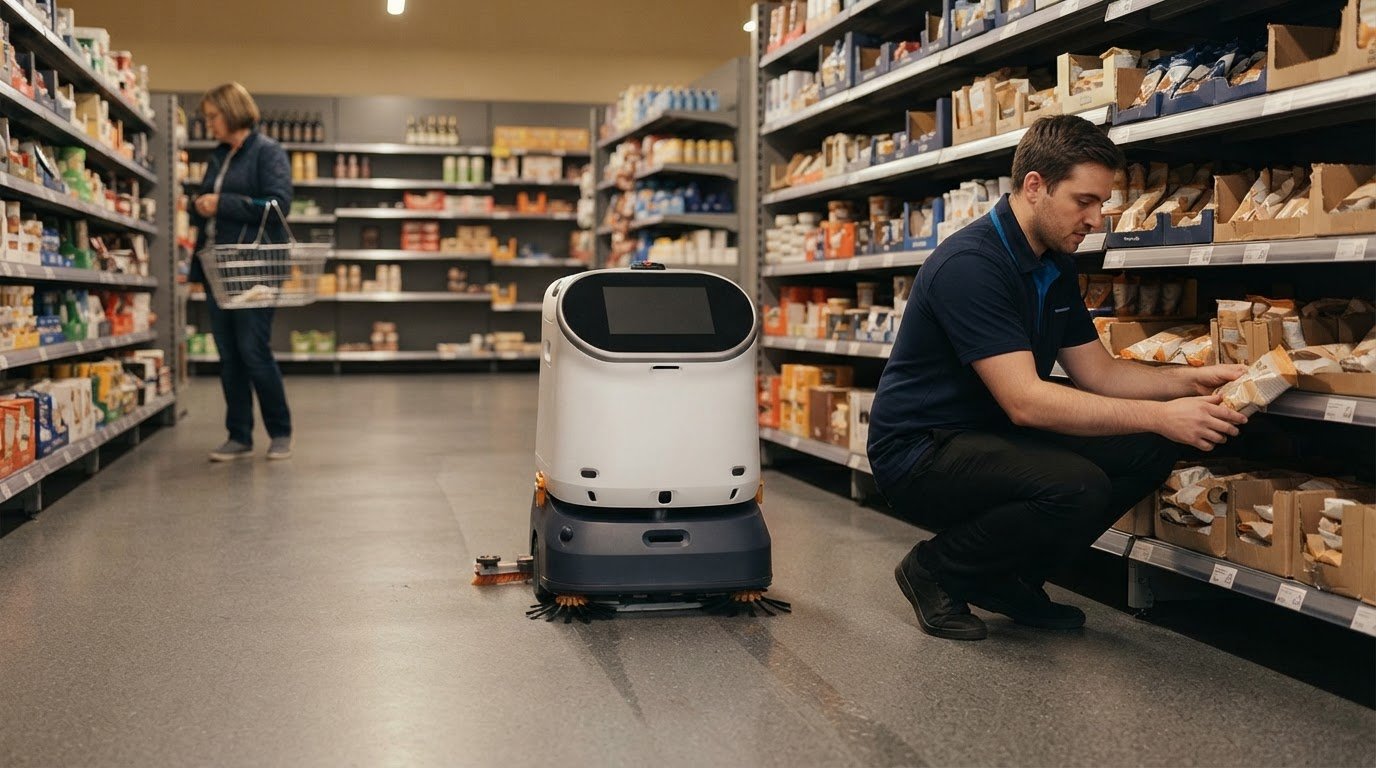
Cleaning is another routine application. A cleaning robot may be assigned to a corridor or other public area, while staff continue to clean rooms and respond to spills or urgent requests. The facility’s cleaning plan should specify which surfaces and areas are included and how staff report missed areas or route obstacles.
Reception tasks can include directing visitors to a department or providing basic location information. A robot may offer a prompt or display directions, but staff should remain available for complex questions, distress or accessibility needs. A visitor unable to follow screen-based directions may need spoken guidance from reception staff.
These tasks work best when a robot fits an existing workflow. Map the route, identify handover points and decide how staff will load and retrieve items. Check how doors, lifts, changing furniture and busy periods affect the route. A delivery that works during a quiet period may need a different handover procedure during visiting hours.
Cleaning and delivery also require clear hygiene boundaries. Keep food, clean supplies and waste separate, and define how staff clean the robot’s contact surfaces. A robot should enter restricted clinical areas only when its role and local procedures allow it. Facility teams can report faults and blocked routes through their usual equipment-reporting process.
Assign someone to manage exceptions. If a robot stops, takes the wrong route or cannot complete a delivery, staff need a straightforward manual alternative. After use, review repeated obstacles, missed handovers and areas requiring staff intervention. This feedback shows whether the robot supports the routine or adds steps.
Autonomous navigation in healthcare environments
Autonomous navigation lets a mobile robot follow a planned route without staff steering it throughout the trip. It relies on a digital map and sensors that detect surroundings, such as walls, furniture and people. In a clinic, this could support travel between reception, a supply area and a handover point.
Site mapping creates the digital layout used to plan that journey. The map should reflect the actual route, including treatment areas, corridors, doors and waiting spaces. A trolley parked in a corridor or chairs moved for an appointment can change the available space, so the map and route need to account for the facility’s everyday layout.
During travel, sensors help the robot locate itself and detect obstacles. LiDAR sensors use laser light to detect people and objects. If a visitor stops in the route, the robot needs to respond safely according to its design, for example by slowing down, stopping or selecting another available path.
Healthcare corridors are not static. A wheelchair may be moving towards reception while staff push a trolley in the opposite direction. Route planning should account for these encounters, narrow areas, waiting-room foot traffic and places where a robot must not obstruct access. A route that works in an empty corridor may not suit a busy clinic.
Define where the robot is allowed to travel before assigning tasks. For example, a facility may set a route between a stores area and a staffed handover point, keeping consultation rooms outside it. Clear zones help staff understand where deliveries can arrive and where patients will continue to receive direct assistance.
Routes may pass through doors, lifts or access-controlled areas. Assess each transition separately, and do not assume the robot can operate those doors, lifts or controls. If the route depends on them, include their operation in the site assessment before assigning the task.
Test routes under the conditions the robot will encounter. Observe a delivery during visitor movement, after furniture has shifted and while staff carry equipment. Record where the robot pauses, takes a longer route or needs staff assistance. This shows whether the route suits actual work, not just the original map.
Assign staff to manage blocked paths and navigation problems. A clear fallback could ask a team member to complete a delivery when the robot cannot proceed. Review the map after changes to reception furniture, temporary partitions or clinical-room access. For service robots in private healthcare, reliable navigation depends on the building, route and how people use both.
Service robots used in UK private healthcare
Service robots in private healthcare can be grouped by task: moving items, cleaning floors, guiding visitors or supporting social interaction. These roles differ from clinical robots used during surgery or treatment. For a private hospital, clinic or care home, start with the setting and the work the robot would perform.
Mobile delivery robots are designed to move items between agreed locations inside a building. A hospital might consider them for routine internal transport, while a clinic could assess whether repeat journeys between departments follow a consistent workflow. These robots transport items, not make clinical decisions. Staff determine what is moved, where it goes and who receives it.
Cleaning robots support floor care in suitable shared areas. A healthcare facility might assess a reception floor or public corridor. The cleaning team remains responsible for the wider cleaning plan, including work outside the robot’s assigned area. Flooring, room use and the movement of patients and staff all affect where this role makes sense.
Reception and visitor-guidance robots focus on basic information and directions. A visitor arriving for an appointment, for example, may need directions to an imaging department or waiting area. Keep this role to straightforward guidance. Reception staff handle sensitive enquiries, appointment changes and requests requiring personal judgement.
Social or companion robots have a different purpose: supporting interaction rather than transporting items or cleaning. Some care homes may use them as part of activities intended to encourage social interaction, but their effect on loneliness and mental health is not established here. Their role depends on residents, activities and staff oversight. They should complement human contact, not replace it.
Clinical robots are a separate category. Robot-assisted surgical systems support clinicians during procedures, while service robots perform tasks around a facility. This distinction matters when defining intended use, responsibilities and safety assessments. A robot designed to move around public areas should not be treated as a medical device for diagnosis or treatment.
When assessing these types, match the role to a recurring need and identify who remains accountable. A care home considering social interaction has different priorities from a clinic assessing visitor guidance or a hospital reviewing internal transport. Define the task, areas involved and staff handover before introducing equipment.
There is no single robot type for every UK private healthcare setting. The right fit depends on whether the priority is movement, floor care, visitor information or social engagement. A specific task helps staff explain the robot’s role to patients and visitors while keeping responsibility for care and clinical decisions clear.
GO Robotics
GO Robotics can help you assess whether a commercial service robot fits a defined, non-clinical task in your facility. A site survey considers the building and intended workflow before a suitable model is recommended. Available options include Pudu BellaBot, Pudu KettyBot and Pudu HolaBot.
These models may be relevant when you’re considering routine movement or visitor-facing support, rather than clinical treatment. A service robot should not replace clinical equipment or staff decisions about medication, monitoring or patient care. Assess its fit against the task, route and handover process.
If you’re exploring practical robot support for your facility, contact GO Robotics to discuss your requirements.
Plan a practical first step
Choosing service robots in private healthcare starts with a clear operational brief. Identify the recurring task, the people involved and the handover point. Then consider how the robot fits into daily routines, including what staff do when a task changes or cannot be completed.
This makes the next discussion more useful than starting with a model name. GO Robotics can survey your site and recommend an option suited to the intended workflow. Its range includes Pudu BellaBot, Pudu KettyBot and Pudu CC1, giving you models to consider for commercial service robot needs.
Set a realistic goal for an initial deployment: a defined task, clear staff responsibilities and a straightforward way to review how it works in practice. Keep patient care and clinical decisions with the people responsible for them.
Ready to discuss a suitable starting point for your facility? Contact GO Robotics and take the next step towards practical automation.
Frequently Asked Questions
What are the benefits and measurable outcomes of service robots in private healthcare?
Service robots in private healthcare can support defined routine tasks, giving staff more time for work that needs clinical judgement and personal attention. Measure their contribution by recording completed deliveries, missed handovers, staff interventions and delays. For cleaning tasks, track which agreed areas were covered and when. Compare these records with the facility’s existing process to see where automation helps and where staff still need to step in.
What UK regulations and safety standards apply to healthcare service robots?
Assess the robot’s intended purpose against applicable product conformity, medical-device and workplace safety requirements. Before use, document a risk assessment, safe operating procedures and infection-prevention arrangements.
What data protection and cybersecurity rules apply to robots handling patient information?
Assess data protection and cybersecurity requirements before the robot handles identifiable patient information. Consider what data it collects, where it is stored and who can access it. Limit access to relevant staff and define how information is handled.
What UK vendors, integrators and support services supply healthcare service robots?
GO Robotics offers Pudu models that may support practical tasks in private healthcare, including delivery, hospitality and cleaning. The article does not identify other vendors, integrators or support services.