Care home staffing solutions in the UK: a practical buyer’s guide
A rota gap needs a people-led response. A repetitive delivery task may be a process issue instead. When you search for “care home staffing solutions UK”, it can be difficult to tell which option addresses the real need without taking time away from residents.
That pressure is familiar: temporary cover can help maintain routines, while recruitment builds the team for the longer term. Neither makes a robot a substitute for a care worker. Carefully scoped robotic support may assist with defined, repetitive tasks, leaving staff to focus on residents and direct care.
This guide compares temporary staffing, recruitment and task automation, with practical criteria for assessing providers and suppliers. You’ll also find what to gather before seeking a recommendation, including details about your layout, delivery workflow and staff handovers. For care and senior living dining service, GO Robotics supplies the CadeBot L100 and can assess suitability through a site survey, followed by a written recommendation. The aim is to help you match people and technology to the right work, not ask one to do the other’s job.
Key Takeaways
- Use this guide to compare options you may find when searching for “care home staffing solutions UK”, starting with the work that needs covering rather than a particular supplier or product.
- Separate rota gaps that need qualified people from repetitive tasks that may suit task-specific robotic support.
- Compare agency cover, direct recruitment and robotic support by purpose, decision owner and the questions you need answered.
- Assess workforce needs and robot suitability using separate criteria, including task risks, the venue layout and staff handovers.
- See how a site survey and written recommendation can help assess whether CadeBot L100 is suitable for a care-home dining routine.
Care home staffing solutions in the UK: define the work before choosing cover
A rota gap puts immediate pressure on managers: shifts still need covering, residents still need support and the day’s routines must continue. Before choosing an option, define what is missing. A staffing need may call for recruitment, temporary cover or better retention; a repeated non-care task may be an operational bottleneck that merits separate assessment.
In this guide, staffing provision means arranging suitably assigned people to deliver care and other work; robotic task support means using a robot to assist with a defined, repeatable activity. These are different forms of support, not substitutes for each other. When searching for “care home staffing solutions UK”, match each option to the work it can actually address.
For background on how care is organised, see Social care in England. GO Robotics supplies robots, not care workers or emergency staffing cover.
Which work requires a person, and which work is routine?
Personal care, reassurance, relationships with residents and work requiring clinical judgement belong with appropriately assigned people. These activities rely on human attention and decisions that a delivery robot cannot provide.
Set routine movement apart. For example, dining-service items may need to travel repeatedly between areas of a home. A robot may be relevant as task support for a defined delivery workflow, but suitability depends on the actual route, layout, handovers and surrounding activity. The task needs assessing in its real setting, not just on paper.
Separate a rota gap from an operational bottleneck
An unfilled care shift is a staffing gap. Repeated movement of dining-service items through the building is a workflow that may be worth reviewing separately. The distinction matters: choosing task support for a rota gap leaves the need for a care worker unresolved, whilst arranging staff cover does not necessarily address a recurring delivery process.
A robot can assist with a task, but it is not a care worker. Robotic delivery cannot provide staffing cover for a care shift, deliver personal care, offer reassurance or take responsibility for clinical judgement. Treat it only as support for an appropriate, repeatable task, with people remaining responsible for care and resident needs.
Where robotic delivery may support care-home teams without replacing staff
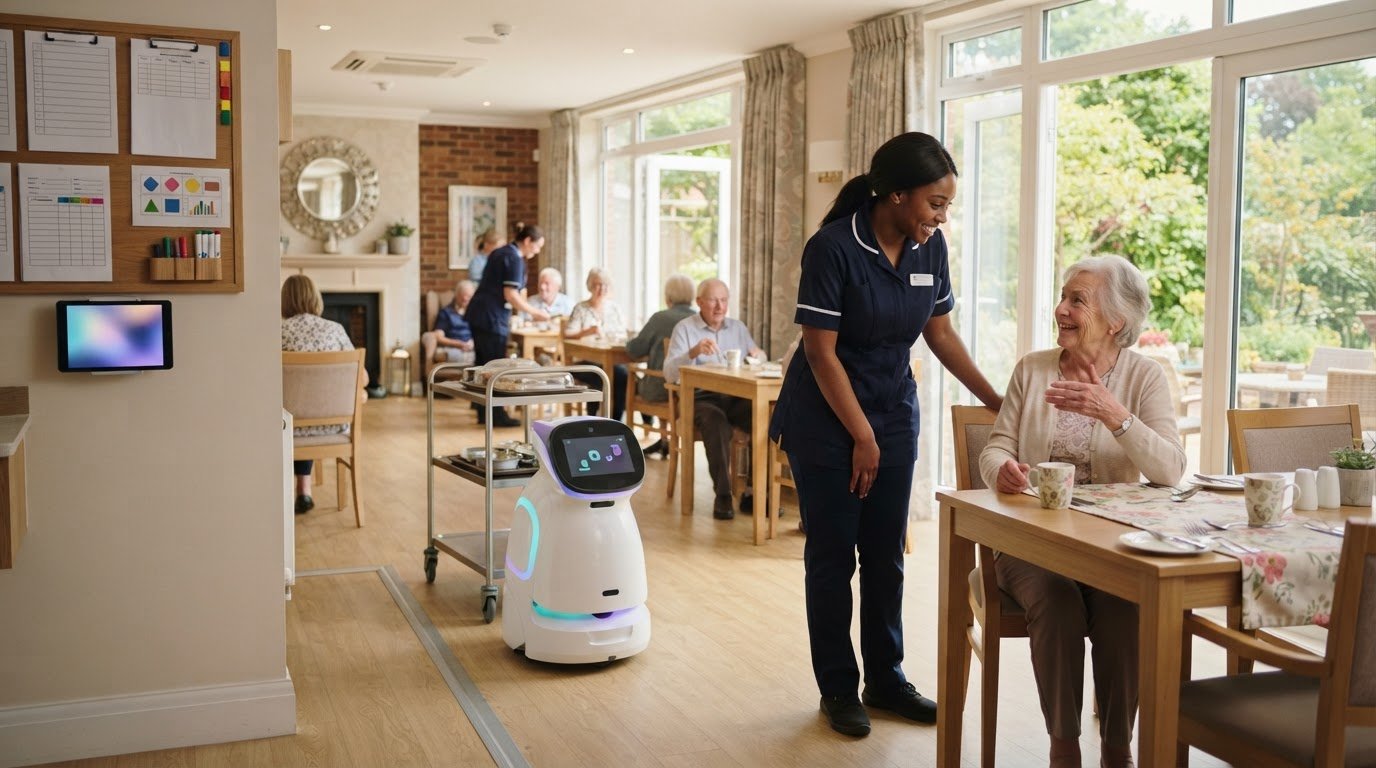
Robotic delivery is worth considering only where it fits a defined, repeatable task. CadeBot L100 is listed for care and senior living dining service. That is a description of its intended setting, not a claim that it provides care, supervises residents or covers a shift.
For a balanced overview of potential uses and considerations, read the UK Parliament POSTnote on robotics in social care. Managers searching for “care home staffing solutions UK” should assess any proposed robot separately from workforce provision, with resident needs and staff responsibilities kept central.
Assess a dining-service workflow before considering a robot
Start by tracing the task as it happens now. Where do dining-service items begin, where must they go, and which staff member receives them at the other end? Ask staff which repeated movements interrupt other duties, then check the route, access points and handover arrangements against the home’s actual layout and daily routines.
A site assessment can help establish whether the proposed workflow is suitable. Don’t assume a robot will save time, reduce staffing needs or deliver a particular service outcome; those claims require evidence specific to the home and task.
Keep staff involvement, safety and resident needs central
Staff remain responsible for resident interaction, care decisions and the handover of items. Before proceeding, consider how a delivery routine would fit around residents’ needs, busy periods and existing ways of working. Ask what happens if the route or handover cannot proceed as planned, and which staff member is responsible for responding.
Discuss staff training and the site assessment as part of planning, rather than treating them as a guarantee that the robot will suit every environment. GO Robotics’ stated support for CadeBot L100 includes a site survey, written recommendation, installation, mapping, commissioning, staff training and documentation. You can review care-home delivery support when preparing questions about your layout and workflow.
Agency cover, recruitment or robotic support: compare the right options
Choose based on the gap you need to address. An agency or direct recruitment can help you arrange people for care-worker and support-worker roles. Robotic support is different: CadeBot L100 is listed for care and senior living dining service, so any assessment should focus on that defined workflow, not a staffing vacancy.
Use this comparison to frame discussions with the relevant decision-makers. Only people can fill care-worker roles; a robot is not a staffing substitute.
| Option | Purpose and what it may address | Decision owner | Questions to ask |
|---|---|---|---|
| Agency cover | Arrange temporary people for care-worker or support-worker shifts. | Care-home manager or person responsible for staffing. | What role requirements can be met? What vetting is carried out? What availability and continuity can the provider confirm? |
| Direct recruitment | Recruit people to fill ongoing care-worker or support-worker vacancies. | Care-home manager and recruitment decision-makers. | How will the role be described, candidates assessed and continuity supported? |
| Task-specific robotic support | Assess support for a defined repeatable task, such as dining-service delivery, where the robot’s documented use applies. | Care-home manager, relevant staff and robot supplier. | Does the site and route suit the task? What training and ongoing support are available? How will staff hand over items? |
When temporary or permanent staff cover is the right route
If a care-worker or support-worker shift is unfilled, speak with an agency or recruitment provider. Ask about the role requirements, vetting processes, availability and how the provider approaches continuity. Keep the decision about the level and type of staffing cover with your care home, based on the work and residents’ needs.
When to assess routine-task automation instead
Consider a robot only when you have identified a repeatable task that fits its documented use. Assess the route and access, staff acceptance, training needs and what ongoing support the supplier provides. These are suitability questions, not evidence that the robot will reduce workload or replace a person.
For more context on technology in care settings, see our healthcare and care-home robotics guide. A site-specific assessment can help you decide whether a dining-service workflow is appropriate to explore, while keeping staffing decisions separate.
A care-home buyer’s checklist for staffing and task-support decisions
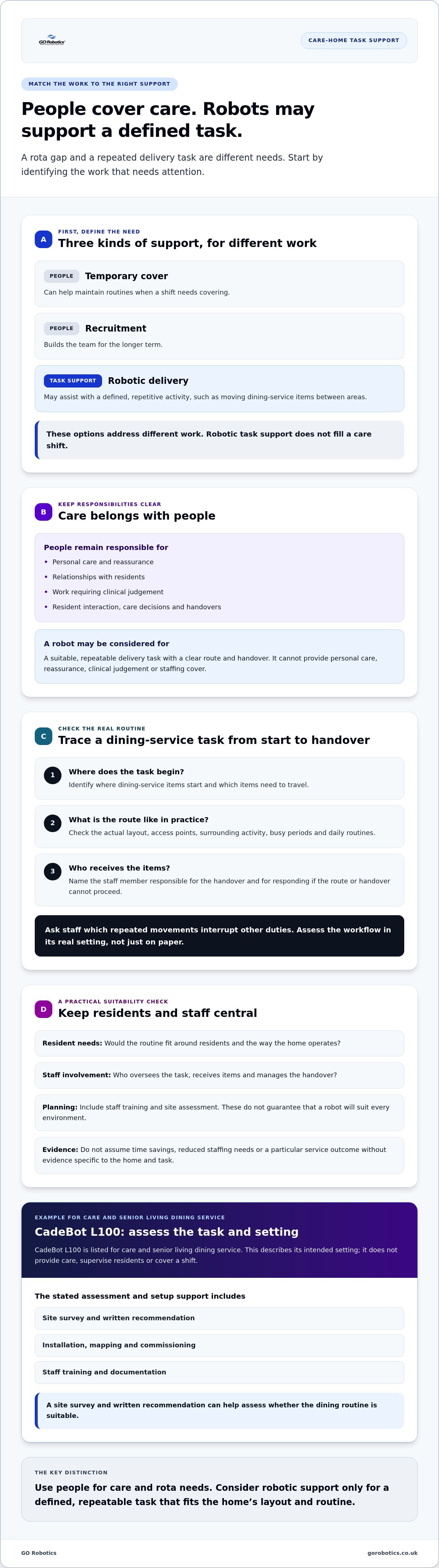
A search for “care home staffing solutions UK” can bring together options that address very different needs. Use this checklist to define the requirement first, then speak to the provider best placed to address it. Workforce provision and task-specific robot support should be assessed separately.
- 1. Identify the gap. Write down what is not getting done, when it happens and who is affected. An unfilled care shift and a repeated dining-service delivery task call for different responses.
- 2. Classify the work. Decide whether it requires a care worker’s skills and judgement, or whether it is a repeatable operational task. A robot cannot fill a care-worker role.
- 3. Assess the risks and setting. Consider resident needs, staff responsibilities and the consequences if the task is delayed or cannot be completed. For a robot, review the workflow, route, access and handover arrangements.
- 4. Compare like with like. Discuss staffing needs with agencies or recruiters, and task suitability with a robot supplier. Compare answers against your home’s requirements, not broad claims.
Questions to ask a staffing provider
Be clear about the role, required skills and shift pattern. Ask what recruitment checks are carried out, how availability is confirmed, how cover requests are handled and what the provider can tell you about continuity. Clarify how changes are communicated and how the provider confirms that a person is suitable for the requested role. Then compare the answers with your own staffing requirements.
Questions to ask a robot supplier
Ask whether the named model is documented for the task and setting you have in mind. For CadeBot L100, confirm that the discussion relates to its listed care and senior living dining-service use. Request a site assessment, written recommendation, installation plan and details of staff training. Discuss support arrangements and who remains responsible for handovers and resident needs during the workflow.
Also clarify the ongoing human involvement required. If you are considering outright purchase or a rental arrangement, use the robots-as-a-service buying guide to understand the rental model and the questions to raise.
GO Robotics’ stated support for CadeBot L100 includes a site survey, written recommendation, installation, mapping, commissioning, staff training and documentation. Discuss a CadeBot L100 site assessment with your workflow, layout and handover needs ready.
How GO Robotics can help assess care-home delivery support
GO Robotics supplies commercial robots in the UK. It is not a staffing agency and does not provide care workers or emergency rota cover. For managers reviewing care home staffing solutions UK providers can offer, keep workforce decisions separate from an assessment of a robot for a defined dining-service task.
CadeBot L100 is listed for care and senior living dining service. That describes its stated use; it does not mean the robot provides care or is suitable for every home. A site-specific assessment should establish whether the task, setting and operating arrangements fit, rather than relying on a general product claim.
What a site discussion should establish
Bring a clear description of the dining-service workflow you want to assess. Explain where items start and finish, how staff currently manage the handover, and which repeated movement you want to review. Include the environment and routes, as well as the home’s day-to-day operating practices.
GO Robotics’ stated process includes a site survey and written recommendation. If you proceed, the documented support includes installation, mapping, commissioning, staff training and documentation. Use the discussion to clarify what each step involves for your site, how staff would take part and what ongoing operational support is available. The assessment should identify limits as well as possible fit.
Take the next step with a clear use case
A useful first conversation starts with the task, not an assumption that a robot is the answer. Be ready to discuss access, routes, staff handovers and how the proposed workflow would sit alongside resident care. Staff remain responsible for resident interaction and decisions, and a robot cannot fill a care-worker role.
If you have a defined dining-service workflow in mind, you can Discuss a care-home site assessment with GO Robotics. The aim is to assess whether CadeBot L100 may suit that specific use. A discussion and written recommendation can inform your decision, but they should not be taken as a promise of a particular result or suitability before the site has been assessed.
Match the support to the work ahead
For managers searching “care home staffing solutions UK”, the key distinction is the work each option can address. Agency cover and recruitment are routes to people for care roles. Robotic support is for assessing a defined, repeatable task, not covering a shift or replacing care staff.
Before considering equipment, identify the workflow and check its fit with your home’s layout, handovers and daily routines. GO Robotics AI Ltd is its authorised UK supplier and support partner, with documented support including a site survey, written recommendation, installation, commissioning and staff training. A site assessment can help establish suitability, but it cannot promise a particular outcome.
If dining-service delivery is a task you want to assess, Discuss a care-home site assessment with GO Robotics. A clear use case gives you a practical starting point for deciding what belongs with staff and whether robotic task support is worth exploring.
Frequently Asked Questions
Can a robot solve care-home staff shortages?
No. A delivery robot cannot fill an unstaffed care shift or provide care-worker cover. It may be worth assessing for a specific, repeatable task, such as dining-service delivery, if that task fits its documented use and the home’s environment. Keep recruitment, temporary cover and retention discussions focused on people and rota needs; assess any robot separately as support for a routine activity.
Can a robot replace care workers in a care home?
No. A robot cannot replace the personal care, resident relationships, reassurance or judgement provided by appropriately assigned staff. Its possible role is limited to assisting with a defined task, not supervising residents or making care decisions. Staff remain responsible for resident interaction and any handover. Treat robotic delivery as a separate operational consideration, never as a substitute for people in care-worker roles.
What should a care home compare when choosing staffing cover?
Compare providers against the role and cover your home actually needs. Clarify required skills, shift patterns, how recruitment checks are handled, availability, continuity and how changes to a cover request are communicated. Ask how suitability for the requested role is confirmed. For care home staffing solutions UK managers assess, use your own staffing requirements as the benchmark rather than relying on general claims.
Is robotic delivery suitable for every care home?
No. Suitability depends on the particular task, building and working practices. Before considering a robot, assess the proposed route, access, dining-service workflow and staff handovers. Also discuss how the routine fits around residents and how staff would remain involved. A supplier’s site assessment can help determine whether the documented use fits your setting, but it should not be treated as a guarantee of suitability.
What does GO Robotics provide for care homes?
GO Robotics supplies robots, not care workers or emergency staffing cover. GO Robotics AI Ltd is its authorised UK supplier and support partner. Documented support includes a site survey, written recommendation, installation, mapping, commissioning and staff training. Discuss the details of each step and what applies to your home before deciding whether to proceed.
How can a care home assess whether a robot is worth considering?
Start with one clearly defined, repeatable task. Note where items start and finish, which staff handle them, how handovers happen and what site conditions may affect the route. Ask staff whether this movement interrupts other duties, then request a site-specific assessment and written recommendation. Use these details to judge whether the proposed use is practical; don’t assume it will save time or change staffing needs.