Commercial Floor Scrubbing Robots: UK Business Guide
If you’re searching for a “floor scrubbing robot commercial” option, start with the site and the cleaning task, not the headline claims. A specification sheet can’t tell you whether a machine suits your building’s surfaces, layout and daily routine. A model that works well in one venue may not suit another.
Cleaning performance matters, but so does fitting automated cleaning around staff, visitors, deliveries and busy periods. This guide explains how to assess site suitability, what to ask during a demonstration and how to plan a trial that reflects real working conditions.
Look at the whole routine: where the robot needs to clean, what could obstruct its route, which surfaces it must handle and when cleaning can take place. A trial on your own site can help you judge practical fit more clearly than a demonstration alone. GO Robotics can assess your venue and discuss suitable models, with installation, site mapping, staff training and ongoing technical support available. The aim is to help your cleaning team with repetitive work while keeping people central to the service.
Key Takeaways
- Assess whether a commercial floor-scrubbing robot suits your building by considering floor surfaces, layout and cleaning routines, not specifications alone.
- Understand how automated scrubbing may apply cleaning solution, scrub the floor and collect dirty water, while checking the method used by the specific machine.
- Compare robotic, manual and mechanised cleaning against the task, floor type, access needs and staff involvement.
- Prepare a useful trial by choosing representative areas, noting obstacles and floor types, and reflecting normal access patterns and cleaning schedules.
- Site assessment, installation, mapping, staff training and ongoing support can help you evaluate a suitable model, including the Pudu CC1.
What a commercial floor scrubbing robot does in a working building
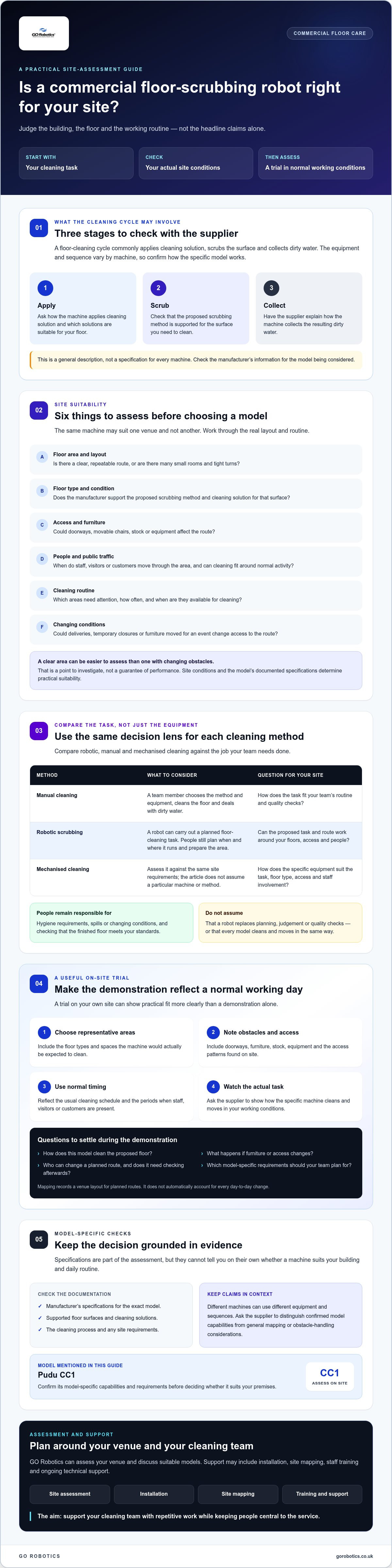
A commercial floor scrubbing robot is designed to clean floors by applying cleaning solution, scrubbing the surface and collecting the resulting dirty water. The equipment and sequence vary by machine, so check the manufacturer’s specifications rather than assuming every model works in the same way.
For facilities, cleaning and operations managers, the practical question is whether the task suits your floors and routines. Start with the areas to be cleaned, the condition of the surfaces and the times when those areas are available. GO Robotics offers the Pudu CC1, but you should confirm its model-specific capabilities and requirements before deciding whether it suits your premises.
How machine scrubbing differs from manual floor cleaning
With manual cleaning, a team member chooses the method and equipment, applies the cleaning solution, scrubs the floor and deals with the dirty water. A robot can carry out a planned floor-cleaning task, but people still need to decide where and when it should run and prepare the area.
Your team remains responsible for judging hygiene requirements, responding to spills or changing conditions, and checking whether the finished floor meets your standards. A robot assists with repetitive floor-care work. It does not replace the team’s planning, judgement or quality checks.
Which commercial areas might merit assessment?
Some areas may be worth assessing for automated scrubbing, but suitability depends on the site and the specific model. Consider:
- Floor area and layout: Is there a clear, repeatable route, or are there many small rooms and tight turns?
- Floor type: Does the manufacturer support the proposed scrubbing method and cleaning solution for the surface?
- Access and furniture: Could doorways, movable chairs, stock or equipment affect the route?
- Public traffic: When are people moving through the area, and can cleaning fit around normal activity?
- Cleaning frequency: Is the task routine enough to make automation worth assessing?
An open corridor or a clear section of a retail or leisure venue may be easier to assess than a floor crowded with furniture and changing obstacles. That is a factor to investigate, not a guarantee of performance. Site conditions and the chosen model’s documented specifications determine practical suitability.
Movement also matters. Some machines use planned routes through a mapped site; others may work differently. For a general explanation of how an automated guided vehicle follows routes in commercial or industrial settings, see Wikipedia. Assess how the specific machine cleans and moves in your actual working conditions.
How a commercial floor scrubbing robot cleans and moves around a site
A floor-cleaning cycle commonly involves applying a cleaning solution, scrubbing the surface and collecting dirty water. The process and equipment can differ, so treat this as a general description, not a specification for every model. If you’re comparing options after searching “floor scrubbing robot commercial”, ask the supplier to explain the proposed model’s process from start to finish.
Movement is a separate part of the assessment. Site mapping records a venue layout so a robot can follow planned routes. Mapping may help organise repeat cleaning tasks, but it does not account automatically for every day-to-day change. Furniture moved for an event, a delivery left in a corridor or a temporary closure can affect access and the available route.
What site mapping means for day-to-day cleaning
A mapped route may help schedule a recurring cleaning task for a defined area. Before a demonstration, ask how staff can request a route change if a room is rearranged or an access point becomes unavailable. Find out who can make changes and whether the route needs to be checked again afterwards. These are general mapping considerations, not confirmed functions of the Pudu CC1.
How to account for people, obstacles and floor surfaces
Use the demonstration to check how the specific machine behaves in your normal working conditions. Ask the supplier to show how it handles your site rather than relying on a general claim about obstacle detection or surface suitability. Check:
- People and traffic: Are staff, visitors or customers likely to cross the planned route?
- Obstacles: Do bins, cables, stock or movable furniture change position during the day?
- Layout changes: How will the route be reviewed when access or room arrangements change?
- Floors and transitions: Which surfaces and changes between floor areas does the manufacturer support?
- Cleaning method: Which cleaning agents and operating conditions does the manufacturer permit?
Manufacturer instructions should determine floor compatibility, cleaning agents and operating limits. Ask for the guidance for the exact model you’re considering, and include the surfaces and access conditions on your premises in the demonstration. The Pudu CC1 is part of GO Robotics’ range, but its specific mapping and cleaning capabilities should be confirmed rather than assumed.
For broader facilities context, REMI Network discusses how robotics can revamp modern maintenance. A site assessment and demonstration can help you judge whether a particular machine fits your routes, surfaces and cleaning routine.
How to assess a commercial floor scrubbing robot against other cleaning methods
Compare the proposed machine with the process your team uses now, whether that is manual cleaning or an existing powered scrubber. Start with a recurring task, such as cleaning a defined floor area. Occasional spill response or specialist cleaning may need a different method. If you’re searching for a commercial floor-scrubbing robot, judge the fit against your actual task, not a general claim about what robots can do.
Assessment
Manual cleaning
Mechanised cleaning
Robotic cleaning
Task fit
Check whether the method suits routine work and spot cleaning.
Check which recurring floor-care tasks the current machine handles.
Check whether the proposed task can be repeated in the areas you select.
Floor type
Confirm the tools and cleaning agents suit the surface.
Check the machine’s documented floor and cleaning-agent guidance.
Request the same evidence for the specific robot model.
Access
Consider how staff reach crowded or restricted areas.
Assess access and handling in the actual layout.
Check routes, thresholds, furniture and changing access conditions.
Staff involvement
Record preparation, cleaning and quality checks.
Record who prepares, operates and checks the machine.
Record preparation, supervision, handover and follow-up checks.
Evidence required
Document the area covered and the completed-work check.
Record observed performance on the selected task.
Use manufacturer specifications and observations from a site-specific trial.
Which questions should a buyer ask about machine specifications?
Ask the supplier for the manufacturer’s figures for cleaning rate, runtime, capacity and operating limits. Clarify what each capacity figure refers to, and ask how the cleaning rate and runtime were measured. Check whether figures are maximum ratings or reflect conditions like those at your site. A published maximum should not be treated as an expected result in a busy building.
Use only specifications documented for the exact model under consideration. If a figure or capability cannot be confirmed, leave it out of your comparison. This applies to the Pudu CC1 too: assess it using available model-specific documentation, not assumptions based on another machine.
How to compare operational fit fairly
Keep the comparison like for like. Select the same areas, floor requirements and cleaning schedule for each method, then record what happens during the assessment. Note preparation, supervision, handover and extra checks, as well as obstacles or tasks the method cannot handle.
Use those observations to identify where a robot may assist with recurring work and where manual or mechanised cleaning remains more suitable. Avoid turning a short demonstration into a claim about savings or productivity. A useful decision rests on documented evidence from the task and conditions you actually assessed.
How to prepare your premises for a floor-scrubbing robot trial
A useful demonstration should reflect how your building normally operates, not just an empty floor with obstacles removed. If you’re assessing a commercial floor-scrubbing robot, agree the trial area and what you need to learn before the visit. That gives your team a fair basis for judging whether the machine fits the task.
What to check before the demonstration
Prepare a floor plan and note the areas to include or exclude. Share the information with the supplier in advance so you can discuss the site and identify what needs checking during the demonstration.
- Mark the areas: Identify the floors and routes you want assessed, along with any rooms or zones that must remain out of scope.
- Describe the surfaces: List floor finishes and transitions between them, including thresholds that may affect access.
- Note access conditions: Flag restricted routes, furniture, stored equipment and other obstacles. Include items that move or appear at different times of day.
- Share the cleaning schedule: Explain when the area is usually cleaned and what normal footfall or site activity looks like during that period.
- Confirm preparation: Ask which cleaning agents and floor-preparation steps the manufacturer requires for the specific model.
Choose conditions that represent an ordinary shift. A demonstration in a clear area may show the basic process, but it will not reveal how the machine fits a busy route or a changing layout. Agree who will handle site mapping, staff training and review of the trial results. GO Robotics offers site assessment, installation, mapping and staff training; confirm the scope and responsibilities for your proposed trial in advance.
What to measure during the trial
Use a simple record sheet so staff can capture consistent observations during each run. Compare the results with your venue’s own cleaning requirements rather than relying on general claims.
- Area covered: Record which planned sections were cleaned and which were missed or excluded.
- Interruptions: Note pauses, route changes, access issues and the conditions at the time.
- Cleaning quality: Check the floor after each run against your usual inspection criteria.
- Staff input: Record preparation, supervision, handover and any follow-up work required.
- Limitations: Ask the supplier to explain what affected the result and what setup or checks remain outstanding.
Keep trial findings specific to the site, model and conditions tested. Do not assume the same result will apply to another building or a different layout without supporting evidence. To discuss a site assessment and trial requirements, speak with GO Robotics about your premises.
How GO Robotics can help you assess a commercial floor scrubbing robot
Choosing a model starts with your building, cleaning routine and trial findings, not a product name alone. Searches for commercial floor-scrubbing robots can bring up broad claims, but your assessment should focus on what the machine needs to do on your premises and what the supplier can confirm about the exact model.
GO Robotics supplies commercial robots in the UK, including the Pudu CC1. A site assessment can help match a model to your venue’s requirements. Consider Pudu CC1 performance only against confirmed, model-specific manufacturer specifications.
What to expect from supplier assessment and installation
The process begins with your site and task requirements. Share the floor areas, surfaces, access conditions and cleaning routine you want to assess. The supplier can then recommend a model for consideration, followed by installation and site mapping where appropriate. Mapping records the venue layout to plan robot movement.
GO Robotics also offers staff training and ongoing technical support. Before proceeding, clarify what those arrangements cover and who handles software questions, maintenance and day-to-day operational issues after installation. Agreeing these responsibilities early helps your team understand what to expect and where to turn for guidance.
Ask for written, model-specific information on cleaning performance, supported floor types, operating limits and required cleaning agents. If a detail is not documented, treat it as an open question rather than assuming a capability. This is particularly relevant when assessing the Pudu CC1: confirm the product details needed to evaluate your site and task.
What to include in your next-step decision
Bring the evidence together before deciding whether to proceed. A clear summary should cover:
- Site requirements: The areas, surfaces, routes and operating conditions the machine needs to handle.
- Trial observations: What was cleaned, the quality checks, interruptions and staff input recorded during the assessment.
- Outstanding questions: Any specifications, setup needs, maintenance responsibilities or support arrangements still to confirm.
- Purchase or service arrangement: Whether you want to discuss outright purchase or a Robots-as-a-Service (RaaS) subscription. GO Robotics’ RaaS model covers robotic hardware lease, software licensing and cloud management tools, with maintenance and remote technical support included.
For broader background before comparing models, you can also read GO Robotics’ Commercial Cleaning Robot UK guide. Then discuss your site requirements and assessment with GO Robotics to establish what should be checked next.
Make your next cleaning decision site-specific
A commercial floor-scrubbing robot should be assessed against your surfaces, layout and cleaning routine, not a specification sheet alone. A site trial gives you a chance to check the route, cleaning quality, interruptions and staff involvement under conditions that reflect your building.
Before choosing, confirm the exact model’s documented capabilities and record what the trial shows, including any limitations or setup still required. A search for “floor scrubbing robot commercial” options is only the starting point; evidence from your own premises makes the decision more grounded.
GO Robotics supplies commercial robots in the UK and offers site assessment, installation, site mapping, staff training and ongoing technical support. Ask about outright purchase or a Robots-as-a-Service arrangement, and clarify which support and maintenance responsibilities apply.
Discuss a site assessment with GO Robotics to take a practical next step towards assessing whether automation can assist your cleaning team.
Frequently Asked Questions
What does a commercial floor scrubbing robot do?
A commercial floor scrubbing robot carries out a floor-cleaning task using a machine-based process. Depending on the model, this may involve applying cleaning solution, scrubbing the surface and collecting dirty water. Equipment and methods vary, so check the manufacturer’s information for the specific machine. Staff still plan when and where it runs, prepare the area and check the finished floor against the site’s cleaning standards.
Can a floor scrubbing robot clean every type of commercial floor?
No. Do not assume a particular robot suits every commercial floor. Surface material, floor condition, transitions and cleaning method all affect suitability. Check the manufacturer’s instructions for supported floor types, cleaning agents and operating limits before considering a trial. If your premises have several finishes, list them for the supplier and ask which can be assessed. Confirm claims against documentation for the exact model, not a similar machine.
How does a commercial floor scrubbing robot navigate a building?
Navigation varies by model. Some machines use site mapping, which records a venue layout to plan movement along routes, while the manufacturer’s documentation explains the specific method used. Furniture, temporary obstacles, thresholds and access changes may affect the route. Ask how the machine’s route is set up and reviewed when your layout changes. Confirm whether it can pass through a doorway or handle a particular transition rather than assuming it can.
Is a commercial floor scrubbing robot suitable for a busy building?
It may suit some tasks in a busy building, but suitability depends on the layout, cleaning schedule, public access and specific model. If you’re comparing commercial floor-scrubbing robots, assess the machine in representative conditions rather than judging it in an empty demonstration space. Consider when staff, visitors or customers use the area, and ask the supplier how those patterns will be reflected in a site trial.
How should a business test a floor scrubbing robot before deployment?
Choose an area and time that reflect normal working conditions. Share a floor plan, list surfaces and access restrictions, and identify furniture or obstacles that may move. During the trial, record the areas covered, interruptions, staff input and cleaning quality. Check the result against your own standards, and ask the supplier to explain any limitations or setup still needed. Keep findings specific to the model and conditions tested.
Does a floor scrubbing robot replace cleaning staff?
No. A floor scrubbing robot can assist with repetitive floor-care tasks, but cleaning staff remain essential to planning, preparing areas and checking work. Your team also makes decisions about hygiene requirements and responds to spills or changes in the building. Before a trial, agree who will oversee the task, manage access and review the results. Treat the robot as one part of the cleaning routine, not a replacement for people’s judgement.