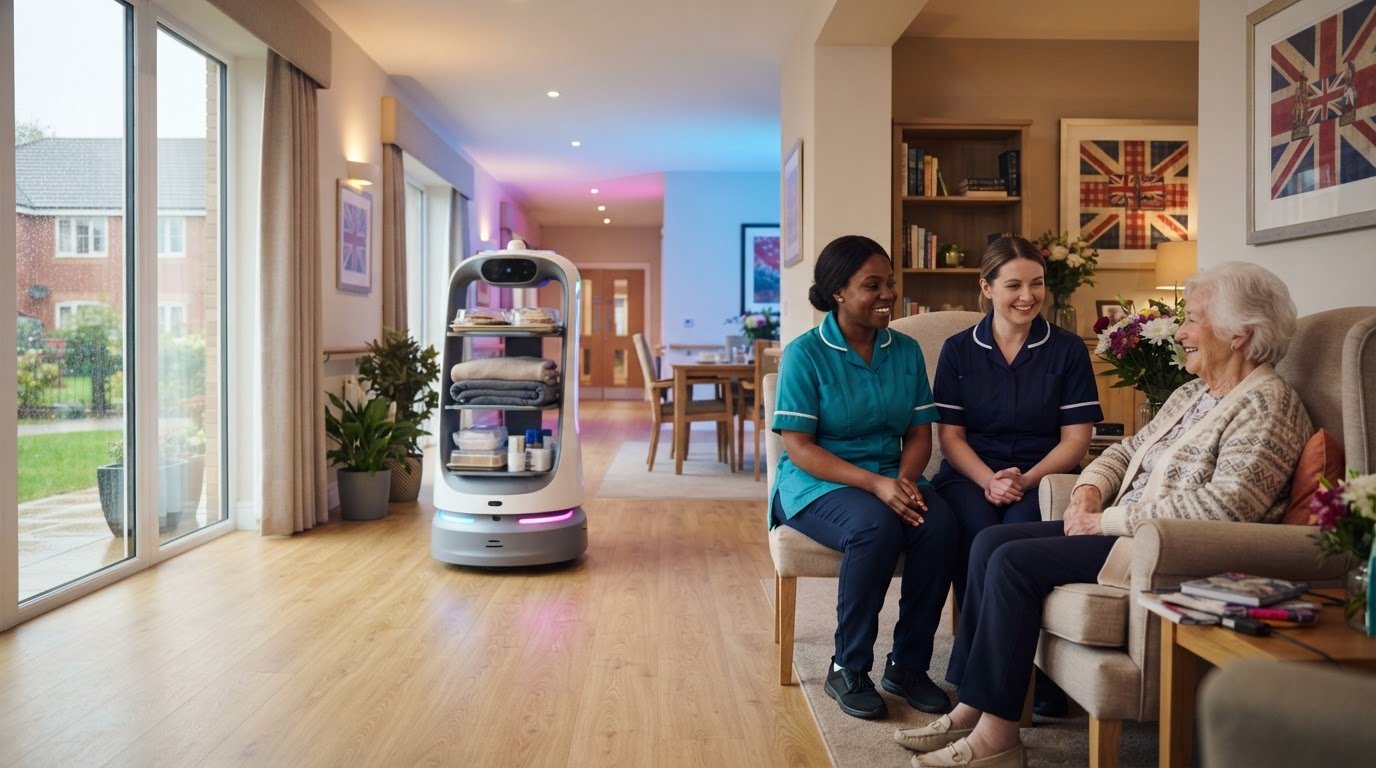
Hidden Costs of Robots-as-a-Service: A UK Business Buying Guide
The hidden costs of Robots-as-a-Service are often responsibilities and work that sit outside the subscription, rather than automatic extra charges. A monthly arrangement can give your business access to a commercial robot without buying the hardware outright. To judge whether it fits, look at the subscription scope alongside the tasks your team will handle and the conditions at your site.
GO Robotics’ RaaS subscriptions cover robot hardware, software licensing and cloud management tools, with maintenance packages and remote technical support included. GO Robotics also provides site surveys, model recommendations, installation and staff training. A clear deployment plan helps you understand how these services fit your venue and what your team needs to do.
This guide sets out what to review before choosing a subscription: the deployment work and support included, whether the robot’s intended tasks match your requirements, and how your responsibilities, renewal and exit terms are defined. Use the practical checks below to compare proposals on the same basis and decide whether the arrangement suits your operations and internal capacity.
Key Takeaways
- The hidden costs of Robots-as-a-Service can include work beyond the subscription, so compare the written scope rather than relying on the headline offer.
- Use a site survey and model recommendation to match the robot and deployment plan to your venue’s tasks and conditions.
- Record how support, software access, expected use and service changes are covered in the agreement.
- Compare RaaS with outright purchase by considering who coordinates maintenance, software access and ongoing technical support.
- Before choosing, document your responsibilities and review the agreement’s duration, renewal and exit terms.
Hidden costs of Robots-as-a-Service start with what the subscription covers
Robots-as-a-Service (RaaS) is a monthly arrangement that can provide access to a robot alongside software, cloud management tools and support. It is a service model, not simply another name for leasing; the Robot as a service (RaaS) financial model overview explains the distinction. For your decision, focus on the services and responsibilities set out in the written agreement.
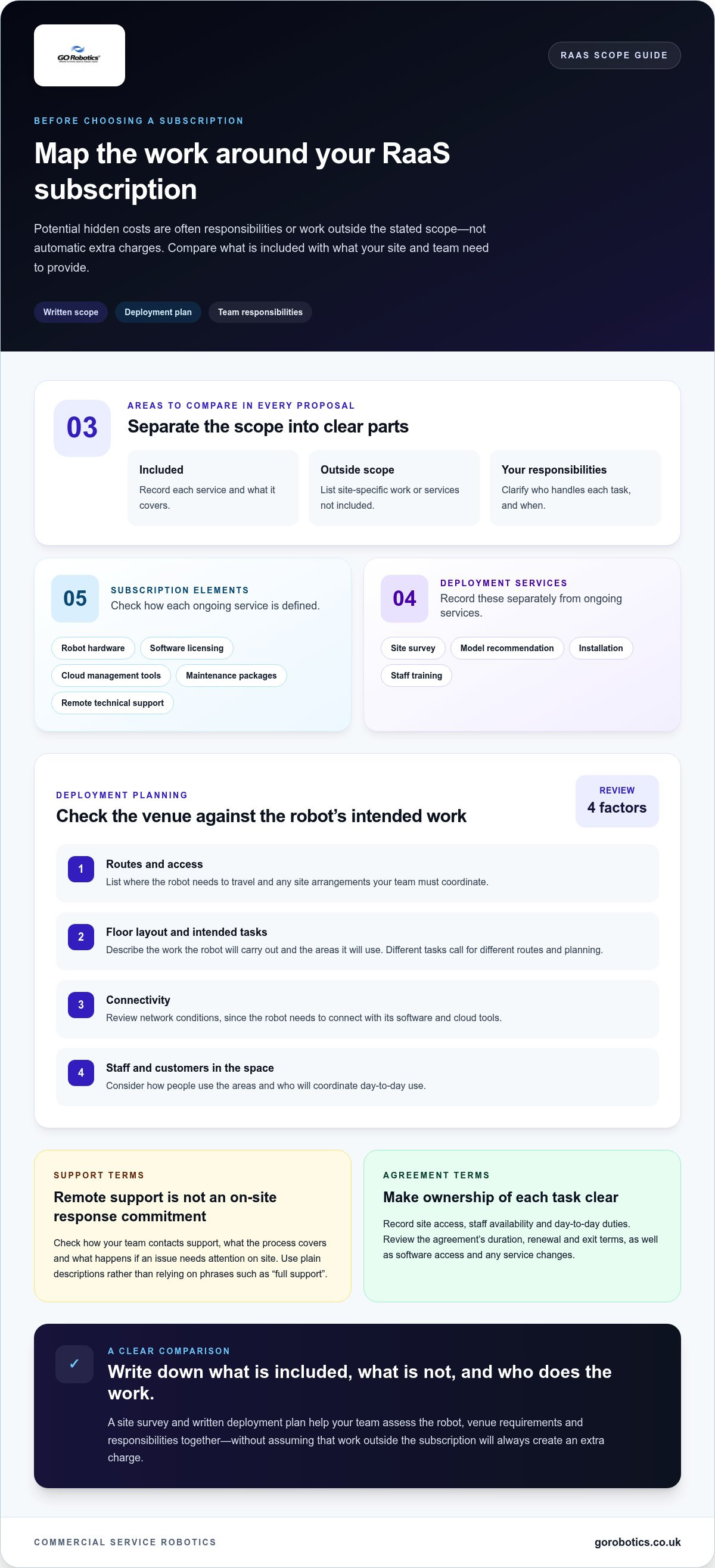
Some elements continue throughout the subscription, while installation and training are part of deployment. A clear scope helps you see which services GO Robotics provides and which tasks your team needs to coordinate. Use the same categories to compare every proposal.
Which services may sit inside a RaaS subscription?
GO Robotics’ RaaS subscription includes robot hardware, software licensing and cloud management tools, alongside maintenance packages and remote technical support. These give your team access to the robot and its management tools, with support for maintenance and technical issues. Remote assistance is distinct from an on-site response commitment, so read the support terms for the precise service provided.
GO Robotics also provides site surveys, model recommendations, installation and staff training. Treat these as deployment activities and record their scope separately from ongoing maintenance and technical assistance. This makes it easier to see what happens before the robot starts working and what continues during the subscription.
What should the agreement define in plain English?
Record the robot covered, the software and cloud access provided, what the maintenance package involves, and how remote support is delivered. Note your organisation’s responsibilities too, such as arranging site access and making relevant staff available for installation or training. The written agreement should make clear who handles each task and when.
Terms such as “full support” or “standard maintenance” can mean different things unless they are explained. Look for a description of the maintenance work, how your team contacts remote support and what the support process covers if an issue needs attention on site.
| Proposal area | What to record | What you need to clarify |
|---|---|---|
| Included | Robot, software access, cloud tools, maintenance and remote support | What each item covers and how support is delivered |
| Outside the stated scope | Any site-specific work or service not included in the subscription | Whether installation, integration or other deployment tasks are covered |
| Your responsibilities | Site access, staff availability and day-to-day duties | Who handles each task, and when |
This comparison makes potential hidden costs of Robots-as-a-Service easier to identify without treating them as automatic extra charges. It gives you a practical basis for comparing proposals and agreeing responsibilities before deployment begins.
Robot deployment can create work beyond the recurring RaaS service
A deployment plan should reflect the robot’s intended work and the conditions at your site. A delivery robot in a hotel, for example, follows different routes from a floor-cleaning robot in a retail space. Consider access routes, floor layout, connectivity and how staff will work alongside the robot. These are planning topics, not evidence that extra work or charges will always arise.
Discussing these points during a site survey helps define the deployment and your team’s responsibilities. GO Robotics surveys the site and recommends a model based on the venue and intended tasks. This helps you distinguish the initial setup and staff familiarisation from the recurring RaaS service. The hidden costs of Robots-as-a-Service are best assessed as possible gaps in planning and scope, not assumed add-ons.
How can site conditions affect the deployment plan?
The venue layout and intended tasks guide the model recommendation. List where the robot needs to travel, what work it will carry out and how staff or customers use those areas. Review network conditions too, since the robot needs to connect with its software and cloud tools.
Site mapping means creating a digital layout of a venue to support robot navigation. GO Robotics begins with a site survey and written recommendation, using the work and environment you describe to inform the model and deployment plan. The Interlake Mecalux overview of RaaS as an alternative to purchasing also provides context on the service model, including the role of maintenance and upgrades.
What should installation and staff training cover?
GO Robotics provides installation and staff training as part of deployment. Before installation, identify who will arrange site access, which areas need to be available for setup and which staff should take part in training. This gives your team a clear starting point for using the robot for its intended tasks.
After installation, make sure staff know who will coordinate day-to-day use and how to raise questions or technical issues. GO Robotics’ published guide to robot installation and staff training can help you prepare your team for these activities.
Keep the deployment plan specific. Record the intended tasks, site arrangements, installation scope and training responsibilities. If you’re assessing a robot for your venue, explore GO Robotics’ commercial service robots and RaaS as part of your planning.
Usage, support and contract terms can change the value of RaaS
A subscription works best when its agreed scope matches how you plan to use the robot. A model intended for regular deliveries across a hotel may be used differently from one supporting cleaning tasks in a venue with changing opening patterns. Compare the written proposal with the work you expect the robot to do, not just its headline description.
The hidden costs of Robots-as-a-Service can include a mismatch between the agreed service and the work your team expects the robot to do. That does not mean a particular use will trigger extra charges. It means you should define expected use and the supplier’s responsibilities before signing.
How should businesses assess the fit between use and subscription?
Build a practical picture of expected use. Note the tasks, operating periods and locations involved, then consider whether seasonal demand or planned site changes could alter that pattern. If the robot will move between areas or locations, include those requirements in the deployment discussion.
Compare your list with the tasks and robot capacity described in the agreement. GO Robotics’ UK RaaS business guide provides wider context on the subscription model. Keep your assessment focused on whether the written offer matches the work you need done and the support your team can provide.
Which support and contract details deserve close attention?
The support terms should explain what maintenance covers, how to access remote assistance and how an issue is escalated if remote help is not enough. Remote support does not itself promise a particular response time or an on-site visit. Treat any such commitment as a separate term and make sure it is stated precisely.
Review the agreement’s duration, renewal process and provisions for changing the service, cancelling or returning equipment. Clear terms help you plan for changing demand and understand what happens when the arrangement ends.
| Area to compare | Supplier responsibilities | Your team’s responsibilities |
|---|---|---|
| Usage and scope | Robot capacity and tasks covered by the proposal | Expected tasks, operating periods and locations |
| Support | Maintenance, remote assistance and escalation route as written | Day-to-day supervision and site coordination |
| Contract changes | Process for renewal or changes to the service | Notice, decisions and information needed to request a change |
| Exit | Equipment return and end-of-agreement process | Preparing the site and coordinating the handover |
Use this comparison for each proposal. It makes differences in service boundaries, support and flexibility easier to spot, while keeping the decision tied to what each agreement actually promises.
Compare RaaS with ownership by mapping the whole business commitment
RaaS and outright purchase place different responsibilities with your business. A subscription gives you access to automation without buying the hardware outright, while buying means your organisation owns the robot and plans how it will be operated and supported. Neither model is automatically the better choice. The right fit depends on your expected use, the agreement’s scope and your team’s capacity to manage the work around the robot.
Compare the full operational commitment, not just the equipment. Include software access, maintenance coordination, technical support and the time your staff will spend overseeing day-to-day use. The hidden costs of Robots-as-a-Service are easier to assess when you consider these responsibilities alongside the subscription.
When might a subscription suit your operating priorities?
A subscription may suit your business if you want access to automation without buying the hardware outright, or if you prefer a defined service arrangement. GO Robotics’ RaaS subscriptions cover robot hardware, software licensing and cloud management tools, with maintenance packages and remote technical support included.
Check that the written scope matches your needs and shows what your team still manages, such as day-to-day supervision and site coordination. A subscription does not remove those responsibilities, so compare the service terms with your expected use.
When might outright purchase fit better?
Buying may suit an organisation that prefers direct ownership and has the capacity to coordinate the robot’s ongoing operation. Your team will need to consider how software access, maintenance and technical support will be managed, whether internally or through separate arrangements. Ownership gives you the asset, along with responsibility for planning its ongoing use and support.
For a focused decision, use GO Robotics’ published buy-versus-rent robot comparison alongside the written proposals you’re considering. Assess each option against your venue’s tasks, your internal capacity and the service scope on offer. Avoid assuming the same arrangement will suit every business.
- RaaS: Consider whether the subscription’s software, maintenance and support arrangement fits how your team wants to manage the service.
- Purchase: Consider whether direct ownership fits your plans and whether you can coordinate ongoing operation and support.
- Either option: Compare the robot’s intended use, responsibilities and support arrangements in writing.
GO Robotics supplies robots through RaaS and outright purchase, with site surveys and model recommendations to help align the choice with your work. Discuss the right robot buying option for your organisation.
Build a RaaS checklist before choosing a robot subscription
A clear checklist turns your operational needs into points you can compare with the written proposal. It also helps surface potential hidden costs of Robots-as-a-Service, such as staff time or site responsibilities outside the subscription. Work through these steps before deciding:
- Define the tasks. Describe the recurring work you want the robot to support, when it will operate and which areas it needs to cover.
- Survey the site. Note the layout, access arrangements, floor conditions and connectivity topics that may affect the deployment plan.
- Map the scope. Record what the proposal says about the robot, software access, maintenance, support, installation and training.
- Compare the terms. Set out your responsibilities alongside support arrangements, renewal, service changes and exit conditions.
- Decide on fit. Check that the proposed robot, service scope and division of work suit your venue and your team’s capacity.
What information should you prepare for a site survey?
Bring a practical picture of your venue and its work. Describe the recurring tasks, intended operating areas, current workflows and the people who will coordinate robot use. Include known changes to the site or work pattern that could affect how the robot is used.
Write down questions about software access, support channels, maintenance responsibilities and what the agreement covers. This gives the survey and recommendation a useful operational starting point.
How can GO Robotics help you assess RaaS fit?
GO Robotics carries out site surveys and recommends a model based on your venue and intended tasks. We also provide installation, staff training and ongoing technical assistance, helping you plan the handover from deployment to day-to-day use. The written scope sets out the service and responsibilities for your arrangement.
Bring your task list and questions to the discussion. Discuss a RaaS arrangement for your business and assess an option suited to your site and team.
Choose a RaaS arrangement that fits your operation
The hidden costs of Robots-as-a-Service are easier to manage when you look beyond the subscription headline. Compare what the agreement includes with the deployment work and day-to-day responsibilities your team will take on. Then check that the robot’s intended tasks, support arrangements and contract terms match your requirements.
RaaS can provide access to robot hardware, software licensing, cloud management tools, maintenance packages and remote technical support. The detail matters: make sure the written scope explains what is covered, who does what, and how renewal and exit work. A site survey helps connect those terms to your venue and the work you need done.
GO Robotics provides nationwide site surveys, model recommendations, installation, staff training and ongoing technical assistance. If you’re assessing automation for your business, discuss a RaaS arrangement for your business. Share your intended tasks and site requirements to start planning an arrangement that suits your team.
Frequently Asked Questions
What does a Robots-as-a-Service subscription usually include?
A RaaS subscription can bundle access to robot hardware, software licensing, cloud management tools and support into a monthly arrangement. GO Robotics subscriptions include hardware, software licensing and cloud management tools, with maintenance packages and remote technical support. Read the scope to understand what each element covers and which tasks remain your organisation’s responsibility.
Are installation and staff training included in RaaS?
GO Robotics provides installation and staff training, alongside site surveys and model recommendations. The deployment plan should describe the activities and your team’s role, including arranging site access and making relevant staff available. This distinguishes the initial setup from services that continue during the subscription.
Can a RaaS agreement include maintenance and technical support?
Yes. GO Robotics RaaS subscriptions include maintenance packages and remote technical support. Read the agreement to understand what maintenance covers, how your team accesses assistance and how issues are escalated. Remote technical support is not the same as an on-site response commitment, so treat any response-time or site-visit term as a separate commitment.
What happens if a business needs to change its robot usage?
The agreement’s terms determine how a change is handled. If your tasks, operating pattern or site requirements change, review the provisions for service changes, renewal and cancellation. The written terms should explain how to request a change and what happens if the arrangement no longer fits. Document expected seasonal demand and possible changes to your work before signing.
Is Robots-as-a-Service better than buying a service robot?
Neither option is automatically better. RaaS may suit a business seeking access to automation without buying the hardware outright and preferring a defined service arrangement. Outright purchase may fit an organisation that values ownership and can plan for software access, maintenance coordination and technical support. Compare the intended use, written service scope and your team’s capacity before choosing.
How can I compare two RaaS agreements fairly?
Compare both written proposals against the same requirements to assess the hidden costs of Robots-as-a-Service. Record the hardware, software access, cloud tools, maintenance and support included, then note deployment work and your team’s responsibilities. Compare expected use, contract duration, renewal, service changes and exit provisions as well. Clear descriptions make differences easier to identify and help you judge whether each offer fits your tasks.
Can a business use RaaS without a large upfront hardware purchase?
Yes. RaaS gives a business access to robot hardware through a monthly subscription rather than an outright hardware purchase. The arrangement also includes software licensing, cloud management tools, maintenance packages and remote technical support through GO Robotics. Review the written scope to see how those elements apply to your intended use, and include the contract duration, renewal and exit terms in your decision.