How to Get Management Buy-In for Automation: UK Guide
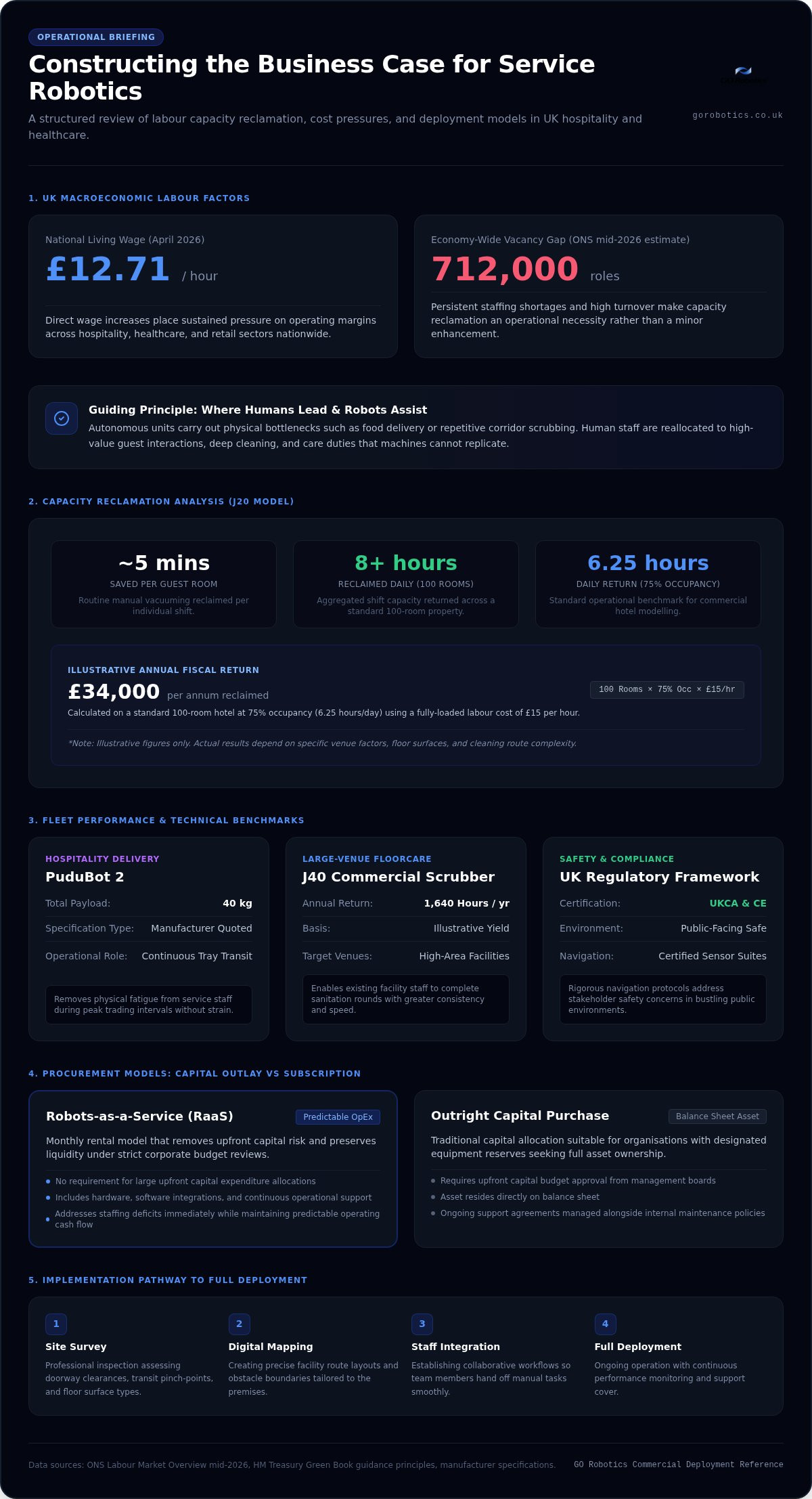
The UK National Living Wage is set to reach £12.71 per hour in April 2026, putting direct pressure on hospitality, retail, and healthcare margins. Many operators are currently struggling with high staff turnover and a vacancy gap that the ONS estimated at 712,000 across the economy in mid-2026. While you might see the operational benefits of service robots, the real challenge is often how to get management buy-in for automation when capital budgets are under scrutiny.
We agree that a robot must be a strategic asset that returns time to your team rather than a simple novelty. This guide explains how to construct a data-led business case that speaks the language of the board, focusing on capacity reclamation. You will learn how to present a clear ROI framework, plan for robots to work alongside your staff, and use flexible financial models like Robots-as-a-Service (RaaS) to remove capital risk. We will move from the initial site survey through to a fully supported deployment, ensuring your leadership team sees automation as a reliable partner for growth.
Key Takeaways
- Learn why the April 2026 National Living Wage increase to £12.71 makes reclaiming staff capacity an operational priority for UK businesses.
- Discover how to get management buy-in for automation by presenting a business case based on real-world data, such as returning over six hours of labour per day in a standard hotel.
- Compare the advantages of outright purchase against the Robots-as-a-Service (RaaS) model to find a subscription that removes capital risk.
- Address safety and morale concerns by highlighting UKCA-certified navigation technologies that allow robots to assist staff in public-facing environments.
- Understand the importance of a professional site survey to ensure your venue meets the mapping and passage-width requirements for successful deployment.
Identifying Operational Bottlenecks in UK Hospitality and Healthcare
The UK labour market is entering a period of significant cost pressure. From April 2026, the National Living Wage will rise to £12.71 per hour, which fundamentally changes the financial model for hospitality and healthcare operators. When considering how to get management buy-in for automation, you must start by identifying physical bottlenecks where expensive human labour is currently wasted on low-value, repetitive work. These are the areas where rising costs hit hardest and where the impact of a robotic assistant is most immediate.
We use the philosophy "Where Humans Lead & Robots Assist" to frame these discussions with stakeholders. It isn't about replacing your team; it's about reclaiming their time from tasks like food running or vacuuming endless corridors. By automating these specific manual processes, you allow your staff to focus on high-value guest interactions or resident care that a machine cannot replicate. Identifying these bottlenecks is the first step in proving that automation is a necessity rather than a luxury.
The True Cost of Repetitive Manual Tasks
Manual floor cleaning in a hotel or care home is a prime example of a hidden bottleneck. When a housekeeper spends a large portion of their shift pushing a vacuum, they aren't available for deep cleaning or personalised guest service. Our operational model shows that the J20 floor-scrubbing robot can save roughly five minutes of labour per guest room. In a 100-room hotel, these small savings aggregate into over eight hours of reclaimed capacity every single day. These gains allow managers to reallocate staff to areas that directly impact guest satisfaction scores or healthcare outcomes without increasing headcount.
Recognising the Limits of Human Labour
Physical fatigue is a reality in high-volume environments. Pushing industrial vacuums for an eight-hour shift or carrying heavy trays across a large restaurant takes a toll on staff wellbeing and leads to higher turnover. The PuduBot 2 is designed to alleviate this burden, featuring a manufacturer-quoted total payload of 40kg. Unlike human workers, robots maintain consistent performance during peak trading hours without suffering from fatigue or repetitive strain. This consistency ensures that guest service standards don't slip when the venue is at its busiest.
To help stakeholders manage the transition, many UK firms are looking at the Robotics-as-a-Service (RaaS) financing model. This approach allows you to treat automation as a predictable operating expense, which is often a key factor in how to get management buy-in for automation. By removing the need for large upfront capital, you can begin addressing labour shortages and staff burnout immediately while maintaining a healthy cash flow.
Constructing a Data-Led Business Case for Robotic Assistants
Securing executive approval requires moving beyond excitement into financial evidence. When researching how to get management buy-in for automation, your most powerful tool is a business case that aligns with HM Treasury Green Book guidance for economic appraisal. Directors need to see how a physical asset translates into a fiscal gain. By presenting clear, data-driven projections, you move the conversation from a technological "maybe" to a commercial "must".
The J20 floor-scrubbing robot provides a clear example for ROI calculations. In a standard 100-room hotel operating at 75% occupancy, this unit returns 6.25 hours of labour per day to your team. Using a fully-loaded labour cost of £15 per hour, the annual value of this reclaimed time is £34,000. It is vital to qualify these figures as illustrative. Actual results depend on specific site factors, including floor surface types and the complexity of the cleaning routes.
Calculating Labour Value Returned
We define 'labour value returned' as the cost of the hours a robot works that would otherwise require manual intervention. For larger venues, the J40 model provides an illustrative return of 1,640 hours per year. This isn't about reducing headcount. Instead, it allows your existing teams to complete their rounds faster or with more attention to detail. If you want to see how these figures apply to your specific venue, you can book a free site survey to get a tailored recommendation.
Beyond the Spreadsheet: Service Quality Gains
The business case must also address the qualitative benefits that drive revenue. A BellaBot Pro in a restaurant can handle a 40kg total payload of plates, which allows waiters to stay in the dining room rather than shuttling back and forth to the kitchen. Increased 'table presence' often leads to higher guest satisfaction and potentially increases the average table spend. When staff aren't exhausted from physical hauling, they sell more effectively.
Stability also plays a role in reducing waste. The PuduBot 2 features a manufacturer-cited 30% improvement in motion stability. This keeps full glasses upright and reduces the risk of spills during peak service. By combining these service quality gains with hard labour data, you present a comprehensive argument for how to get management buy-in for automation. You show that the technology protects both your margins and your reputation.
Financial Flexibility: Comparing RaaS Subscriptions with Capital Expenditure
One of the biggest hurdles in how to get management buy-in for automation is the hesitation to commit large sums of capital to physical hardware. Finance directors often worry about the long-term impact on the balance sheet, especially when technology is evolving quickly. We address this by providing several acquisition paths, ranging from outright purchase and leasing to a flexible subscription model. By aligning the cost of the technology with the monthly productivity gains we've already identified, businesses can protect their cash flow while modernising their operations.
What is Robots-as-a-Service (RaaS)?
Robots-as-a-Service (RaaS) is a monthly rental arrangement that can include the robot, software, and ongoing support. This model shifts the financial burden from a capital budget (CapEx) to an operational budget (OpEx), allowing you to pay for the service out of the value it generates each month. These subscriptions usually include software licensing and access to a fleet management dashboard, providing a centralised interface for monitoring your units across multiple locations in real time.
Mitigating Technology Risk
The pace of technological change often makes management nervous about obsolescence. RaaS allows venues to upgrade as newer units, such as the BellaBot Pro, become available, ensuring your site always has access to the most efficient sensors and battery endurance. This flexibility is a powerful point when discussing how to get management buy-in for automation, as it removes the risk of being stuck with older hardware. Furthermore, introducing automated machinery into a shared workforce requires strict adherence to HSE's PUWER regulations, which govern the safe use of work equipment. Our RaaS agreements help management meet these standards by including regular maintenance and remote diagnostics to ensure every unit remains in peak condition.
Purchasing a unit outright remains a popular choice for organisations with available capital, particularly as it allows for a 12-month warranty as standard. However, the RaaS model extends this peace of mind by providing a full warranty for the entire contract period. With UK-based technical support and engineers available to assist, the risk of extended downtime is significantly lower than when buying from overseas sellers without local representation. We offer both outright purchase and lease options to suit different balance sheet requirements, ensuring that the financial model fits your specific business structure. This level of partnership proves the investment is backed by a reliable service infrastructure, making the decision easier for stakeholders.
Addressing Management Concerns: Safety, Staff Morale, and Guest Experience
Safety is usually the first question a board asks when you propose a new technology. You can't expect to get management buy-in for automation if the leadership team thinks the hardware poses a hazard to the public. We address these concerns by using advanced navigation systems that ensure every unit is aware of its surroundings. LiDAR sensors use laser light to detect people and obstacles instantly, while SLAM mapping technology lets the robot build a digital picture of the venue to navigate with centimetre-level precision. The BellaBot Pro takes this further with triple-redundant navigation, which combines vision, LiDAR, and marker positioning to ensure it never loses its way, even in a crowded hospital corridor or a busy restaurant.
Compliance and Safety Standards
Every robot we supply is UKCA and CE marked for commercial supply in Britain. These certifications are essential trust signals that prove the equipment meets strict legal safety requirements. To protect shoppers and residents, the units use multi-sensor fusion. This process combines data from cameras and lasers to improve perception, allowing the robot to spot small children, pets, or stray trolleys that a single sensor might miss. The BellaBot Pro also includes ground-projection safety patterns that cast light onto the floor at junctions, giving people a clear visual warning that the robot is approaching an intersection.
The Human Element: Staff Training and Acceptance
Buy-in doesn't stop at the executive level; it requires the support of the frontline team. Morale stays high when robots are framed as assistants that remove the "donkey work" rather than as replacements for people. We provide comprehensive on-site staff training and documentation to ensure everyone feels confident working alongside their new robotic partners. For example, the J36 floor-scrubbing robot can identify liquid spills on a shop floor and immediately report them to a human supervisor for follow-up. This partnership keeps the staff in control. By using a phone app to manage the J20, employees stay in charge of the technology, using it to handle the most repetitive parts of their shift so they can focus on guest service.
A final, crucial part of how to get management buy-in for automation is proving that the hardware enhances the customer journey. The CadeBot L100 features a manufacturer-cited 21.5-inch screen that turns a delivery robot into a mobile tool for in-store media and promotions. It adds value by displaying daily specials or event information as it moves through a venue, turning a functional task into a marketing opportunity. If you're ready to show your directors how this technology integrates into your specific site, talk to an automation engineer to discuss a tailored deployment plan.
Navigating the Implementation: From Site Survey to Full Deployment
Once you understand how to get management buy-in for automation, the focus shifts to the physical reality of your venue. A clear, risk-free roadmap for implementation is often the final piece of evidence a director needs to sign off on a project. We manage this transition through a structured deployment process that begins with a professional assessment of your site. This ensures that the technology fits your environment perfectly before any hardware arrives on your floor.
The Importance of the Site Survey
A professional site survey is the foundation of a successful deployment. We visit your venue to identify specific physical challenges, such as steep ramps or narrow corridors, that could affect performance. For example, the manufacturer quotes that the FlashBot Max can handle gradients of up to 12.5%, but we verify this against your actual floor conditions. We also check passage widths; the FlashBot Max requires a minimum of 600mm to navigate safely. Following the survey, we provide a written recommendation that details the required quantity of units, tray configurations, and expected throughput for your specific rounds.
This detailed planning helps to further reduce the capital risk discussed by your leadership team. If you are still deciding between different financial models, you can read our Robots as a Service UK: The Complete Business Guide (2026) to see how a subscription model can simplify your budgeting. Our goal is to ensure the transition is as smooth as the technology itself.
Integrating with Building Infrastructure
Modern service robots don't just move; they communicate. IoT integration allows a unit to call a lift or open an automatic door via a secure network signal, removing the need for staff to act as gatekeepers. Crucially, this lift integration requires no mechanical modifications to your existing equipment, which is a major relief for facilities managers. Once a map is created for one floor, we can often replicate it across identical levels in a hotel or care home to speed up the commissioning process. This ensures your fleet is active and returning value as quickly as possible.
For those in the leisure sector, our Hospitality Robots UK: The Comprehensive Guide to Service Automation in 2026 provides deeper insights into sector-specific infrastructure needs. We handle the technical heavy lifting of mapping and integration so your team can stay focused on guest service. To start your specific site evaluation and see how these systems could work in your building, talk to an automation engineer today.
Modernise Your Venue with Strategic Automation
Securing approval for new technology requires a shift from viewing robots as a novelty to seeing them as essential capacity tools. You've seen how a data-led case, built on reclaimed labour hours and the April 2026 National Living Wage increase, provides the financial proof your directors need. By choosing flexible models like RaaS, you remove the capital risk that often stalls modernisation. Understanding how to get management buy-in for automation is the first step toward building a more resilient, staff-focused business.
We support your transition with UKCA and CE certifications as standard, ensuring every unit meets British safety requirements. As an authorised UK supplier for Pudu and UBTECH, we provide UK-based technical support and spares to keep your fleet active. You don't have to navigate these technical shifts alone. Our engineers are ready to help you map out a clear path to deployment that protects your margins and your team.
Book a free site survey with a GO Robotics automation engineer to start your modernisation today. It's time to let your staff lead while robots handle the repetitive tasks.
Frequently Asked Questions
How much does a delivery robot cost for a UK business?
Pricing depends on the specific model, configuration, and acquisition method chosen for your venue. We offer outright purchase, fixed-term finance, or a monthly Robots-as-a-Service (RaaS) subscription. Because every site has unique requirements for mapping and building integration, we provide a tailored quote after a free site survey. This ensures your investment aligns with the actual capacity gains your business needs to achieve.
Can a service robot really operate safely in a crowded restaurant?
Yes, our robots use advanced sensors to navigate safely around guests and employees. Models like the BellaBot Pro use triple-redundant navigation, combining vision and laser sensors to detect obstacles like chair legs or moving children. The robot reroutes instantly without sudden stops. Ground-projection safety patterns also warn people of the robot's approach at blind corners, ensuring it moves predictably in busy dining environments.
Do I need to modify my lifts for a room service robot to work?
No mechanical modifications to your lifts are required for multi-floor delivery. The FlashBot Max uses cloud-based and hardware lift control to communicate with major brands like KONE and OTIS. The robot calls the lift and selects the correct floor via secure building integration. This allows for autonomous delivery across your entire building without any structural changes to your infrastructure or expensive engineering works.
What happens if the robot breaks down or the Wi-Fi drops?
If your site Wi-Fi drops, models like the CadeBot L100 use LoRa wireless to stay coordinated and continue operating. For hardware issues, we provide UK-based technical support, remote diagnostics, and a full supply of spares. Our team can often identify problems via the fleet management dashboard before they cause downtime. This reliable support infrastructure is a vital part of how to get management buy-in for automation.
Will my staff feel threatened by the introduction of robots?
Staff typically embrace robots when they see them as assistants that handle physically demanding, repetitive work. Our philosophy is "Where Humans Lead & Robots Assist," focusing on reclaiming capacity for your existing team. By letting a robot handle the "donkey work" of food running or vacuuming, your employees can focus on guest service. Proving that this technology supports staff wellbeing is essential for how to get management buy-in for automation.
Is there a minimum aisle width required for these robots to pass?
Minimum passage widths vary by model to ensure safe and efficient movement through your venue. The FlashBot Max requires at least 600mm, while the BellaBot Pro and CadeBot L100 need 650mm. The PuduBot 2 everyday workhorse requires 800mm for its standard trays. During our free site survey, an engineer will measure your narrowest points and turns to recommend the most suitable model for your building's specific layout.
How long does it take to charge a commercial cleaning robot?
Charging times depend on the specific model and its battery capacity. The J36 retail robot reaches a full charge in 2 hours, while the J40 hospitality model takes 2.5 hours. For the J20 guest-room robot, charging takes 180 minutes or less from a 20% battery level. Most units feature autonomous docking, returning to their station to recharge automatically when the battery runs low during a cleaning shift.
Does the J20 cleaning robot mop with dirty water?
The J20 guest-room cleaning robot never mops with dirty water. It features separate internal tanks, with a clean-water capacity of up to 490ml and a dirty-water tank of up to 420ml. This ensures a hygienic single-pass sweep, vacuum, and mop on every guest-room floor. This separation is a critical feature for hospitality managers who need to maintain high cleanliness standards without the need for constant manual supervision.