How to Measure Automation’s Impact on Customer Satisfaction
A faster service isn’t necessarily a better customer experience. Measuring the impact of automation on customer satisfaction means looking beyond response times, task volumes and other operational measures to find out what customers actually experience.
It’s understandable to look first at efficiency. Automation can take on repetitive tasks, such as moving items within a venue or supporting staff with routine service duties. But shorter queues or quicker task completion won’t tell you whether customers found the process easy, got the help they needed or missed speaking to a person. Feedback can also be patchy, making comparisons difficult.
A practical measurement plan gives you a fair way to assess what changed, where friction remains and what to do next. This article explains how to choose measures such as satisfaction, effort and resolution, capture useful comments, and compare results before and after automation. It also covers how to account for changing service conditions and the way staff and automation share tasks, so you can decide what to adjust, retain or extend based on customer outcomes, not robot activity.
Key Takeaways
- Define impact through changes customers notice, including how the service feels and how much effort it takes.
- Build a plan for measuring the impact of automation on customer satisfaction with measures that answer distinct questions, rather than relying on one score.
- Make before-and-after comparisons more useful by keeping survey wording, feedback points and customer groups consistent.
- Sort comments into themes such as ease, waiting and access to help to identify where the automated service causes friction.
- Use customer feedback alongside service data and staff observations to decide whether to retain, adjust, limit or extend an automated task.
Measuring automation’s impact on customer satisfaction starts with the experience
Measuring the impact of automation on customer satisfaction means assessing how a defined change in an automated service affects customers’ views, effort and experience, compared with a consistent baseline. This keeps the focus on what customers encounter, rather than assuming that faster service or more completed tasks automatically improve their experience.
Start by naming the part of the service you want to understand. If a commercial service robot carries items between areas of a venue, for example, are you assessing the customer’s wait, how easy it is to get help, or the interaction with staff while the robot assists? A clear boundary makes the results easier to interpret. General satisfaction with an entire venue may not reveal what customers think about one automated interaction.
Customer satisfaction is an overall judgement of an experience. Perceived service quality concerns how well the service seems to perform; customer effort is how easy or difficult it feels to get something done; willingness to recommend reflects whether someone would endorse the experience to others. These ideas are related, but they aren’t interchangeable. The Customer Satisfaction overview provides background on the concept and common ways to measure it.
Separate customer outcomes from operational activity
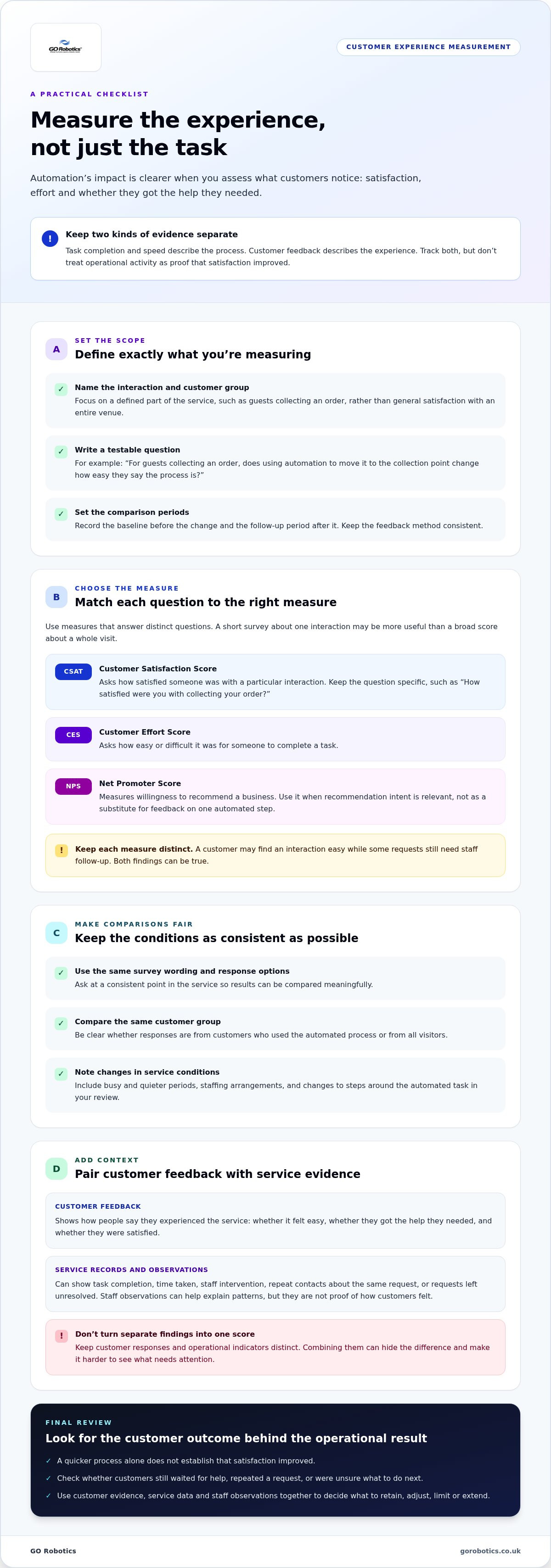
Operational measures describe what happened in the process. They might include whether a task was completed, how long it took, or how often staff had to step in. Customer feedback describes the experience: whether the service felt easy, whether the customer got the help they needed, and whether they were satisfied. Track both, but don’t treat one as a substitute for the other.
A quicker process, on its own, can’t establish that satisfaction improved. The customer may still have waited for assistance, repeated a request or been unsure what to do next. Staff observations can help explain patterns in the results. A team member might notice, for instance, that customers regularly ask for directions at a particular step. That is useful context, not proof of how customers felt. Pair it with feedback from the people using the service.
Set a clear measurement question before collecting data
Write one testable question that identifies the customer group, interaction and change. For example: “For guests collecting an order, does using automation to move it to the collection point change how easy they say the process is?” This doesn’t assume the change will help. It sets out what the evidence needs to examine.
Then record how you’ll make the comparison. Name the baseline period before the change and the follow-up period after it, and keep the feedback method consistent. Note service conditions that could affect responses, such as busy and quieter periods, staffing arrangements, or changes to steps around the automated task. If those conditions differ, include them in your review rather than treating every difference as an effect of automation.
Choose customer satisfaction measures that fit the automated service
Choose measures for the decision you need to make, not simply because they’re familiar. A short survey about a specific interaction may tell you more about an automated task than a broad score covering a customer’s whole visit. Keep questions clear, ask them at a consistent point in the service and define which customers’ responses you’ll compare.
For a hospitality venue, you might want to know whether customers found an automated delivery interaction satisfactory, easy to complete or worth recommending. These are distinct questions. A robot assisting staff with repetitive tasks may affect one part of the experience without changing how customers feel about the venue overall.
Match each measure to the customer question
Customer Satisfaction Score (CSAT) asks how satisfied someone was with a particular interaction. Customer Effort Score (CES) asks how easy or difficult it was to complete a task. Net Promoter Score (NPS) measures willingness to recommend a business, so use it when recommendation intent is relevant, rather than as a stand-in for feedback on one automated step.
Keep the question focused. “How satisfied were you with collecting your order?” is more useful for assessing that interaction than asking customers to rate their entire visit. Use plain wording, the same response options and the same collection point in each comparison period. Make clear which customer group the answers represent, such as guests who used the automated process rather than all visitors.
Combine feedback with service evidence carefully
Customer responses show how people say they experienced a service. Records can help explain what happened around that experience. Pair feedback with relevant indicators, such as repeat contacts about the same request or requests left unresolved, where those records relate to the interaction under review. Don’t assume that these indicators explain a customer’s feelings on their own.
Keep the measures distinct. A customer may report that an interaction was easy, while service records show that some requests still needed staff follow-up. Both findings can be true. Combining them into one score would hide the difference and make it harder to identify what needs attention.
| Measure type | What it tells you | Example |
|---|---|---|
| Customer-reported | What customers say about an experience | CSAT for a delivery interaction; CES for completing a collection |
| Operational indicator | What happened in the service process | Repeat contacts or unresolved requests linked to that service |
Use only measures that can inform a decision. If you’re assessing service automation in a hotel, restaurant or other venue, connect the question to a specific task and how staff and automation share it. This keeps measuring the impact of automation on customer satisfaction grounded in evidence you can act on, rather than a collection of disconnected scores. For context on service robots in venues, see the 2026 guide to hospitality robots in the UK.
For an overview of GO Robotics’ commercial service robots, visit the GO Robotics website.
Compare results fairly before and after automation
A before-and-after comparison is only useful if you know what changed besides the automation. Keep the measurement process steady, record relevant changes to the service and be cautious about attributing a difference in customer feedback to one cause. Use this sequence to make the comparison clearer.
- Define the change. Record which task is now automated, which customers encounter it and what part of their experience you’re assessing. Note any staff responsibilities that remain part of the process.
- Capture a baseline. Before the change, ask the same customer questions you plan to use afterwards. Record the collection point and service context, so you can compare like with like.
- Measure consistently. Keep the question wording, response options, timing and customer group consistent across both periods. If practical, compare similar interactions that received the change with those that did not.
- Interpret cautiously. Review customer feedback alongside changes in staffing, opening patterns and other process updates. State what the comparison can support, and where it leaves uncertainty.
Build a useful baseline and comparison
Choose a baseline period that reflects the service you intend to assess, then capture feedback before the new process begins. For a reception interaction, for example, use the same question at the same point for visitors who speak to staff before the change and for the relevant group afterwards. Where a comparable interaction remains unchanged, it can offer helpful context, though differences between the groups may still affect the comparison.
Keep a simple record of conditions in each period: staffing arrangements, opening patterns, process changes and any unusual disruption. This helps you identify where the periods differ instead of treating them as directly equivalent.
Check whether the result differs across customers
An overall score can hide different experiences. Review results by relevant journey, channel or customer group, such as visitors using reception compared with those seeking help from staff. Look for repeated comments and patterns, not just movement in an average. Keep reporting at a level that doesn’t expose personal information.
If one group reports more difficulty, check the service context before drawing conclusions. They may have encountered a different step or needed a different kind of assistance. Record that distinction so the follow-up can test a specific part of the experience rather than treating every customer response as the same.
A change in scores after automation is an observed movement, not proof that automation caused it. A consistent comparison can strengthen your interpretation, but concurrent changes or differences between customer groups may still provide another explanation. Be clear about those limits when using the evidence to guide your next decision.
Turn customer feedback into a practical automation improvement plan
Feedback is most useful when it leads to a specific action. Group comments and service records into themes, then identify which step customers struggled with and what you can change or test. This turns a general concern, such as “the service felt difficult”, into a question the team can investigate.
Useful themes might include:
- Ease: could customers work out what to do?
- Waiting: did they experience delays or uncertainty?
- Access to help: could they reach a staff member when needed?
- Successful completion: did the task end as customers expected?
Prioritise issues by considering both their effect on customers and how often they recur in feedback or service records. A repeated obstacle that prevents people completing a task may need attention before an isolated preference. Don’t create arbitrary cut-off scores. Record why the team considers an issue important and what evidence supports that judgement.
Investigate negative or mixed feedback
Trace a comment back to the step it describes. If a customer says they couldn’t get assistance, review the relevant service records and ask staff what was happening at that point. The cause may relate to the automated interaction, a separate process problem or a combination of both. Keep those possibilities distinct unless the evidence connects them.
Consider what happens when a customer needs help the automated process can’t provide. Where the service calls for it, make the route to a staff member clear and accessible. Staff observations can help pinpoint friction, but check them against customer comments or other relevant evidence before deciding what to change.
Retest changes without moving the goalposts
For each priority issue, write down the proposed action, the person responsible and what result would prompt a further review. For example, if customers are unsure how to request help, test a clearer sign or instruction at that step. Keep the original customer question and feedback collection method where possible, so the next measurement remains comparable.
Record each change between measurement rounds, including adjustments to the automated task, staff responsibilities or the wider customer journey. If several things change at once, it may be harder to tell which one relates to a difference in feedback. A small shift in responses is a reason to review the evidence, not proof that the change worked.
This measured approach helps you act on customer experience without assuming automation is always the cause or answer. As part of measuring the impact of automation on customer satisfaction, keep a simple action log with the theme, supporting evidence, planned test, owner and review finding. That record gives your team a clear basis for deciding whether to retain the change, refine it or investigate further.
GO Robotics supports businesses planning commercial service robot deployments. Read about the company’s services at GO Robotics.
Use customer evidence to decide what automation does next
Once you’ve reviewed customer feedback alongside service records and staff observations, use the combined picture to decide what should happen next. Look for agreement between the evidence sources, but don’t force them into a single score. Customers describe their experience; operational records show what happened in the process; staff can explain how the work was shared.
Robots can assist with repetitive tasks while staff continue to provide human-led service. The decision is not simply whether to keep or remove automation. You can retain the current task, adjust it, limit where it is used or extend it, depending on what the evidence supports.
Decide whether the evidence supports a change
Use the findings to choose a proportionate next step. If customer feedback is acceptable and service records and staff observations give no reason for concern, retaining the current approach may make sense. If comments point to a specific difficulty, such as an unclear handover, adjust that part and assess it again. If customers report unresolved problems or the evidence is incomplete, pause wider expansion while you investigate.
Write down why you chose that action and what evidence would prompt another review. This keeps decisions grounded in the service experience rather than in a preference for more automation or less. It also helps your team explain what it has learned and what remains uncertain.
Plan evaluation around the real service setting
Before considering equipment, define the task, the customer touchpoints and the responsibilities staff will retain. In a hotel, for instance, map where a service robot would assist with a repetitive task and where a member of staff remains responsible for helping a guest. Site mapping, installation and staff training are deployment considerations; completing them does not, on its own, show that satisfaction has improved.
Keep the service-model decision separate from the customer-outcome decision. Whether you purchase or rent a robot is a different question from whether the automated task supports a good customer experience. Your evaluation should focus on the defined service, how staff and automation work together, and what customers report.
That distinction makes measuring the impact of automation on customer satisfaction useful beyond the first review. It gives you a basis for refining the task, retaining staff involvement where it matters and deciding whether there is enough evidence to extend automation to another part of the service. The right next step may be to keep the scope as it is while you gather clearer feedback.
GO Robotics can help you assess the practical requirements of a customer-facing service robot. Find out more about its services at GO Robotics.
Put customer evidence at the centre of your next step
Your measurement plan can do more than assess a new automated task. It can help you shape how that task fits into the service your customers and staff rely on, and give you a reasoned basis for deciding what to test next. Keep the customer experience as your reference point as the service develops.
For commercial service robots, the practical details matter too. GO Robotics provides UK-wide supply, installation, integration and support, with site surveys and staff training as part of its deployment approach. These steps help define how a robot and your team will share tasks in your setting. They don’t replace the need to assess customer feedback once the service is running.
Use measuring the impact of automation on customer satisfaction to keep decisions connected to the people using your service. Start with the interaction you want to improve, then build your next step around what customers experience and what your team sees in practice.
Talk to GO Robotics about planning a customer-facing service robot deployment.
Frequently Asked Questions
What is the best way to measure automation’s impact on customer satisfaction?
Start with the decision the results need to support, such as whether to change a handover or keep a task in its current form. Then make feedback easy to give immediately after customers complete that interaction, including a way to explain their rating in their own words. When measuring the impact of automation on customer satisfaction, check who responded as well as what they said, since feedback from one type of customer may not represent everyone.
Can automation improve customer satisfaction while keeping human support?
Yes. Automation can take on a defined, repetitive task while staff remain responsible for situations that need judgement, reassurance or a personal response. Make that division clear in the service design: customers should know how to reach a person, and staff should know when to take over. The right balance depends on the interaction, so review handovers as part of the service rather than treating them as exceptions.
How long should a business measure customer satisfaction after introducing automation?
Measure for long enough to include the operating conditions that could change the experience, rather than stopping after an initial run. A service affected by seasonal demand, events or changing routines may need a longer observation period than a steady process. Set a review point in advance, then continue gathering evidence if the period misses important conditions or feedback remains too limited to guide a decision.
What data should be included when measuring automation and customer satisfaction?
Keep a record that lets you understand each response in context without collecting unnecessary personal details. Useful fields may include the interaction type, channel, whether automation completed the task, whether a staff member took over and the outcome recorded by the service team. Add a short free-text response option so customers can describe an issue that fixed-choice answers might miss. Limit access to the information to people reviewing the service.
How can a business compare automated service with human service fairly?
Take care with interactions where a staff member steps in part-way through. Record these as assisted or handed-over cases rather than labelling them as fully automated or entirely staff-led. That distinction helps you see whether customers’ experience changes when a person becomes involved. Also avoid comparing a simple automated request with a complex request handled by staff, since differences in task difficulty can shape the outcome.
Is customer satisfaction score enough to judge automation?
Not on its own. An average score can conceal a split in experience, with some customers rating the service well and others encountering difficulty. Review the spread of responses and the number of people who provided feedback, not just the headline figure. If the average changes but the pattern of ratings or the types of respondents also shift, note that before making a decision about the automated task.
What should a business do if satisfaction scores improve but complaints increase?
Check whether the survey and complaints represent the same customers and parts of the service. People who choose to complete a survey may differ from those who make a complaint, and complaint themes may point to a problem affecting a smaller group. Sort complaints by issue and stage, then review whether they concern the automated task, the handover or another service matter. Address unresolved issues before treating the higher score as a clear success.