Innovative guest experience ideas for hotels: practical ways to make every stay memorable
A memorable hotel stay doesn’t need more technology at every touchpoint. It needs thoughtful service that makes things easier for guests while leaving room for genuine contact with staff. The best innovative guest experience ideas for hotels fit the way your venue works and respond to what guests actually value.
You may be balancing requests for quicker, more convenient service with the personal welcome that brings guests back. New ideas need to work during a busy shift and suit different types of stay. Technology should support useful interactions, not get in the way.
This article explores practical ways to improve arrival, service and dining, from simple personal touches to guest-facing robotics in hotel restaurants, lounges and banqueting. Match each idea to your venue and guests, then trial a change and gather feedback from staff and guests. Start with one improvement that feels useful, manageable and true to your service style.
Key Takeaways
- Choose innovative guest experience ideas for hotels that address a real point of friction and fit the way your team serves guests.
- Consider each stage of the stay, from clear pre-arrival information to simple ways to request help and a considerate departure.
- Match staffed service, digital self-service and assisted delivery to the guest’s needs and the setting, including restaurants, lounges and banqueting.
- Assess guest groups, accessibility, service style and staff workflows before selecting an idea to trial.
- Run a focused pilot, brief your team, gather guest and staff feedback, then refine the change before widening its use.
What makes an innovative guest experience idea worthwhile for a hotel?
Unclear arrival information, a wait at reception or uncertainty about how to ask for help can create friction before a guest has settled in. Later, confusing wayfinding or an unanswered request may shape their impression of the whole stay. Useful innovation starts by noticing these moments, not by adding technology simply because it’s new.
A worthwhile idea improves a real guest interaction and fits the way your team delivers service. That might mean making essential information easier to find, offering a more convenient way to make a request or helping staff manage a routine task. Judge an idea by whether it works for your guests and your hotel, not by how impressive it sounds.
Where do guests notice friction during a hotel stay?
Map the experience from pre-arrival planning through departure and any post-stay communication. Note where guests need clearer information, better wayfinding, less waiting or easier access to assistance. Small details, such as explaining where to find a facility or how to contact the team, can make a stay feel more welcoming without requiring a major change.
Hotels are one part of the wider hospitality industry, but every venue has its own guests, service style and pinch points. A business traveller arriving late may need different information from a family planning a meal or a delegate attending a function. Review the journey from each guest’s perspective before deciding what to improve.
How can hotels keep new ideas useful and human?
Assess each idea against three practical tests: is it useful to guests, manageable for staff and a good fit for your service style? A digital request option, for example, may suit guests who prefer to handle simple tasks themselves, while others will value speaking directly with a team member. Keep both routes clear where possible.
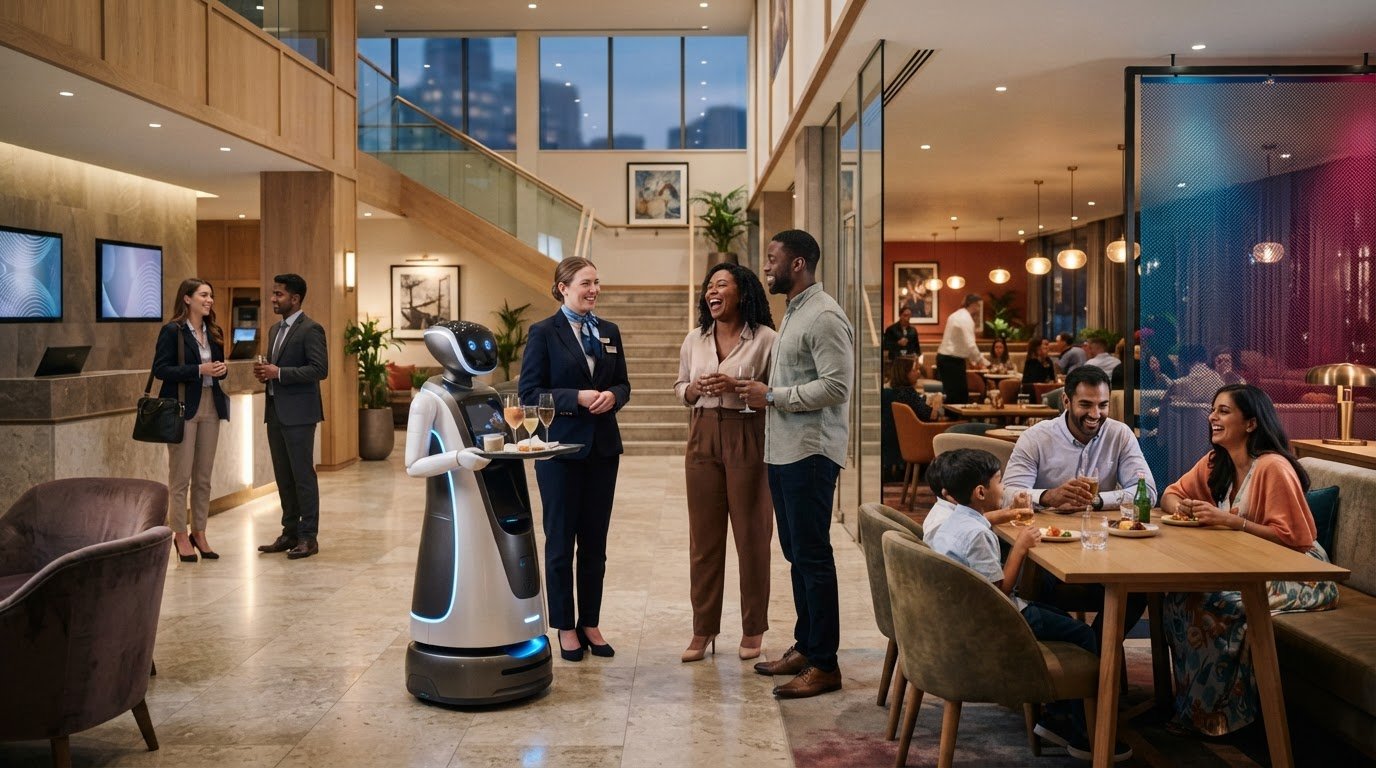
Technology should support staff interactions, not replace them. A guest-facing robot could assist with delivery in a hotel restaurant, lounge or banqueting area, while staff remain available to welcome guests and respond to individual needs. It’s one option to assess, not a prescription for every venue.
The ideas in this guide cover arrival, personalisation, service, dining and follow-through. Treat them as starting points: identify a guest moment that needs attention, then consider a change your team can deliver consistently. Memorable improvements often begin with a practical detail and a clear understanding of your guests.
Personalise the hotel stay before arrival, at check-in and beyond
Personal service starts before a guest reaches reception. Clear, relevant information can reduce uncertainty, while a choice of ways to ask for help lets guests decide how much interaction suits them. The strongest innovative guest experience ideas for hotels respond to what a guest needs at each stage, rather than assuming everyone wants the same welcome.
What can hotels tailor before a guest arrives?
Send concise arrival guidance that answers practical questions: how to reach the hotel, where to find access information, what facilities are available and how to contact the team. Keep details current, especially if services or opening arrangements change. Guests can then find the essentials without searching across several channels.
You can invite guests to share relevant preferences, such as a dietary requirement or a preferred way to receive information. Explain why you’re asking, make sharing optional and handle responses respectfully. A preference helps only if staff can act on it, so avoid collecting details without a clear purpose.
Which small touches can improve the stay itself?
At check-in, a warm welcome and a clear explanation of how to get assistance may be more useful than a scripted presentation of every facility. During the stay, make service options easy to find, whether guests prefer speaking to staff, using a digital request channel or consulting an in-room guide. Offer choice and keep a human route available.
Tailor service to the guest’s cues. Someone arriving late may appreciate concise directions to available food, while a guest celebrating a special occasion may welcome a personal message if they’ve shared the reason for their visit. These touches work best when they feel appropriate, not automatic. Harvard Business Review explores the emotional drivers of customer loyalty, a useful reminder that how a service makes someone feel can matter as much as the task it completes.
Local recommendations can add value when your team can keep them accurate. A short, checked list of places to eat or things to do is more useful than a long guide with outdated opening details. Match suggestions to likely guest needs and make the list easy for staff to update.
- Before arrival: share directions, access details, facility information and contact options.
- At check-in: explain the essentials and ask whether the guest needs anything specific.
- During the stay: make requests and assistance easy to find, with a choice of contact methods.
- At departure: offer a straightforward way to raise a final question or share feedback.
Follow-through matters. If a guest mentions a preference, make sure the relevant team can see and act on it, and avoid asking them to repeat information unnecessarily. If you’re considering a guest-facing robot as one service option, you can explore hospitality robotics with GO Robotics and assess whether it fits your venue and service style.
Make hotel dining and service more engaging without losing human contact
In a hotel restaurant, lounge or banqueting space, guests may want different kinds of service. One might appreciate a quick answer about the menu, while another would rather speak with a member of staff. Offer options and keep staff available for the moments that need personal attention.
Staffed service is best placed for conversation, recommendations and requests that need judgement. Digital self-service can make routine information or simple requests easier to access, provided guests can still ask a person for help. Assisted delivery is another option for moving items within a venue. Choose according to the task, setting and guest preference, not simply because a method is new.
Deloitte’s hotel guest experience report offers broader context on combining hospitality with technology. For your team, the practical questions are how a tool fits the service already offered, who monitors requests, who helps if a guest is unsure and how staff remain easy to reach.
These checks matter in dining spaces, where routines differ between a restaurant table, a lounge and a banqueting event. Self-service might suit a straightforward request, while a staff member remains the right contact for a dietary question or an order change. Make the available choices visible and brief the team on how to support each one.
How could a delivery robot fit a hotel service moment?
BellaBot Pro is one optional guest-facing example for hotel restaurants, lounges and banqueting. It can assist staff with delivery-related tasks while team members continue to welcome guests and handle requests that call for personal attention. Its suitability depends on your layout, service routines and the tasks you want it to support. For premium and themed restaurants, the robot can become part of the experience.
Its five interaction modes are greeting, lighting, voice, ear-touch and back-touch. Its triple-redundant navigation system combines Vision SLAM, LiDAR SLAM and marker positioning. SLAM means simultaneous localisation and mapping, a technology that helps a robot build a picture of its surroundings and navigate. Consider these product details alongside the day-to-day service plan, not as a reason on their own to introduce a robot. Specifications are indicative and subject to change as products are updated.
Before choosing assisted delivery, map the hand-off: how staff prepare and load items, where delivery takes place, and who steps in if a guest needs help. BellaBot Pro is a Pudu Robotics product supplied and supported in the UK by GO Robotics AI Ltd. Support includes a free site survey and written recommendation, installation, mapping, commissioning, on-site staff training and documentation. For product-specific evaluation, consult its BellaBot Pro buying guide.
For further details, contact Geoff Stillman, Sales Director: Geoff Stillman - Email: geoff@gorobotics.co.uk - Mobile: 07826 286001 - Phone: 01285 414561. All trademarks belong to their respective owners.
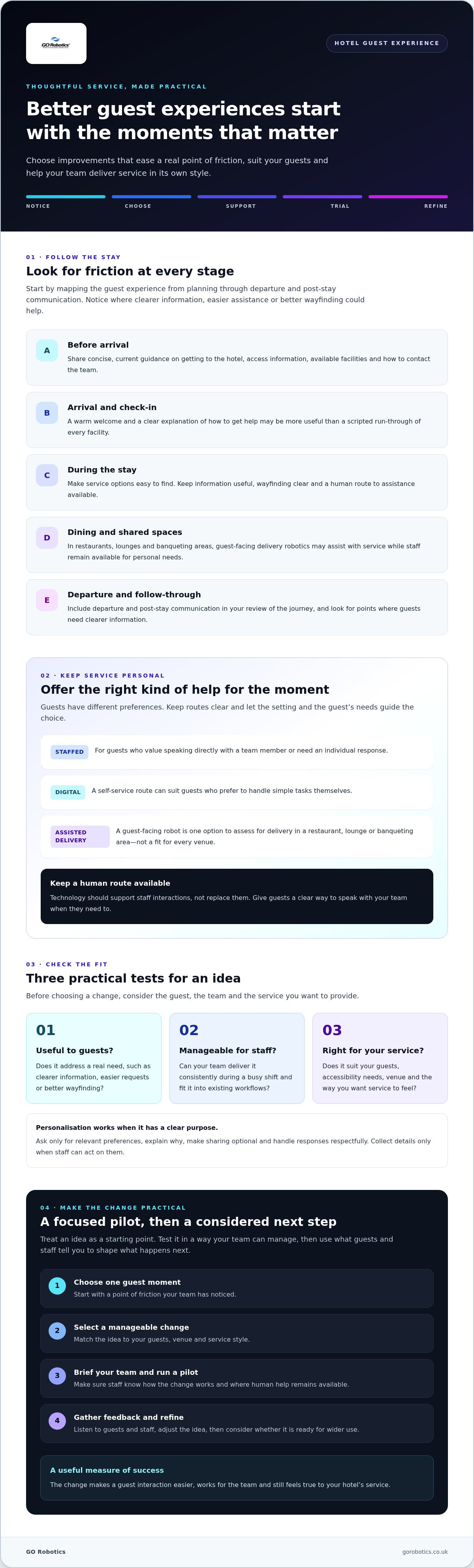
Choose hotel guest experience ideas that fit your guests and operation
An idea can sound appealing and still be awkward to deliver on a busy shift. Before adopting it, connect it to a specific guest need, check how it fits your service and staffing, then test it on a manageable scale. This gives you a practical way to compare innovative guest experience ideas for hotels without treating every new option as a must-have.
How should a hotel shortlist ideas?
Start with a guest moment, not a product or feature. If guests struggle to find help, for example, consider whether clearer signs, a better service menu or an easier way to contact the team would address the problem. Then check whether staff can explain the change, support it during busy periods and keep any information up to date.
Consider who uses the service and how. Guests may have different communication preferences, mobility needs or levels of familiarity with your venue. Ask whether the idea is easy to access and whether an alternative remains available for someone who doesn’t want, or can’t use, a digital option. A good shortlist reflects your guests, not an imagined average visitor.
What should a hotel check before a trial?
Some ideas need a staff-process update; others may need technology or supplier input. Make that distinction early. A revised arrival message might only require an agreed owner and a process for keeping details current. A guest-facing robot needs a closer look at the proposed setting, task, staff hand-offs and how guests will get assistance.
Before trying any change, agree:
- The need: Which guest moment are you trying to improve?
- The setting: Where will the change happen, and what practical access considerations apply?
- The workflow: Which staff members will explain, monitor or maintain it?
- The guest information: How will people know what to do and where to turn for help?
- The review: What will you ask guests and staff after using it?
Keep review questions open and useful. Did guests understand the new option? Could staff support it alongside their usual duties? Where did people hesitate, ask for help or choose another route? Collect comments and staff observations, then decide whether to adjust, continue or stop the trial. You don’t need to invent a target in advance; you need clear questions that help your team judge whether the change works in practice.
If you’re assessing a robot for a hotel setting, ask for a site assessment and written recommendation before making a decision. GO Robotics supplies and supports BellaBot Pro in the UK, with installation, mapping, commissioning and on-site staff training. Discuss a hotel robotics assessment to explore whether it suits your venue and service routines.
Turn a promising hotel guest experience idea into a practical pilot
A small, well-planned trial can show whether a change works for guests and staff before you make it part of your usual service. Start with one guest moment and one clear need. Brief the team, run the trial in the intended setting, collect feedback and refine the approach based on what happens.
How can a hotel review a guest experience pilot?
Before the trial, agree what you want to learn. Ask guests whether the new option was easy to understand and use, and ask staff whether it fitted the service routine. Note where people needed help, chose another option or raised questions. These observations can be more useful than a general comment that the idea was “good” or “bad”.
Compare what you hear and see with the original guest need. If the idea addressed that need but caused confusion elsewhere, consider changing the instructions, workflow or setting. Then decide whether to adjust, continue or stop. Base the decision on your hotel’s findings, without assuming that one trial will suit every guest group or service period.
What support can GO Robotics provide for a BellaBot Pro discussion?
If your trial involves a guest-facing robot, include staff in the planning from the outset. For a hotel restaurant, lounge or banqueting area, think through the task it would assist with, where staff hand over items and how guests can ask for help. The robot supports the team with tasks; it doesn’t replace the welcome or judgement staff provide.
GO Robotics supplies and supports BellaBot Pro in the UK. Support includes a free site survey and written recommendation, installation, mapping and commissioning, plus on-site staff training and documentation. UK-based support, diagnostics and warranty are also provided. A site assessment can help establish whether the intended setting and workflow are suitable; it doesn’t mean every model will be right for every venue.
Use this same process to assess innovative guest experience ideas for hotels: define the moment, brief staff, trial the change, gather feedback and refine it. If BellaBot Pro is one option you’re considering, you can discuss a hotel service demonstration with GO Robotics and decide whether a closer assessment makes sense for your venue.
Geoff Stillman - Email: geoff@gorobotics.co.uk - Mobile: 07826 286001 - Phone: 01285 414561.
All trademarks belong to their respective owners.
Make your next guest experience improvement count
The most useful innovative guest experience ideas for hotels begin with a real guest need and fit the way your team works. Clear information, thoughtful personal touches and service options that keep staff accessible can all help make a stay feel more welcoming. Start with one practical change, brief your team, then use guest and staff feedback to decide what to refine.
If you’re considering BellaBot Pro for a hotel restaurant, lounge or banqueting space, GO Robotics can support your evaluation with a free site survey and written recommendation. Support also includes installation, mapping, commissioning, on-site staff training and documentation, plus UK-based support, diagnostics and warranty.
Discuss a hotel guest experience demonstration to explore whether this option fits your venue. Geoff Stillman - Email: geoff@gorobotics.co.uk - Mobile: 07826 286001 - Phone: 01285 414561.
Choose a change that serves your guests and works for your team. Thoughtful progress can start with one well-chosen idea.
Frequently Asked Questions
What are innovative guest experience ideas for hotels?
Useful ideas improve a recognisable moment in the stay, rather than adding novelty for its own sake. Examples include clear arrival details, tailored recommendations guests have chosen to receive, straightforward ways to ask for help or assisted delivery in dining areas. The best innovative guest experience ideas for hotels reflect the venue’s guests and service style. Start with one need, then decide whether a staff-led change, digital option or assisted service fits.
How can a hotel personalise a guest’s stay?
Use information guests choose to share to make relevant service easier to access. You could offer clear arrival guidance, explain facilities that match their plans or suggest suitable places to eat. Keep preference-sharing optional and explain how it helps the team respond. Let guests correct what they’ve shared, and don’t assume everyone wants the same recommendations, level of contact or personal touches.
Can technology improve the hotel guest experience?
Yes, technology can help guests find information or request a service if it addresses a real need. It should also fit staff workflows and leave a clear route to personal assistance. Before introducing a tool, decide what it will do, who will support it and how guests can get help. Then gather guest comments and staff observations to assess whether it’s useful in practice.
Is a hotel service robot suitable for every hotel?
No, a robot won’t suit every venue or service routine. Consider the hotel’s layout, guest expectations and the task staff would want it to assist with. Ask a supplier about site assessment, installation, staff training and ongoing support, then assess whether the proposed use fits a specific service moment. A demonstration can help you explore suitability, but it isn’t proof that the idea will work for your hotel.
How can hotels make dining feel more memorable for guests?
Make the dining experience clear, welcoming and consistent with your hotel’s service style. Helpful staff, easy-to-understand menus and simple ways to request assistance can all contribute. You might also consider guest-facing delivery or an interactive element, provided it supports the team and suits the setting. Think about the guest’s reason for visiting, whether they’re dining in a restaurant, relaxing in a lounge or attending a function.
What is a practical way to test a new hotel guest experience idea?
Choose one guest moment and state what you want to learn. Brief the staff involved, explain the change to guests where appropriate, then gather feedback during the trial. Ask whether the idea was clear and useful, and note how it fitted the team’s workflow. Review those comments and observations against the original need, then decide whether to adjust, continue or stop the trial.