Pudu CC1 Cleaning Robot in the UK: A Practical Buyer’s Guide
A product page can describe a robot, but your cleaning priorities, floor plan and working routines determine whether it fits your venue. If you are considering the Pudu CC1 cleaning robot in the UK, start by defining the work you need it to support and the conditions in which it would operate.
This guide sets out a practical way to assess the CC1, compare it with your current cleaning approach and plan a deployment. It covers the information to gather about your site, how to assess product details and how to prepare your team. GO Robotics supplies the Pudu CC1 and supports commercial robot deployments across the UK, including site assessment, installation, mapping and staff training. You can also discuss purchase and Robots-as-a-Service arrangements as part of your planning.
Key Takeaways
- Begin with the cleaning tasks, floor areas and routines you want the Pudu CC1 to support.
- Assess product information against your site requirements, and keep details about different models or variants separate.
- Compare manual routines, existing equipment and a possible robotic approach against the same tasks.
- Plan routes, operating times, staff responsibilities and training before deployment.
- GO Robotics supplies the Pudu CC1 and can support site assessment, installation, mapping, training and ongoing technical support. Purchase and Robots-as-a-Service arrangements are available.
What the Pudu CC1 cleaning robot is designed to help businesses assess
The Pudu CC1 is a commercial cleaning robot that businesses can assess for fit with their floor-cleaning tasks, venue layout and team routines. To make a sound decision, identify the work you want it to support and compare that requirement with information specific to the CC1. A general description of commercial cleaning robots is not a substitute for checking the named model.
A useful assessment starts with your site rather than a list of features. Record which areas need cleaning, how often they need attention, when they are accessible and how work is organised around customers, residents or other staff. For background on the manufacturer, see Pudu Robotics.
Which commercial cleaning tasks should buyers assess first?
List your regular floor-cleaning duties by area. Separate routine work from occasional tasks and specialist jobs, since they may call for different equipment or staff input. For example, a recurring clean of a corridor is not the same requirement as detailed edge work or a one-off spill response. Treat these as prompts for your site assessment, not as claims about the CC1.
- List the areas that need regular floor cleaning.
- For each area, record the task, how often it is done and when the space is available.
- Identify occasional cleaning, specialist work and tasks that require staff judgement.
Next, decide what role a robot could play alongside your team. Staff continue to manage work outside the robot’s assigned tasks and respond to changing conditions. A practical plan defines which routine duties may be suitable for the robotic approach, who coordinates its use and where human attention remains necessary.
Why model identity matters when researching the Pudu CC1
Check the exact product name on each page, video or specification sheet you use. The Pudu CC1 and CC1 Pro are distinct model names, so keep information about each one separate. The same principle applies to specifications or capability claims from other cleaning robots.
For every detail that influences your decision, note which model it describes and where the information comes from. This simple step helps prevent a comparison assembled from mixed product details. You can then assess the CC1 against your venue’s needs using model-specific information and a clear description of the work you expect it to support.
How to assess Pudu CC1 claims without relying on a feature list
A specification becomes useful when you can connect it to an operating requirement. Begin with your tasks, floor plan, operating hours and preferred working arrangements. Then compare information about the CC1 with those requirements, paying attention to what a stated capability means for your actual cleaning routine.
Keep a short assessment record. For each product detail, write down the source, the model it refers to, any stated conditions or limitations and the site requirement it may address. This gives your team a common basis for discussion and makes it easier to identify unanswered operational questions before deployment.
- Cleaning tasks: Which routine floor-cleaning jobs need support, and in which areas?
- Floor plan: What routes connect those areas, and where are access points or transitions?
- Working hours: When can cleaning take place without disrupting normal venue activity?
- Operating arrangements: Who will coordinate use, and how will it fit around staff routines?
Professional service robots are receiving wider attention in business settings; the International Federation of Robotics discusses this in its overview of professional service robots and their use in everyday operations. That wider context can help explain why organisations are considering automation, but it does not tell you whether the CC1 fits your venue. Your decision should rest on the needs of your site and information about the specific model.
What should CC1 product documentation make clear?
Look for information that clearly names the Pudu CC1 and describes the function or specification being presented. Check any operating conditions and limits included with the claim, and record how it relates to your assessment. Attribute technical details to the manufacturer or the named document they come from. Avoid filling gaps with assumptions or details taken from another model.
Information about the named model helps you assess that model. A general product-family statement does not establish that the same detail applies to the CC1.
How to avoid confusing Pudu CC1 and CC1 Pro claims
Before using a product page, specification sheet or demonstration to inform your decision, check the model name it identifies. A demonstration of the CC1 Pro should not be treated as evidence about the CC1. Keep product details and figures from different models in separate notes so they cannot be accidentally combined.
Once you have gathered model-specific information, compare it with your site requirements. GO Robotics can help you assess the venue and plan deployment, including site mapping and staff training. Explore venue assessment support as a next step.
Compare the Pudu CC1 with your current commercial cleaning approach
Compare approaches against the same jobs, rather than assuming a robot will suit every floor or cleaning routine. Include your current manual process, any floor-care equipment already in use and a possible robotic approach. For the CC1, use information specific to that model and record which tasks would remain with staff.
| Area to compare | Manual routines | Existing equipment | Robotic approach |
|---|---|---|---|
| Task coverage | Staff carry out the tasks assigned in the cleaning routine. | Coverage depends on the equipment and tasks it is used for. | Match documented CC1 functions to the tasks you need covered; note any gaps. |
| Scheduling | Work is organised around staff availability and venue activity. | Use is planned around access, staff routines and equipment availability. | Compare the venue’s cleaning windows with the CC1’s documented operating arrangements. |
| Staff interaction | Staff complete the work and adapt as conditions change. | Staff operate the equipment and handle work outside its intended use. | Plan how staff will coordinate with the robot and manage tasks it doesn’t cover. |
| Site fit | Staff can adjust their approach to room changes and obstacles. | Suitability depends on the equipment and the spaces it can be used in. | Assess floor surfaces, transitions, routes and obstacles against CC1-specific documentation. |
| Management | Supervisors organise tasks and review completed work. | Teams manage equipment use and upkeep as part of the routine. | Identify who will plan, monitor and respond during the robot’s scheduled work. |
Which venue requirements should shape the comparison?
Walk the areas in your proposed cleaning routine and record floor surfaces, transitions, obstacles and access constraints. An open floor and a busy shared route can present different practical demands. Note what you observe, then compare it with information about the CC1 and your planned routes as part of the site assessment.
Compare your cleaning schedule with the operating arrangements described for the product. Mark duties that still call for staff judgement, follow-up or specialist equipment. This can include detailed edge work or any task outside the model’s documented scope. A clear list of these requirements helps prevent a deployment plan from overlooking work the team must continue to do.
How should managers compare operational fit?
Decide when cleaning can take place, how staff will coordinate around it and who will monitor the plan. Set out how the team will respond if the routine needs attention, and how supervisors will review whether the planned work is being completed as intended. These are practical considerations in automation in facilities management, but they do not establish a result for a particular model. CBRE UK’s discussion provides broader context, not evidence of CC1 performance.
Assess the Pudu CC1 against your own tasks, layout and working practices. A manual routine, existing machine or robotic approach may each suit different parts of the same building. Base your decision on documented fit and a realistic division of responsibilities, rather than assuming productivity gains or savings without evidence that applies to your site.
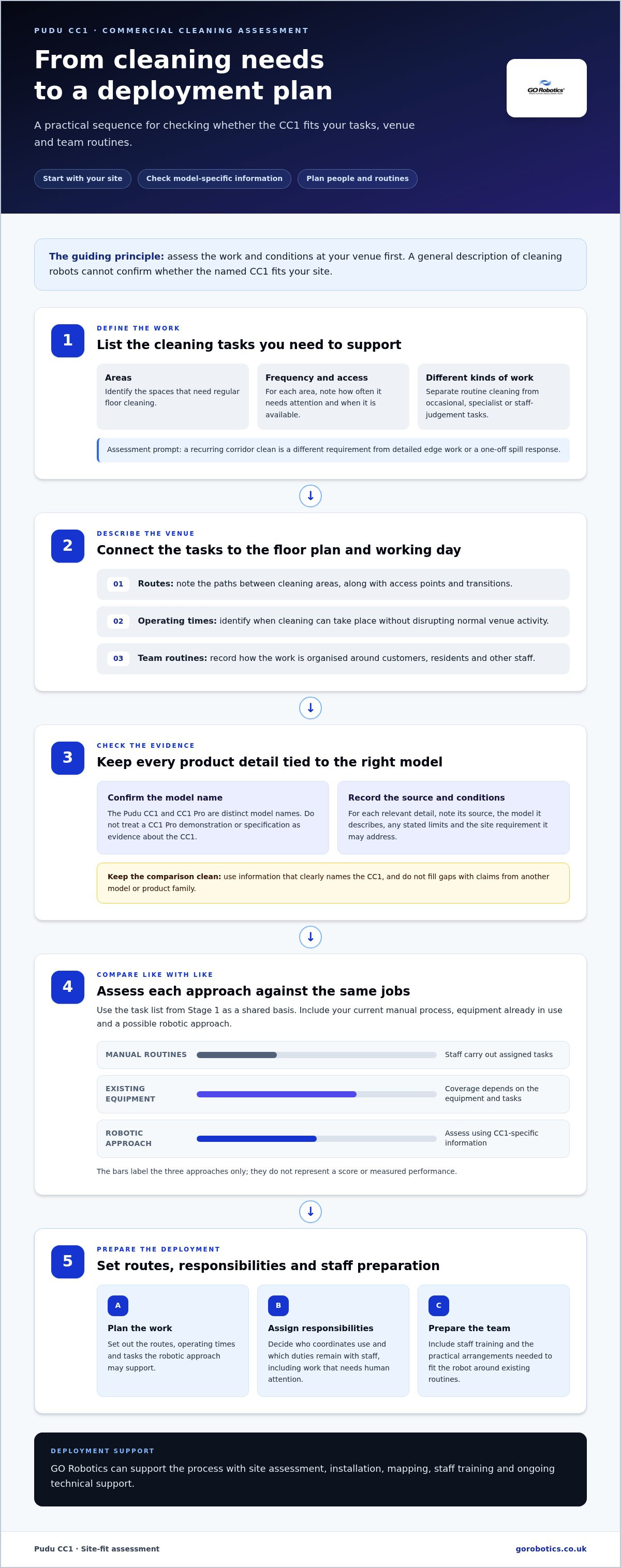
Plan a Pudu CC1 deployment around your venue and cleaning team
Build the deployment plan around your cleaning routine, venue layout and team workflow. Assessing the Pudu CC1 cleaning robot in the UK means relating product information to the building and the work you want done. A site assessment brings these operational details together before you decide how to introduce the robot.
GO Robotics supplies commercial cleaning robots and can support planning for the Pudu CC1. If you are comparing the wider category, read our guide to commercial cleaning robots for businesses. For a CC1 deployment, keep the assessment focused on the named model and your site requirements.
What happens during a commercial robot site assessment?
A site assessment records the areas you want included, access routes, cleaning priorities and normal venue routines. It should also capture practical constraints, such as transitions, obstacles and times when spaces are busy or unavailable. These details help shape a plan around the work your team needs done.
Site mapping creates a digital layout of a venue to support robot navigation. In deployment planning, the mapped areas and routes help relate the building to the proposed work. Mapping is one part of the assessment, alongside checking that your requirements match information about the CC1 and identifying where staff input or other equipment remains necessary.
How can teams prepare for day-to-day use?
Choose who will receive training, coordinate routine use and monitor how the plan is working. Make sure staff understand the robot’s documented operating limits, which tasks remain their responsibility and how to raise an issue through the agreed support process. Technical support is part of deployment planning, while clear ownership within your team remains essential for day-to-day use.
Use a clear planning sequence
- Define the cleaning need. List routine tasks and the areas they cover.
- Record the site conditions. Note relevant floors, routes, access points, obstacles and venue routines.
- Match needs to information. Compare your requirements with CC1-specific product details and identify any gaps that need resolving in the plan.
- Plan the team workflow. Set cleaning times, staff responsibilities, training needs and an escalation route.
- Review the arrangement. Check whether the planned tasks and routes suit the venue in practice, then adjust the routine where needed.
This sequence grounds the decision in your building and your team. GO Robotics supports UK deployments with site assessment, installation, site mapping, staff training and ongoing technical support. Plan a Pudu CC1 site assessment with GO Robotics to discuss your venue’s requirements and the proposed deployment.
Explore the Pudu CC1 with GO Robotics and choose a clear next step
A useful recommendation connects four things: the cleaning tasks you need covered, information specific to the Pudu CC1, your venue layout and the way your team works. A product description alone cannot assess all four. The next step is to bring your site requirements and routine into the discussion.
What support can buyers expect during deployment?
GO Robotics supports commercial robot deployments across the UK, from site assessment and planning through installation and ongoing technical support. Site mapping records relevant areas and routes to inform deployment planning. The proposed tasks should also be compared with information about the CC1, so the plan reflects the named model and your requirements.
Staff training helps your team understand routine use, responsibilities and the product’s documented operating limits. Decide who will coordinate use, monitor the arrangement and raise issues through the agreed support process. Your staff remain involved in day-to-day routines, with technical support available as part of deployment support.
How should a business take the next step?
Bring a practical picture of your venue to the discussion. List the floor areas and tasks you want to address, when those spaces are available and any layout or workflow constraints that could affect cleaning. This gives GO Robotics a useful basis for a site assessment and a recommendation shaped around your requirements.
GO Robotics offers purchase and Robots-as-a-Service arrangements for commercial robots. Discuss how you prefer to acquire and manage the equipment alongside the operational assessment. The right arrangement depends on your organisation’s requirements, while the assessment should still focus on task fit, venue layout and team workflow. For background on the wider category, read our guide to commercial floor-scrubbing robots. It complements this CC1-specific assessment rather than replacing it.
Talk to GO Robotics to discuss your venue, cleaning routine and the next steps towards a site-specific Pudu CC1 recommendation.
Make your next cleaning decision with confidence
Assess the Pudu CC1 against your venue’s floor-cleaning tasks, layout and staff routines, rather than relying on a feature list alone. Keep product details tied to the model they describe, and compare the proposed robotic role with your existing approach. This gives you a practical basis for deciding whether the Pudu CC1 cleaning robot suits your operation.
GO Robotics can help you assess your site and plan deployment, including installation, site mapping and staff training across the UK. You can also discuss purchase or a Robots-as-a-Service arrangement. A site-specific recommendation should reflect your requirements and support the way your team works each day.
Talk to GO Robotics about a site-specific recommendation. Start with your cleaning priorities and venue layout, and plan the next step with your team in mind.
Frequently Asked Questions
What is the Pudu CC1 cleaning robot used for?
The Pudu CC1 is a commercial cleaning robot for businesses to assess as part of their floor-cleaning routines. Start by listing the areas and recurring tasks you want it to support, then compare those requirements with information specific to the CC1. Also identify the work that will continue to need staff attention, such as tasks requiring judgement or follow-up.
How do I know whether the Pudu CC1 suits my venue?
Compare your cleaning tasks, floor plan, operating hours and staff workflow with information about the CC1. Record floor surfaces, transitions, obstacles and access routes, then identify any requirements that need more planning. A site assessment can help relate those needs to deployment planning. Base your decision on the fit between the model, the work and your venue.
Is the Pudu CC1 the same product as the Pudu CC1 Pro?
No. The Pudu CC1 and Pudu CC1 Pro are different model names. Do not assume that a feature, specification or demonstration shown for the Pro also applies to the CC1. Check the exact model identified in any product page, video or document, and use CC1-specific information when assessing the standard CC1 for your venue.
Can a commercial cleaning robot work alongside a cleaning team?
Yes. A commercial cleaning robot can be assessed for suitable routine tasks while staff continue to handle work requiring judgement, follow-up or specialist equipment. Plan who will coordinate its use, how the tasks fit around the cleaning schedule and what staff should do if the routine needs attention. A robot assists the team; it should not be treated as a replacement for staff.
What should I assess before introducing a cleaning robot at work?
List the floor-cleaning tasks, areas and routines you want to assess. Review the venue layout, floor surfaces, routes, transitions, obstacles and the times each area is available. Compare those requirements with information about the exact model, and include staff responsibilities, training needs and how you will review the plan once it is in use.
How does GO Robotics support commercial robot installation in the UK?
GO Robotics supports UK-wide commercial robot deployments with site assessment, installation, site mapping, staff training and ongoing technical support. The process connects your cleaning requirements and venue layout with a deployment plan. Training helps staff understand routine use and responsibilities, while the proposed use is planned around information specific to the model.
Can a business use Robots-as-a-Service for a cleaning robot?
Yes. GO Robotics offers Robots-as-a-Service (RaaS), a monthly rental arrangement, as well as purchase options for commercial robots. You can discuss the arrangement that suits your organisation alongside the site assessment. Review the relevant package details before deciding, and assess the cleaning tasks and venue layout regardless of the arrangement you choose.