Pudu HolaBot UK: Is This Collection Robot Right for Your Venue?
A collection robot only earns its place when it fits the route your team already follows. When assessing Pudu HolaBot UK, start with the work it would handle, not just its carrying capacity.
In a busy restaurant, hotel or care setting, collecting used items can take staff away from guests and other duties. Before changing a routine, map where items gather, where they need to go and who is responsible at each hand-off. These details help you decide whether a collection robot belongs in the process.
GO Robotics supplies Pudu HolaBot to UK businesses. This guide sets out a practical way to assess the collection task, compare it with manual collection and delivery work, and prepare for a discussion about your venue. The focus is on workflow fit: what needs moving, how people share the route and what your team would need to manage.
Key Takeaways
- Start with a specific collection task and map its starting points, destination, route and hand-offs.
- Compare your actual collection loads and handling routine with the product configuration discussed for your venue.
- Assess manual collection, collection-focused work and delivery tasks separately, because each involves different routes and responsibilities.
- Include staff, guests, shared spaces, access and exceptions in your site assessment.
- Bring a workflow map and a list of practical questions to a discussion with GO Robotics.
Pudu HolaBot UK: What collection work is it designed to support?
During a busy service, staff may be greeting guests, taking orders and clearing used crockery at the same time. If collection pulls someone away from the room, other tasks can wait. Start by identifying where items accumulate, who moves them now and where they go next.
HolaBot is a Pudu Robotics product available from GO Robotics. To assess whether it suits your operation, define the collection job rather than relying on the model name alone. For example, list the items involved, the points they need to travel between and the people who take responsibility during the process.
A collection robot is assessed for work that gathers items from collection points and moves them onwards. This is different from assuming that any particular task can be completed without staff involvement. A service robot is used to perform tasks outside industrial manufacturing, but that broad category does not establish whether a specific model fits your building or routine.
How does a collection robot differ from a delivery robot?
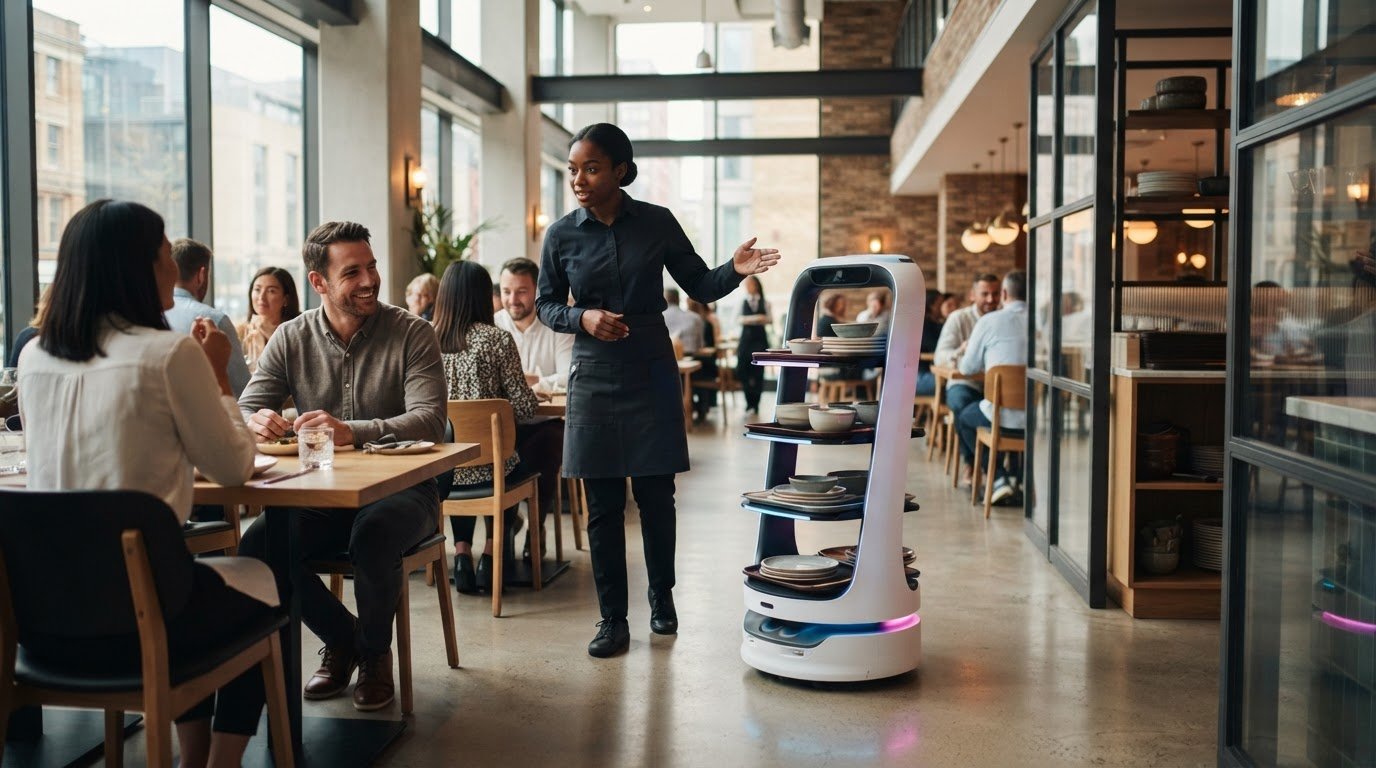
Compare the direction and purpose of the work. Collection brings items together from places where they have been used, such as tables. Delivery moves items towards a destination, such as from a service point to a dining area. One venue may have both kinds of task, but the routes and hand-offs are different.
For table collection, record where used crockery is gathered and where staff take it afterwards. For delivery, map the route from the preparation point to the person receiving the items. In either process, identify who loads and unloads, who handles exceptions and where a staff member needs to make a judgement. This gives you a like-for-like basis for comparing the tasks.
Which venue workflows might make HolaBot relevant?
Begin with the collection points. In a restaurant, note where cleared dishes build up, how staff carry them away and whether those movements interrupt other duties. Then identify the destination and who handles each hand-off. A specific route gives you something practical to assess, rather than assuming that a robot will reduce workload simply because it is being considered for collection work.
For a hotel or care setting, use the same method for the items and locations involved. Separate routine collections from tasks that need a staff member to check the item, choose where it goes or speak with a guest or resident. The distinction helps you identify which parts of the process are suitable for assessment and which remain people-led.
For Pudu HolaBot UK, define the task in plain terms: what needs gathering, from which points, and where it goes next? Keep that workflow separate from assumptions about speed, staffing or results. It will help you judge whether the collection role matches a real need in your venue.
Pudu HolaBot features: what the supplied product information actually says
When comparing a robot with your current process, separate confirmed product details from the requirements of your venue. Start with the details that affect the work: the carrying arrangement, how items are loaded and unloaded, and how the robot fits into the route. Then consider how the process would work during busy periods and when an exception occurs.
For Pudu HolaBot UK, the useful questions are practical ones. What items would your team expect to collect? How are they handled now, and what destination would they need to reach? A clear answer makes it easier to focus a product discussion on your operation rather than broad assumptions about performance.
What do pager notifications mean in a venue?
A pager notification is an alert intended to prompt staff attention. In a venue, the operational question is who receives that alert and what they need to do next. A notification only helps a process when someone is responsible for responding to it.
Trace your current routine: who handles a collection, where that person is likely to be and which task they may need to pause? If an alert is part of the proposed workflow, decide who owns it during service and how staff will know whether it needs immediate attention. This prevents a new alert from becoming one more message with no clear recipient.
How should buyers read HolaBot capacity claims?
Capacity matters only in relation to the items your team collects and the way they are handled. Make a short list of typical loads, including any awkward or fragile items, and note how staff group them. Then compare those examples with the product configuration and documented limits being discussed for the deployment.
Keep these questions separate when reviewing capacity information:
- Total carrying capacity: the combined load limit stated for the robot.
- Carrying-space layout: how the available space is arranged and whether it suits the items you handle.
- Individual load limits: any restrictions that apply to a tray or separate part of the robot.
Do not assume that a total capacity figure is also the limit for each tray or section. Think through how staff would load and unload the items, whether they need to keep different items apart and what happens when a load is unsuitable. These details give your team a more useful basis for assessing the product than a single capacity figure.
For a practical discussion about the product and your venue’s requirements, speak with GO Robotics about HolaBot. Bring examples of your usual items and collection routine so the conversation can stay focused on the task.
Pudu HolaBot compared with manual collection and other robot roles
A category label is a starting point, not a decision. Compare the approaches against the same task: where items originate, where they need to go and which parts require a person. This makes the differences between manual collection, a collection robot and a delivery-focused role easier to see.
- Manual collection: Staff gather items and move them to the next point in the process. People make decisions, carry items and manage hand-offs. Consider how this work fits around their other duties and guest interactions.
- Collection robot: Assess whether the collection task and route suit the product being considered. Staff still need to account for loading, unloading and exceptions. Map how the route fits around activity in your venue.
- Delivery-focused robot role: Consider this for work that moves items towards a destination. Map who prepares and loads the items, who receives them and how the route connects those points.
Record what you know about each approach. Observe the manual routine as it happens, including busy periods and hand-offs. For a robot-supported process, keep the product’s stated role separate from assumptions about its performance. Wider service automation can also provide context: GO Robotics’ hospitality robots guide considers other service-robot roles alongside collection.
When might manual collection remain the better fit?
Some tasks rely on judgement or direct guest interaction. A staff member may need to decide whether an item should be cleared, answer a question or respond to an unusual situation. Keep those requirements visible when comparing a robot-supported process with the current routine.
Record how collection happens, where hand-offs occur and which steps require a person to make a decision. Include exceptions, such as an item that needs special handling or a collection point that is temporarily unavailable. This will not establish savings, but it will show what a new process would need to account for and which responsibilities remain with staff.
When should a venue assess a robot-supported collection process?
Start with one clearly defined route. Mark where items originate, the collection points they pass through and who currently takes responsibility at each hand-off. Then consider how the route interacts with staff, guests and other activity in the venue. A site assessment can examine those conditions in context.
Keep possible process fit separate from measured results. A route map and clear hand-offs can help you decide whether a task merits further assessment, but they do not prove that a robot will complete it faster or reduce staff workload. Use the map to focus planning on the job, its operating conditions and the evidence needed to evaluate the process.
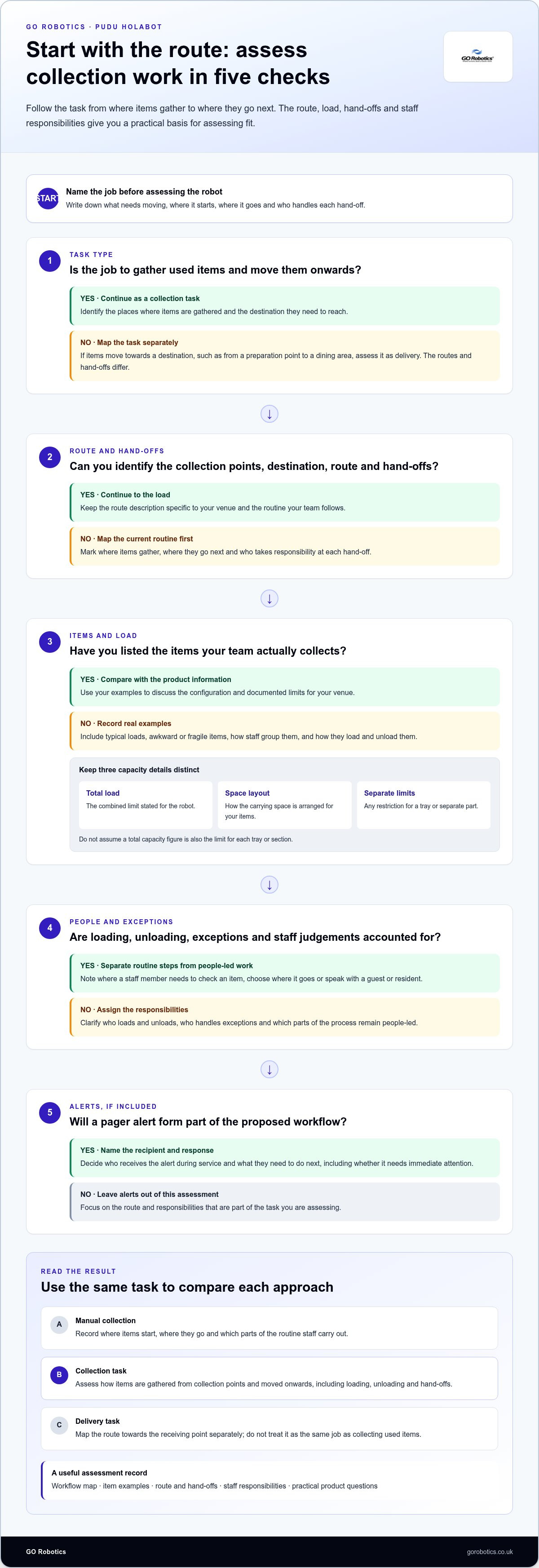
How to assess whether HolaBot fits your venue before choosing
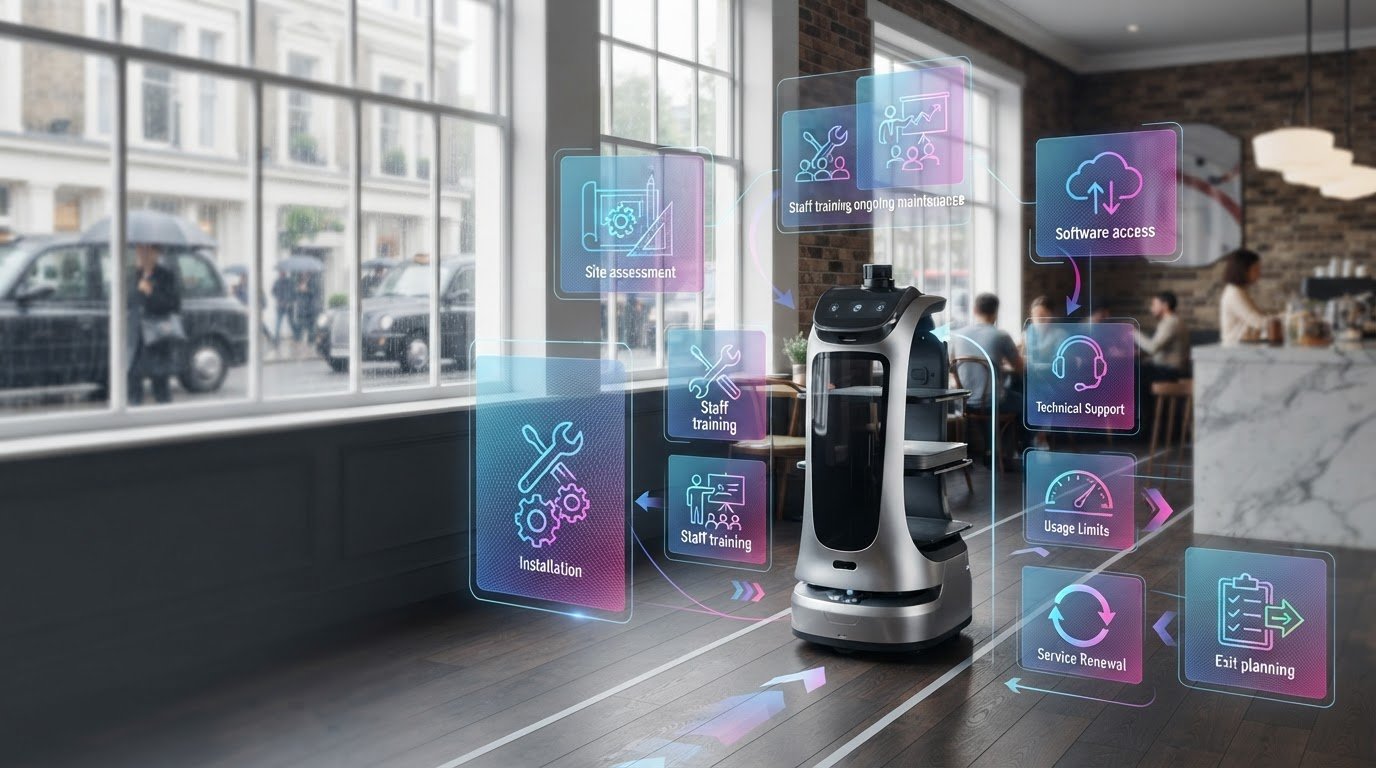
A useful assessment starts with the work itself, not a feature list. Before discussing Pudu HolaBot UK, write down the collection task and the people, places and hand-offs involved. This gives you a clear basis for comparing your needs with the product information and the conditions at your site.
What should you map in the collection workflow?
Follow the task from its starting point to its destination. Include the people involved and the conditions that change how the work happens. A simple floor plan with notes can help make the task easier to discuss during a site assessment.
- Map the task. Record what is collected, where it originates, where it needs to go and how often the task occurs during a typical service period.
- Mark routes and collection points. Note turns, entrances, shared areas and places where people or activity affect the route. Treat these as assessment points, not proof that a robot can pass through them.
- Describe each hand-off. Write down who gathers the items, who loads or unloads them and who takes responsibility at the next point. Include what happens when the usual person is busy.
- Identify user groups. Consider the staff who would work alongside the process, along with guests or others who use the same spaces. Note where their movement and interaction may affect the task.
- List site questions. Record relevant features of the venue and questions for a site assessment. Avoid treating assumptions about access or routes as technical requirements.
What product evidence should you review?
Keep a short record beside your workflow map. For each product detail, note where it comes from and how it relates to the task. This makes it easier to compare your venue’s requirements with the information being discussed.
- Product specifications: identify the details that relate directly to your items, route and operating routine.
- Capacity and configuration: compare the stated carrying arrangement with how your staff group and handle items.
- Workflow match: record whether the information answers a real question about your collection points or hand-offs.
- Open questions: list any operating details that need to be resolved before you plan a process around them.
This assessment will not predict measured results. It will help you prepare a focused discussion about the task, site and product. For wider purchasing context, the Robots as a Service UK guide covers a subscription approach; keep that separate from questions about HolaBot’s role and capabilities.
Bring your task map and notes to discuss HolaBot with GO Robotics. A clear brief helps keep the conversation focused on your venue’s collection workflow.
Discuss Pudu HolaBot with GO Robotics
GO Robotics supplies commercial service robots to businesses across the UK, including Pudu HolaBot. If you’re considering Pudu HolaBot UK, begin with the task you want to assess. The key is to relate the product’s collection role to the way your team works, rather than assume a particular feature or outcome will suit every venue.
Bring your collection workflow into the conversation. Describe the items, route and hand-offs, including the points where staff need to make decisions. That context helps keep the discussion grounded in your operation rather than broad claims about productivity or savings.
What information will make a product discussion useful?
A short set of practical notes is enough to make the conversation more focused. You do not need to arrive with a technical assessment. Describe what happens during a normal shift and where you see a possible role for collection support.
- Task examples: describe the items involved and the steps staff take to collect and move them.
- Collection points: note where items are picked up and where they need to go next.
- Operating context: explain how the venue is used during busy periods, including staff and guest movement around the task.
- Product questions: list the specifications or operating details you want to compare with the needs of your venue.
Keep the discussion centred on workflow fit. A product description can identify a proposed role, but it cannot establish how that role would work in your setting. Sharing the hand-offs, route and task conditions gives you a sound basis for discussing what the product needs to do and what should be assessed at the site.
How can you explore wider automation context?
HolaBot is one product role within the wider field of service robotics. If you’re comparing different tasks in hospitality, the hospitality robots guide can help put collection alongside other service-robot roles. Healthcare operators can also use the healthcare service robot guide when considering automation in that setting. Keep information about other models separate from details about HolaBot.
That distinction matters when comparing options. A feature or use case described for another robot does not establish that it applies to HolaBot. Keep a note of which product each detail refers to and relate it to the task you want to assess.
If you have a collection task in mind, discuss Pudu HolaBot with GO Robotics. Bring your task examples and questions, and start with whether the collection role fits your venue. A clear discussion can help you decide what to assess next.
Move towards a clear decision for your venue
Turn your assessment into a practical decision by choosing the collection task that matters most, identifying what you need to understand about the product and agreeing what evidence would help you judge its fit. This keeps the discussion centred on your venue rather than assumptions about what automation should deliver.
For Pudu HolaBot UK, the useful question is whether the task, hand-offs and site context you have mapped align with the collection role being considered. Keep unresolved points visible and use them to guide the next planning conversation.
GO Robotics supplies Pudu HolaBot to businesses across the UK. Discuss your venue’s collection requirements with GO Robotics and bring the route, items and hand-offs your team needs to manage. A well-defined task is a practical starting point.
Frequently Asked Questions
Is Pudu HolaBot a delivery robot or a collection robot?
HolaBot is the Pudu Robotics model considered in this article for collection-related work. Collection and delivery describe different tasks: collection gathers items from points where they have been used, while delivery moves items towards a destination. When assessing Pudu HolaBot UK, define the task and hand-offs in your venue so the discussion stays focused on the role you need.
Can Pudu HolaBot be used in healthcare settings?
Healthcare work can involve different items, routes and handling requirements from restaurant collection. Start by defining the intended task, the people who interact with the process and the relevant site procedures. Then assess the product and workflow against those requirements before making a decision about its role in your setting.
Does Pudu HolaBot have an IPX5-rated cabin?
Do not base a cleaning or site procedure on a water-resistance claim alone. A rating needs to be understood in relation to the parts it applies to, the exposure involved and the cleaning process in your venue. If this detail affects your decision, include it among the product questions for your assessment.
What does sound tracking mean on the Pudu HolaBot?
Sound tracking describes a possible way of using sound as part of an operating process, but the phrase alone does not explain what the robot does. For your venue, first decide whether sound-based interaction would solve a specific task or create a clear staff hand-off. Keep the question tied to the operating detail you need to assess.
Does Pudu HolaBot use voice control?
Voice control can refer to different functions, so do not assume which spoken commands a product accepts or what those commands operate. If voice interaction matters to your team, make a note of the specific task you want it to support and include that in your product discussion.
How should a venue assess whether HolaBot can fit its collection routine?
Assess exceptions as well as an ordinary collection run. Decide what happens when an item is awkward to handle, a collection point is unavailable or a staff member needs to pause the task. Assign responsibility for each case and consider how the process will work during a shift change. Those answers can reveal practical gaps that a floor plan alone may not show.
What does contactless delivery mean in the Pudu HolaBot listing?
Contactless delivery describes an intended type of handover, but the phrase alone does not set out the exact process. If limited direct contact is important to your use case, identify who receives the item and how they know it is ready. Include those requirements in your workflow assessment and product discussion.