Pudu SwiftBot UK: A Practical Guide for Business Buyers
The right delivery robot is the one that fits your service routine, not the one with the longest list of product claims. If you’re considering Pudu SwiftBot in the UK, start by assessing whether its routes, handovers and day-to-day use match the work in your venue.
A useful evaluation is based on the way your team works, not an idealised floor plan. Map the recurring deliveries, note who prepares and receives each item, and identify the points where staff judgement or guest interaction is needed. Automation should assist your team, not add unnecessary steps.
This guide sets out how to assess SwiftBot against the delivery tasks you need done, compare its specifications with your site requirements and plan a practical demonstration. GO Robotics surveys your venue before recommending a model, helping you connect the site review with installation and deployment planning.
Key Takeaways
- Choose a recurring delivery task first, then assess whether a robot could assist without disrupting staff routines.
- Measure routes and review handovers against the product’s documented specifications and the conditions in your venue.
- Compare the existing and proposed processes using the same task, route, service period and staff responsibilities.
- Assess the site in sequence: define the task, map the route, review constraints and agree what a useful evaluation should test.
- GO Robotics surveys your venue before recommending a model, helping shape the next steps from site review to deployment planning.
What Pudu SwiftBot could mean for a high-traffic venue
A delivery robot is intended to move items along a route between collection and handover points. That gives you a practical starting point: identify a repeatable movement your team carries out regularly, then assess how it fits the product and your site. Wikipedia’s Delivery robot overview describes the wider category, while a venue assessment focuses on your specific tasks and layout.
For a Pudu SwiftBot UK assessment, begin with the delivery task rather than a general aim such as “improve service”. Staff repeatedly carrying items between the same areas may point to a task worth evaluating, but that does not mean every movement should be automated. Service decisions, guest communication and unusual requests remain part of your team’s work. The question is whether a defined part of the workflow can be supported without making the rest harder.
Start with the task, not the robot
List the routine item movements that take staff away from other duties. Keep delivery separate from collection, cleaning and customer interaction, since each involves different routes, timings and responsibilities. For every potential task, record where an item starts, where it needs to go, and which staff member prepares or receives it.
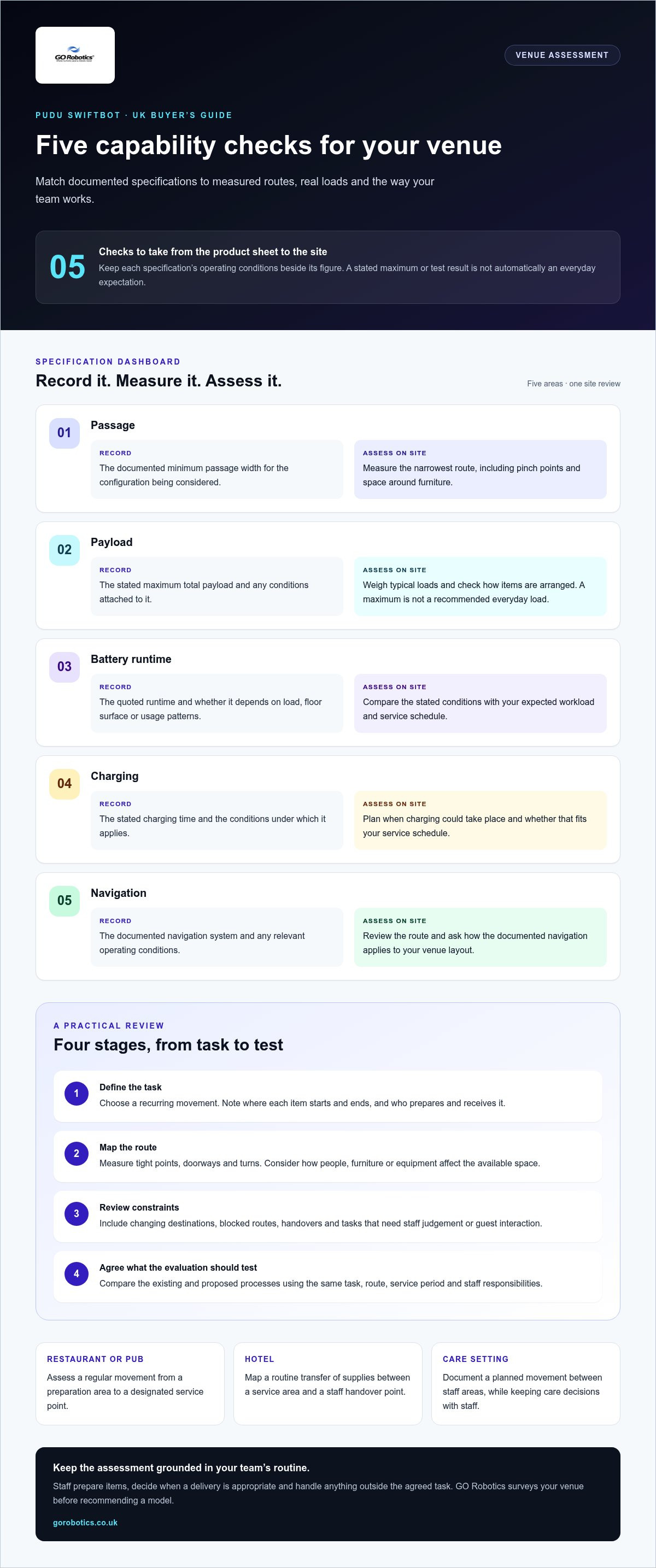
- Restaurant or pub: note a regular movement from a preparation area to a designated service point.
- Hotel: map a routine transfer of supplies between a service area and a staff handover point.
- Care setting: document a planned movement of items between staff areas, while keeping care decisions with staff.
Then note what interrupts the routine: a changed destination, an item needing personal attention, or a route blocked by activity. These exceptions matter. If the task varies each time, a repeatable route may not address the main source of staff effort.
Where a delivery robot may enter the workflow
Plan around a clear handover, not an assumption that the service becomes unattended. Staff need to prepare the items, decide when a delivery is appropriate and deal with anything outside the agreed task. The assessment should define the movement between points and the responsibilities that stay with your team.
For example, a restaurant might assess a regular transfer from the kitchen to a designated handover point, while a hotel could review whether routine supplies follow a consistent route. In either case, decide who loads and receives the items, how staff know a handover is ready, and what happens if the destination changes. Include these requirements in the demonstration plan so you can assess the process in the setting where it will be used.
That distinction keeps the evaluation grounded. Your staff retain responsibility for service and judgement; the assessment focuses on whether a repeatable movement can be supported without adding extra steps.
Which Pudu SwiftBot capabilities should a UK buyer assess?
Compare the product’s documented specifications with measured routes and real loads, rather than relying on a headline claim. A Pudu SwiftBot UK assessment should connect each specification to a practical operating need. Keep the manufacturer’s stated conditions alongside the figures, since a maximum or test result is not necessarily an everyday operating expectation.
Separate specifications from sales claims
Use this shortlist to organise the discussion. It does not predict how the robot will perform in your venue. Record the specification and its operating conditions alongside the questions that need to be answered during a site review.
| Area | Information to record | What to assess on site |
|---|---|---|
| Passage | Record the documented minimum passage width for the configuration being considered. | Measure the narrowest route, including pinch points and space around furniture. |
| Payload | Record the stated maximum total payload and any conditions attached to it. | Weigh typical loads and check how items are arranged. A maximum is not a recommended everyday load. |
| Battery runtime | Note the quoted runtime and whether it depends on load, floor surface or usage patterns. | Compare the stated conditions with your expected workload and service schedule. |
| Charging | Record the stated charging time and the conditions under which it applies. | Plan when charging could take place and whether that fits your service schedule. |
| Navigation | Record the documented navigation system and any relevant operating conditions. | Review the route and ask how the documented navigation applies to the venue layout. |
Keep each source and its wording beside the corresponding figure in your comparison notes. If a claim has operating conditions, retain them rather than treating the number as an expected result. This makes it easier to compare configurations consistently and identify what needs to be assessed on site.
Connect each capability to a real operating need
Measure routes at their tightest points, including doorways, turns and areas where people or equipment may reduce available space. Compare the measurements with the documented passage requirement, then consider how the route is used at different times. A floor plan alone cannot show whether staff need to pass, pause or complete handovers in the same space.
For payload, compare the stated maximum with the weight and shape of normal deliveries, rather than planning around the limit. For runtime, consider how often trips happen, what is carried and the floor conditions. Keep the manufacturer’s stated conditions in view when considering how runtime relates to your operating schedule. Charging time also needs to fit the plan, with a clear place and period for charging.
Bring route measurements, example loads and your service schedule together before deciding which specifications matter most. To review those requirements against your venue, discuss your venue’s requirements with GO Robotics.
How to compare Pudu SwiftBot with your current delivery process
A fair comparison starts with the work as it happens now. Choose a recurring delivery task and examine it under the same conditions in the existing process and a proposed robot-assisted process. That keeps the assessment focused on operational fit rather than broad claims about speed, savings or capacity.
Map the current delivery workflow
Follow an item from preparation to handover. Record who moves it, where it starts, where it must arrive and who receives it. Note the service period and route, including interruptions, handovers or changes of destination. Keep judgement-based work visible too: a person may still need to answer a guest, check an item or decide what to do when the usual route or request changes.
Use observations from normal service, not an idealised quiet period. Separate what you see from what you expect. A recorded route and handover are observations; an expectation that a robot will complete the same task without staff input needs to be assessed against the product’s documented capabilities and the site conditions.
Compare operational fit fairly
Use the same task, route and service period for both approaches. Complete the table during a workflow review, then use it to set questions for a Pudu SwiftBot demonstration. Describe the robot-assisted process as a proposal and base the assessment on documented capabilities and the conditions at your site.
| Comparison point | Current process | Robot-assisted process to assess |
|---|---|---|
| Task | What item moves, and why? | Is this the same defined delivery task? |
| Route | Where does the item travel? Note route changes and obstructions. | Could the route be assessed for SwiftBot use? Record constraints and questions. |
| Handover | Where is the item passed on, and who receives it? | Who prepares and accepts the delivery, and how is the handover managed? |
| Staff involvement | Who carries the item and handles guest or service needs? | Which tasks remain with staff, including decisions and guest assistance? |
| Unresolved exceptions | What happens if the route, destination or request changes? | Which exceptions still need a staff response, and what needs testing? |
During an evaluation, record observable outcomes consistently, such as whether the agreed route was completed and whether the planned handover took place. Note interruptions and staff actions without turning them into projected labour savings or a payback estimate. If an exception cannot be resolved within the proposed process, record it for review.
The purpose is to assess whether a robot can support staff on a specific, repeatable task. It is not a basis for assuming fewer staff are needed. Keep people responsible for service decisions and exceptions, and judge the evaluation by whether the agreed workflow works in practice.
How to assess whether SwiftBot fits your UK venue
A useful site assessment starts with the work your venue needs done, then reviews whether its routes and routines suit a trial. GO Robotics surveys a site before recommending a model. This gives the discussion a practical starting point: the requirements of the task, the building and the people who will work alongside the robot.
Use this sequence to prepare:
- Define the tasks. List the items you’re considering moving, their collection and delivery points, and the periods when those tasks take place. Separate repeatable deliveries from requests that require staff judgement or guest interaction.
- Map the routes. Trace each proposed route and note how staff, guests and service activity affect access at different times. Include handover points and sections where the route changes during normal operation.
- Review the constraints. Record thresholds, narrow sections, access controls, doors, lifts and busy areas. Compare these with the relevant product specifications and include any building connections in the site review.
- Agree the evaluation. Decide what staff and managers will observe during a demonstration, who will manage handovers, and which questions need to be answered before a trial or deployment is planned.
Prepare a useful site assessment
Bring details that reflect how the venue runs. Note the types of items involved, collection and delivery points, operating periods, route restrictions and places where staff would need to load or receive items. Include changes in guest movement or service activity that affect access. A route that looks clear on a floor plan still needs to be reviewed during the periods you plan to assess.
Record situations that fall outside the routine as well. An access point may be unavailable, a destination may change, or a guest may need personal assistance. Identify who would respond and what they would need to do. The UK delivery robots buying guide can help you frame wider purchasing criteria, while the site review focuses on the conditions and workflows at your venue.
Set practical evaluation criteria
Agree observable outcomes before the demonstration. Staff and managers might assess whether the proposed route suits the chosen service period, whether the handover is clear, and which tasks still need staff attention. Make each criterion specific enough for everyone to record the same result, including interruptions and steps that remain unresolved.
GO Robotics uses a site survey to inform its model recommendation. Bring your notes together with the staff who understand the daily workflow and building access, then discuss a site assessment with GO Robotics to plan a review around your venue’s working conditions.
Plan your next steps with GO Robotics
A useful next step is a discussion grounded in your venue, not a decision based on a product page alone. GO Robotics surveys a site before recommending a model, so the process starts with the work you need to support and the conditions where it takes place. For a Pudu SwiftBot UK assessment, bring clear examples of delivery tasks, routes and handovers.
The route from initial enquiry to deployment planning is straightforward:
- Enquiry: Describe your venue, the items staff move and the recurring delivery tasks you’re considering. Note what you hope to improve for the team and where service decisions still need a person.
- Site review: Review the relevant routes, handover points, access constraints and patterns of staff and guest movement. This gives the assessment a practical basis rather than relying on an idealised layout.
- Model recommendation: Use the site context and task requirements to inform the recommendation. Compare relevant product specifications with the routes and operating needs identified during the review.
- Deployment planning: Consider what installation and integration involve for the proposed use, and identify any requirements to resolve before planning a trial or deployment.
What to expect from the discussion
Bring your current workflow, the routes you want to assess and any constraints staff encounter during service. It also helps to describe what a useful outcome would look like, such as a clearly defined handover or fewer interruptions to a particular routine. The discussion should connect the recommendation to these details, rather than treating a headline specification as proof of fit.
GO Robotics offers purchase, lease and robots-as-a-service (RaaS), a monthly rental arrangement that can include the robot, software and support. Discuss which model and arrangement fit the project, alongside the installation and support requirements for your venue.
Make the next action straightforward
You don’t need to arrive with every technical question answered. A task list, route notes and an outline of the service periods you want to assess give the conversation a useful starting point. GO Robotics can survey the venue before recommending a model, keeping the decision tied to your requirements and deployment planning.
Arrange a venue-focused discussion to assess SwiftBot against your delivery workflow. Talk to GO Robotics about Pudu SwiftBot.
Turn your assessment into a clear next step
Before moving ahead, decide who will lead the evaluation and how its findings will be shared with the people affected by the workflow. That gives your team a clear point of contact and keeps the decision tied to the venue’s actual needs, rather than assumptions about what automation should achieve.
For Pudu SwiftBot UK, the useful next step is a grounded discussion about your venue and the delivery task you want to assess. GO Robotics supplies commercial service robots to businesses across the UK and can help you assess SwiftBot against your requirements. Start with the route, task and handover you want to review, then use the site assessment to inform the next decision.
Discuss Pudu SwiftBot for your venue and take the next step with a clear view of what your team needs.
Frequently Asked Questions
Is Pudu SwiftBot available in the UK?
GO Robotics supplies Pudu SwiftBot to UK businesses. If you’re planning around an opening, refurbishment or seasonal service, include those requirements in the site discussion so they can inform the deployment plan.
Can a delivery robot help staff without replacing them?
Yes. A delivery robot can be assessed for a defined transport task while staff remain responsible for service decisions, guest requests and situations that need judgement. When setting expectations with your team, focus on whether the proposed use supports their work rather than assuming it changes staffing requirements. Agree who handles exceptions before an evaluation begins.
What should I prepare before discussing Pudu SwiftBot for my venue?
Decide who should take part in the discussion, including the person responsible for operations and anyone who manages building access or technology. Bring route details, typical loads, the service periods you want to assess and a short note of what a successful evaluation would need to show. If you’re working to a procurement timetable, include the decision stages and approval process.
Can Pudu SwiftBot use lifts or automatic doors?
If your proposed workflow depends on lifts or automatic doors, include those building systems in the site assessment. Record the equipment involved, how access is managed and which routes the robot would need to use. This gives the team a clear basis for reviewing the integration requirements for your venue.
How do I know whether Pudu SwiftBot suits a busy venue?
Assess suitability against the demands of service, rather than relying on a headline performance claim. Choose a representative operating period and note whether staff can keep their normal responsibilities clear during the evaluation. Agree how to pause the trial if it interferes with service. The results should help managers decide whether the proposed role works for their team.
What happens during a GO Robotics site assessment?
GO Robotics uses a site assessment to inform its model recommendation, with your venue’s practical requirements at the centre of the discussion. The review can cover routes, handover points, building access and the installation or integration planning involved. Include the people who understand building systems as well as those who manage daily service, so the recommendation reflects both the venue and the work taking place there.
Can I lease or subscribe to Pudu SwiftBot?
GO Robotics offers purchase, lease and RaaS options across its commercial service robot range. Discuss the arrangement that suits your project alongside the site requirements, installation and support needed for the proposed use.