Reducing Hotel Operating Costs with Technology: A 2026 Practical Guide
Following the rise in the UK National Living Wage to £12.71 per hour in April 2026, hotel balance sheets across Britain face immediate margin pressure. Yet successfully reducing hotel operating costs with technology does not mean compromising guest hospitality or attempting to replace your workforce.
You already manage the daily operational friction: chronic housekeeping turnover, persistent shortages across routine cleaning shifts, and the ongoing challenge of keeping vast corridors and public spaces spotless. Committing large upfront capital reserves to unproven machinery feels equally hazardous when cash flow demands careful protection.
Sustainable savings come from relieving your on-site teams of repetitive physical chores whilst keeping service standards high. Working from the principle where humans lead and robots assist, dependable automation absorbs routine floorcare, returning valuable staff hours directly to attentive customer care.
This practical guide examines proven commercial technologies built for hospitality, outlines flexible procurement models that avoid upfront capital risk, and provides a clear framework to evaluate your real operational return on investment.
Key Takeaways
- Releasing housekeeping hours from expansive corridors and public floors allows teams to focus on room preparation, detailed presentation, and faster turnaround times.
- Discover practical approaches to reducing hotel operating costs with technology by deploying assistive units that work safely alongside your existing workforce.
- Multi-floor delivery units navigate between levels using existing lifts to carry amenities and room-service orders, keeping night staff visible at reception.
- Flexible Robots-as-a-Service monthly rental packages help operators avoid capital risk and eliminate heavy upfront capital expenditure.
Analysing the Pressure on UK Hotel Operating Budgets
Operating a hotel across Britain has grown considerably more expensive. While the global hospitality industry contends with fluctuating travel patterns, UK hoteliers face acute domestic financial hurdles. Compounding energy tariffs and statutory wage increases leave little room for operational error.
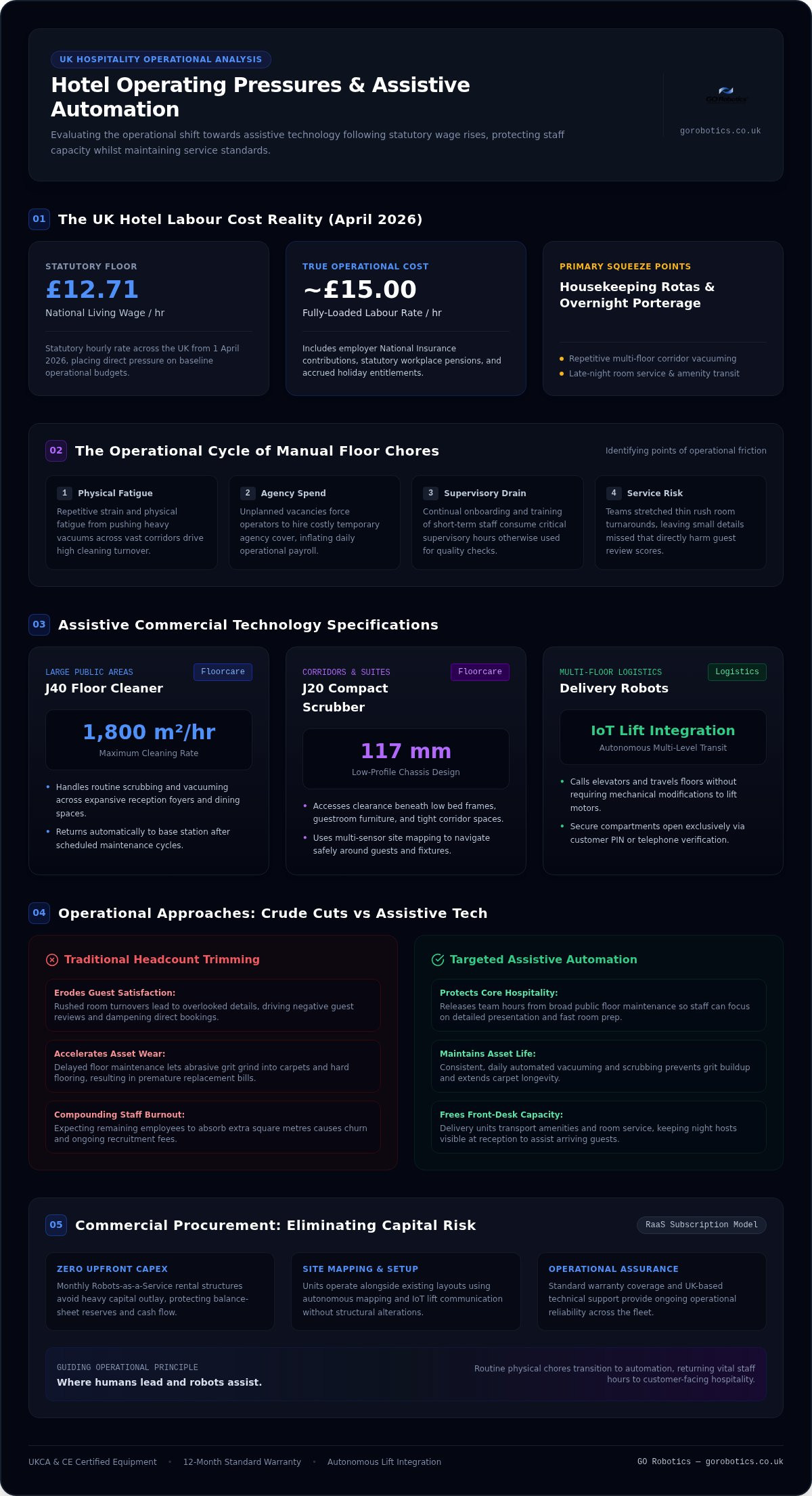
On 1 April 2026, the statutory UK National Living Wage reached £12.71 per hour. For hoteliers, the true financial commitment runs much higher. Once you account for employer National Insurance contributions, workplace pension enrolments, and statutory holiday accruals, fully-loaded labour rates sit near £15 per hour. Housekeeping rotas and overnight porterage absorb the heaviest share of this expenditure, creating severe budget strain on properties running multi-floor layouts.
The Compounding Cost of Repetitive Manual Labour
Vacuuming vast carpeted corridors and turning around guest bedrooms consume substantial blocks of daily rotas. These duties demand hard physical effort. Staff suffer fatigue and repetitive strain injuries, driving high turnover across cleaning departments. When vacancies occur, operators turn to expensive temporary agency cover to plug rotas. Onboarding new starters drains supervisory hours, whilst unplanned absences leave existing teams stretched thin, directly threatening guest cleanliness reviews.
Where Traditional Cost-Cutting Measures Fall Short
Conventional approaches to trimming hotel expenditure rarely protect long-term margins. Operators generally encounter three distinct risks when relying on crude cuts:
- Eroding guest satisfaction: Cutting rotas forces housekeepers to rush room turnover. Overlooked details quickly show up on review platforms, harming direct bookings.
- Accelerating asset wear: Delaying daily floorcare allows abrasive grit to grind into carpets and hard floors, resulting in expensive premature replacement bills.
- Increasing staff burnout: Asking remaining employees to absorb extra square metres causes churn, perpetuating recruitment expenditure.
Hotel venues need capacity gains rather than blunt headcount reductions. Real progress in reducing hotel operating costs with technology happens when automated tools take over routine physical tasks, protecting your team's energy for guest-facing hospitality.
Core Technologies for Reducing Hotel Operating Costs
Recent UK hotel market analysis shows commercial margins tightening across independent and group properties alike. To protect profitability, operators target three practical operational areas: autonomous floor care, room deliveries, and environmental controls. The modern systems driving these disciplines operate quietly alongside current teams without requiring expensive structural renovations.
When assessing equipment, look past isolated, single-purpose tools. Focus instead on physical installation footprints, standard utility consumption, and the actual hours returned to front-of-house teams. Choosing hardware designed around site mapping and lift connectivity ensures smooth, reliable building transit.
Autonomous Commercial Cleaning and Floor Care
Routine floor maintenance consumes disproportionate housekeeping rotas. Deploying dedicated autonomous units handles repetitive vacuuming, scrubbing, and mopping across public reception zones and dining rooms. The J40 autonomous floor cleaner delivers up to 1,800 m² per hour maximum cleaning rate, scrubbing expansive foyers and returning to its base automatically. For guest corridors and suites, units like the J20 feature a 117 mm low-profile design that cleans beneath low bed frames and furniture. You can explore the technology behind autonomous floor maintenance in our commercial cleaning robot UK guide.
Autonomous Room Service and Internal Logistics
Carrying extra towels, dental kits, or late-night room-service orders pulls front-desk hosts away from arriving guests. Multi-floor delivery robots take over these repetitive journeys across hospitality properties. These units use secure internal compartments that unlock only via customer PIN codes or phone verification, keeping deliveries completely protected. Autonomous IoT lift integration allows them to call elevators and travel between floors without requiring mechanical modifications to lift motor systems.
Smart Energy and Environmental Controls
Alongside autonomous mobile hardware, integrated environmental monitoring controls behind-the-scenes utility consumption:
- Connected thermostats: Regulate heating and cooling automatically based on live room check-ins and check-outs, preventing energy waste in empty suites.
- Automated lighting controls: Dim corridors and switch off empty conference suites during low-traffic periods.
- Sensor-led maintenance alerts: Track refrigeration and water pressure, flagging anomalies before expensive equipment breakdowns occur.
Achieving tangible success in reducing hotel operating costs with technology depends on picking dependable machines configured for commercial duty cycles. If you want to assess how these units perform within your specific venue, request an on-site feasibility survey with our engineering specialists.
Evaluating Commercial Cleaning Robots for Housekeeping Capacity
Floor maintenance represents one of the heaviest recurring drains on hotel housekeeping shifts. Vacuuming and washing extensive carpets or polished tiles leaves team members little time to address detailed room staging and touchpoint sanitisation. Commercial floorcare machines rebalance this workload. A single pass handles sweeping, scrubbing, and vacuuming without manual tool changes, following precise mapped routes each night with automated cloud reporting.
Guest Room Floor Care with Low-Profile Units
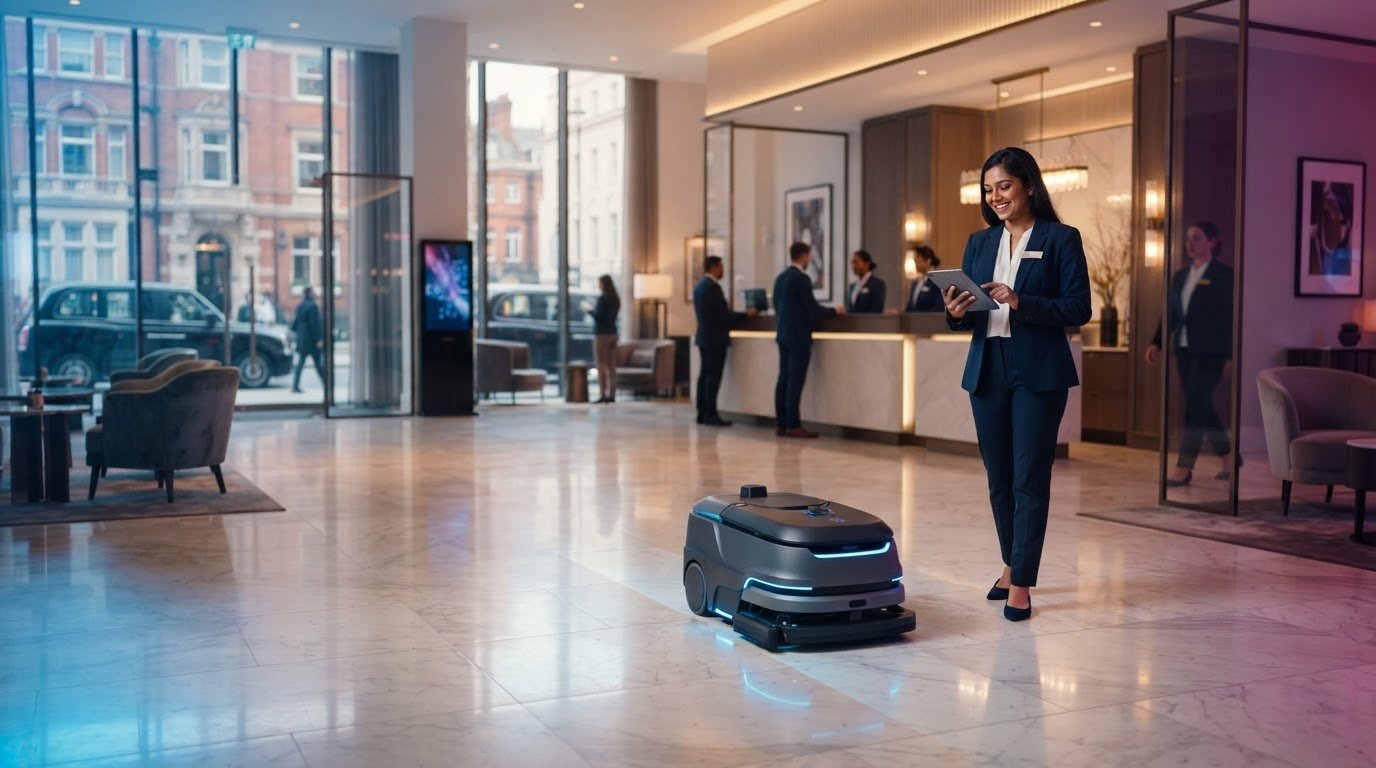
The J20 autonomous scrubber operates alongside room attendants or completes floor cleaning once attendants depart. Designed with a 117 mm height and a compact 360 mm footprint, the unit cleans underneath low bed frames and sideboards where upright vacuums cannot reach. Separate internal clean and dirty water tanks ensure the machine applies only fresh solution to floors. Handling the floor cleaning autonomously saves at least 5 minutes of floor cleaning time per guest room, returning immediate capacity back to the room attendant.
Large-Scale Corridor and Public Area Maintenance
Expansive lobbies, ballrooms, and long bedroom wings require industrial capacity. The J40 manages vast public zones quietly, operating at rated noise levels below 75 dB so resting guests remain undisturbed. Its modular Refresh Hub docks to a standard socket for automated clean water refills and waste drainage. Self-cleaning roller mop technology actively squeegees moisture away, leaving walkways dry and preventing prolonged floor closures. You can explore how these commercial units fit across diverse hospitality settings in our hospitality robots UK overview.
Navigating Hotel Layouts Without Building Alterations
Deploying autonomous cleaners requires zero structural alterations. Using marker-free SLAM, the mapping technology that lets a robot build a picture of its surroundings and navigate, the machines build digital layouts without needing physical tracks, ceiling stickers, or guide rails. Built-in sensors detect wandering guests, service trolleys, and dropped luggage, recalculating a smooth path around obstacles. Operations managers monitor progress via live dashboard mapping, tracking exact run times, square-metre coverage, and any bypassed sections requiring manual inspection.
By shifting heavy floor duties away from staff rotas, hoteliers discover that reducing hotel operating costs with technology strengthens service quality rather than cutting corners.
Streamlining Room Service and Logistics with Autonomous Delivery
Fulfilling room-service orders and delivering guest amenities often disrupts front-of-house operations. A guest requesting extra pillows, toiletries, or late-night refreshments forces reception staff or night porters away from the front desk. Routine courier trips up and down guest wings split staff focus, leaving arrival desks unattended and slowing down service for other guests.
Autonomous delivery units take on these internal courier runs. Kitchen staff or reception hosts simply load the items into the robot, select the destination room on a touchscreen interface, and send the unit on its way. Enclosed compartments keep food warm and protect guest privacy from dispatch to handover.
Multi-Floor Transit via IoT Lift Integration
Operating across multi-storey hotel layouts requires dependable vertical travel. Units like the FlashBot Max navigate between floors using cloud-based software integration to summon lifts and trigger automatic security doors. The integration connects directly to lift controls from major manufacturers including KONE and OTIS without requiring mechanical lift modifications. An adjustable cruising speed up to 1.2 m/s provides steady transit along guest corridors whilst safely steering around guests.
Guest Privacy, Security, and Amenity Dispatch
Secure cargo holds protect sensitive deliveries and ensure hygiene standards remain high across every run:
- Modular storage: Configurable with two to four lockable compartments, the unit carries up to 10 kg per layer for linen, trays, or packaged goods.
- Secure access: Guests retrieve their delivery by entering a private PIN sent via SMS, typing their room number, or using an NFC room card.
- Active ventilation: Built-in compartment fans eliminate lingering food smells between deliveries, ensuring fresh presentation for every order.
Returning Evening Hours to Front-Desk Staff
Reallocating routine delivery runs creates immediate operational breathing room. Night managers remain stationed in the lobby to greet late arrivals, handle reservations, and maintain physical venue security. The system logs exact transit durations, delivery completion times, and retrieval timestamps, giving managers full visibility over shift activity. When its battery runs low, the unit routes itself back to its charging dock without needing manual intervention.
Targeting practical operational bottlenecks like room drops demonstrates the real potential of reducing hotel operating costs with technology. To review automated logistics options for your property, book an initial consultation with our UK team.
Deploying Hotel Technology: Procurement Models and Implementation
Successfully reducing hotel operating costs with technology requires a procurement strategy that aligns with your property's cash flow. Rather than tying up working capital in depreciating machinery, modern operators evaluate equipment through flexible commercial agreements that protect liquidity whilst delivering operational capacity.
Comparing Capital Purchase, Leasing, and RaaS Subscriptions
Outright capital purchase suits operators seeking full asset ownership. Qualifying purchases can take advantage of the UK Annual Investment Allowance, which allows businesses to deduct qualifying capital assets from taxable profits. However, outright purchasing leaves software maintenance and long-term upkeep entirely in your hands.
A Robots-as-a-Service (RaaS) monthly subscription shifts equipment acquisition into an operational expense. This approach eliminates capital risk by bundling the machinery, ongoing software updates, remote diagnostics, and routine maintenance cover into an ongoing monthly agreement. You can explore how these contracts work in our guide to robots as a service UK.
The Four-Step Implementation Process
Staff adoption determines the success of any technological change. Smooth rollouts succeed when teams understand that automation absorbs repetitive physical fatigue rather than threatening employment. This practical balance ensures staff remain in control of service standards while machines shoulder the heavy routine across daily shifts. Deployments follow a structured four-stage pathway:
- Site survey: Engineers inspect floor textures, threshold gradients, lift controllers, and Wi-Fi coverage across all operational zones.
- Digital site mapping: Specialists generate layout maps and set up docking stations connected to standard 13A wall sockets without building alterations.
- Staff training: Housekeeping and front-desk employees receive hands-on instruction on task scheduling, manual overrides, and dispatch routines.
- Performance monitoring: Supervisors use the fleet management dashboard to track daily square-metre coverage, running times, and returned team hours.
Booking an On-Site Demonstration
Every hotel features distinct corridor widths, threshold heights, and carpet depths. Assessing an autonomous unit in your real operating environment confirms how reliably the sensors handle foot traffic and furniture before making a commitment.
GO Robotics specialists conduct live venue surveys across the UK, preparing tailored cost projections based on your venue size and housekeeping schedules. Book a survey to see how assistive technology can stabilise your operational costs.
Securing Sustainable Margins for Your Venue
Managing hospitality overheads no longer requires compromise between service excellence and cost control. As demonstrated across daily housekeeping and overnight dispatch rotas, reducing hotel operating costs with technology succeeds when automation relieves your workforce of repetitive physical burdens. The capacity gained returns immediately to guest hospitality, raising presentation standards and lowering employee churn.
Modern commercial service units require no structural alterations to your building or lifts, navigating existing guest corridors straight from installation. Every machine deployed complies fully with UKCA and CE standards, backed by a standard 12-month warranty and UK-based technical support. Through flexible monthly rental packages, you protect cash flow whilst equipping your property with dependable operational support.
Take the next step in stabilising your hotel's running costs. Book a free site survey with GO Robotics to evaluate live floor compatibility and discover how assistive automation strengthens your team.
Frequently Asked Questions
How does technology help reduce hotel operating costs without reducing headcount?
Commercial service technology generates capacity gains by absorbing repetitive physical tasks rather than replacing staff. When routine jobs like corridor vacuuming and late-night room drops run automatically, existing housekeepers and front-desk teams gain valuable hours. This relieves shift fatigue, reduces expensive agency cover, and cuts recruitment costs caused by staff turnover. Operators succeed in reducing hotel operating costs with technology by lifting output quality while keeping guest hospitality firmly human.
Do autonomous cleaning robots require plumbing work or building modifications?
No structural or plumbing modifications are needed to deploy autonomous floor cleaners. Units such as the J40 use a modular Refresh Hub that connects directly to a standard 13A wall socket to manage water drainage, refilling, and charging. The machines use marker-free mapping technology, so properties avoid installing magnetic tracks, wires, or ceiling guide stickers. Venues can begin automated cleaning across lobbies and corridors without disrupting ongoing guest operations.
Can autonomous delivery robots use standard hotel guest lifts safely?
Yes, delivery units like the FlashBot Max travel between floors using cloud software and IoT integrations without mechanical lift modifications. The system connects smoothly to elevator controls from major manufacturers, including KONE and OTIS, to call cars and select target floors autonomously. Units monitor lift doorways using depth sensors, waiting for passengers to clear before entering safely, ensuring guests and automated deliveries share vertical transit without friction.
What is Robots-as-a-Service (RaaS) and how does it protect hotel capital?
Robots-as-a-Service is an operational subscription model that avoids upfront capital expenditure. Instead of buying machinery outright, hoteliers pay an ongoing monthly fee covering hardware provision, software updates, routine maintenance, and remote diagnostics. This procurement model eliminates capital risk and protects cash reserves, making reducing hotel operating costs with technology financially straightforward. Properties gain modern operational capacity immediately whilst preserving working capital for unexpected property maintenance or seasonal trading dips.
How do service robots navigate around guests, luggage carts, and narrow corridors?
Service robots rely on multi-sensor fusion, combining laser LiDAR with RGB-D depth cameras to maintain 360-degree environmental awareness. If a guest steps out of a room, a child runs across a foyer, or a luggage trolley blocks a hallway, the navigation system recalculates around the obstacle smoothly. Minimum passage widths range from 600 mm for compact delivery units to 650 mm for service models, allowing steady progress through standard hotel corridors.
Are autonomous floor care machines quiet enough to operate during guest hours?
Commercial cleaning robots are engineered specifically to clean during guest hours without causing acoustic disruption. For instance, the J40 operates at rated noise levels below 75 dB, while smaller scrubbing units like the J36 run sweeping routines at 50 dB or lower. These low sound profiles allow teams to maintain public lobbies, dining rooms, and bedroom corridors throughout the day without disturbing conversations or waking resting guests upstairs.
What maintenance is required by hotel staff to keep service robots running?
Daily staff maintenance is minimal, taking roughly five to ten minutes per shift. On floor scrubbers, team members rinse recovery tanks and clear brush rollers of tangled fibres. Docking stations handle water replenishment automatically. Delivery units require only a quick sanitising wipe of interior compartments between courier runs. Software patches, firmware updates, and component diagnostics are handled remotely via the cloud dashboard, leaving staff free to attend to guests.