Robot Dog Security Patrol UK: 2026 Business Buying Guide
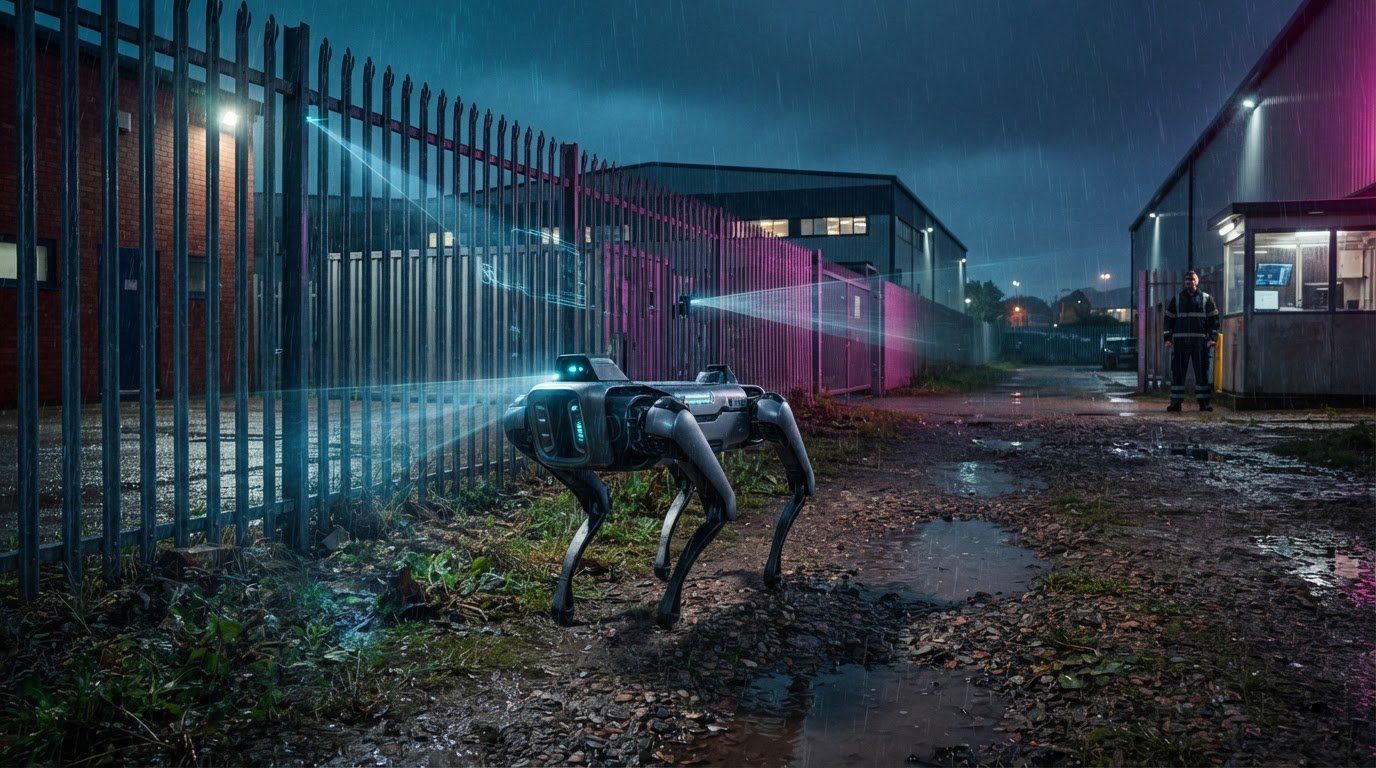
Walking an unlit industrial boundary at two in the morning through driving rain is neither practical nor safe for solitary staff. Deploying a robot dog for security patrol UK businesses can rely on is no longer an experiment; it is now an effective way to inspect hazardous yards, construction sites, and expansive perimeters.
You already know the operational friction of managing round-the-clock physical security. Guarding teams face severe recruitment pressure, wheeled inspection rovers easily get stuck in gravel and wet turf, and ordinary electronics struggle in damp British weather. You need consistent, timestamped site inspections that assist your existing personnel without exposing them to unnecessary physical risk.
This guide explains how four-legged quadrupeds such as the Unitree Go2 carry out scheduled security rounds, tackle uneven terrain, and feed live sensor telemetry back to human supervisors. We examine real-world weather ratings, UK surveillance privacy rules, and how adopting Robots-as-a-Service (RaaS), a monthly rental model covering hardware, software, and maintenance, avoids capital risk while keeping your site protected.
Key Takeaways
- Discover how adopting a robot dog for security patrol UK sites allows operators to inspect challenging outdoor terrain that stops conventional wheeled rovers.
- Learn how LiDAR sensors, which use laser light to map boundaries, combine with thermal imaging to maintain visibility across unlit perimeters.
- Explore how robotic inspections protect on-site personnel by assessing hazardous or isolated zones first, keeping your team safely in control.
- Understand how Robots-as-a-Service (RaaS) subscription agreements minimise capital risk by bundling hardware, software updates, and maintenance into predictable monthly expenditure.
- See how UK-based technical support, thorough site mapping, and practical staff training ensure reliable operation from day one.
What is a Quadruped Robot Dog for Security Patrols?
A quadruped security robot is a four-legged autonomous platform built to inspect areas that stop wheeled vehicles in their tracks. While mainstream media often portrays legged robotics as experimental police technology, commercial adoption tells a different story. Facilities teams and operations directors now use four-legged platforms to carry out routine boundary checks across distribution centres, utility plants, and construction projects.
Wheeled rovers fail the moment they encounter loose gravel, wet turf, or steep kerbs. A quadruped steps over ground obstructions, walks up external metal stairs, and negotiates muddy boundary tracks. Deploying a robot dog for security patrol UK sites require ensures reliable coverage across rough outdoor terrain where conventional surveillance cannot reach.
The Unitree Go2 in a Security Context
The Unitree Go2 provides a compact, practical platform for commercial security tasks. It navigates broken tarmac, drainage gullies, and unpaved boundary lines without losing balance. Operating during unsociable night shifts, the unit completes scheduled rounds along pre-mapped routes while streaming live visual data back to an on-site control room or off-site monitoring station.
This deployment protects your workforce. Security officers remain safely inside monitoring screens while the robot conducts checks in isolated or poorly lit perimeters, confirming whether fence alarms require human attention.
Core Components of a Security Robot
Commercial quadruped systems combine stable mechanics with dedicated inspection hardware to support round-the-clock operations:
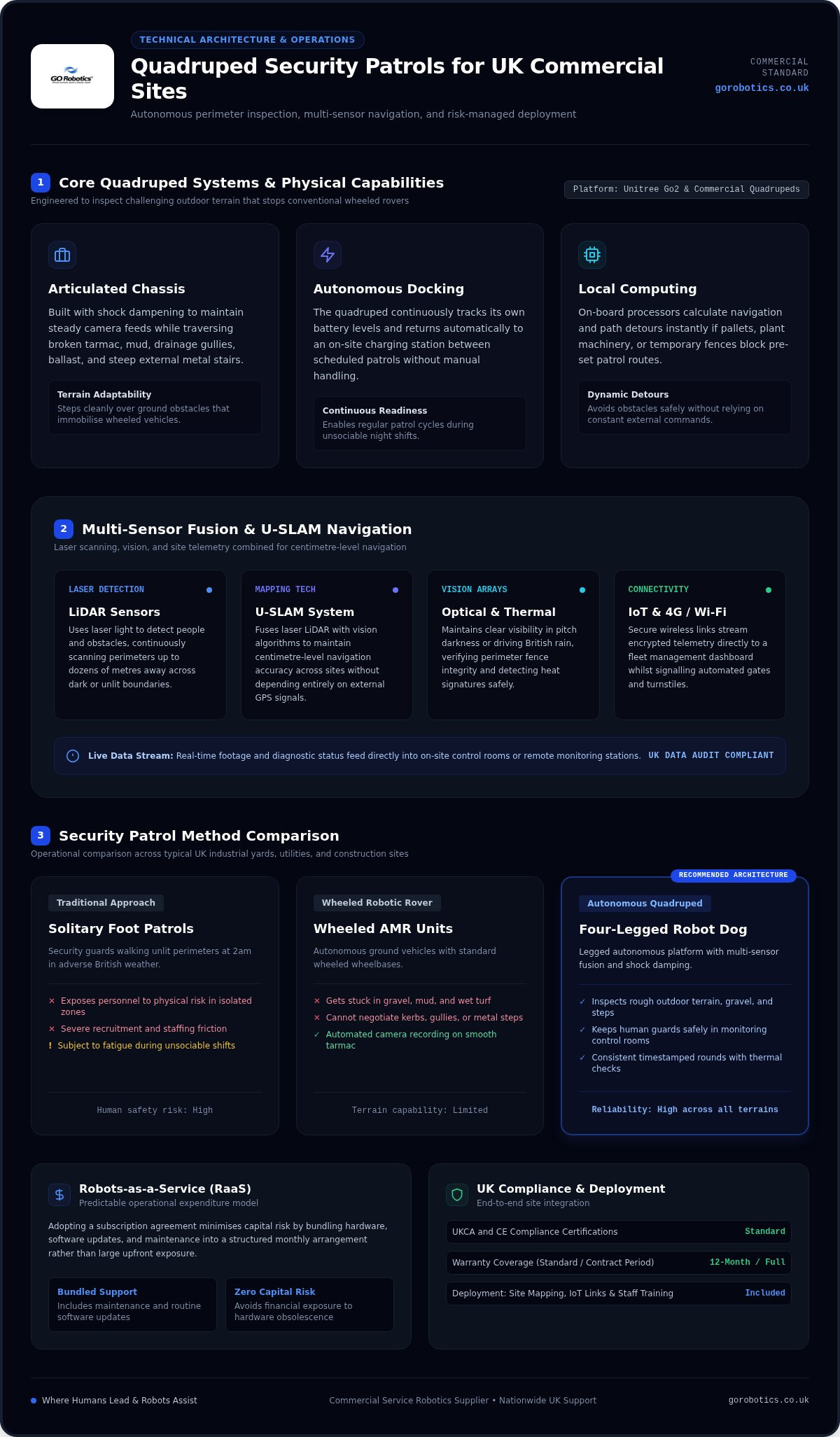
- Physical chassis: Designed with articulated legs and integrated shock dampening to keep camera feeds steady while walking across ballast, mud, and uneven concrete.
- Autonomous docking: The robot monitors its remaining battery capacity and returns to an automated charging base between scheduled patrols, ready for the next inspection without manual handling.
- On-board computing: Processors handle navigation calculations directly on the machine. This local processing ensures rapid obstacle avoidance if pallets, temporary fencing, or vehicles block the pre-set patrol route.
Essential Sensors and Navigation for UK Site Inspection
A robot dog for security patrol UK operations needs more than a standard optical camera. It relies on multi-sensor fusion, which combines data from laser scanners, depth sensors, and optical cameras to maintain spatial awareness in darkness or heavy rain. This sensory approach ensures reliable boundary detection across challenging commercial environments.
LiDAR sensors, which use laser light to detect people and obstacles, continuously scan perimeters up to dozens of metres away. By pairing LiDAR with SLAM, the mapping technology that lets a robot build a picture of its surroundings and navigate, the quadruped maps site perimeters accurately without relying entirely on external GPS signals. Real-time footage and telemetry transmit directly to a central security room, giving human operators instant confirmation of any disruption.
Navigation in Complex Environments
Commercial yards and depots change constantly. The robot uses U-SLAM, the navigation method that fuses laser LiDAR and vision to maintain centimetre-level navigation accuracy, even when pallets, containers, or plant equipment shift positions. If a delivery vehicle blocks an assigned path, the unit recalculates a clear detour around the hazard, keeping the patrol moving safely without human intervention.
Data Security and Connectivity
Quadrupeds maintain a secure wireless data link using commercial 4G mobile networks or dedicated site Wi-Fi. This connection streams telemetry and diagnostic status directly into a central fleet management dashboard, a digital interface used to monitor and control robots across different locations. Built-in IoT integration allows the platform to communicate with physical infrastructure, automatically signalling automated gates or turnstiles to open during patrol rounds.
Every recorded patrol event, perimeter photo, and thermal reading is encrypted and stored securely to meet UK data audit standards. If you want to explore how these sensor arrays integrate with your current surveillance systems, you can speak with the GO Robotics technical team to review your site requirements.
Comparing Robotic Patrols with Traditional Security Methods
Repetitive perimeter patrols on long night shifts inevitably cause fatigue. Guarding personnel walking extensive sites in bad weather can easily miss subtle signs of intrusion or property damage. A robotic platform carries out the same programmed route at 03:00 with the exact same vigilance as it does at midday, logging every checkpoint reliably.
Investing in a robot dog for security patrol UK facilities require does not mean removing human guards from the site. Autonomous systems cannot hold a Security Industry Authority (SIA) licence and cannot detain trespassers. Instead, the quadruped acts as a reconnaissance scout. By adopting a model where humans lead and robots assist, your licensed security officers stay out of harm's way, dispatching the unit to inspect perimeter alarms before deciding whether to intervene or contact emergency services.
Quadrupeds vs Fixed CCTV Systems
Fixed cameras are essential, yet they inevitably leave blind spots behind stacked containers, temporary plant, and perimeter vegetation. Extending hard-wired camera networks across large industrial yards involves significant civil works and cabling expense.
A quadruped removes these visual gaps by moving through them. A visible, moving patrol also creates a strong physical deterrent that static camera domes mounted high on poles cannot replicate. When a fence sensor or motion beam triggers, the control room can redirect the unit immediately to investigate the specific coordinates, giving operators immediate visual confirmation.
Operational Reliability in the UK
Operating outdoors across Britain means confronting heavy rain, standing surface water, and winter cold. Platform resilience depends heavily on physical ingress protection (IP) ratings. Enclosures rated at IP54 only resist light water splashes, whereas units built to IP67 standards offer complete protection against dust and heavy rain.
Battery endurance also demands realistic planning. Manufacturers often quote battery life based on flat, indoor laboratory tests with no carried payload. In real-world UK conditions, factors such as fighting head winds, walking across wet grass, and powering onboard lighting or thermal cameras will shorten runtime. Effective site routines schedule regular, automated top-ups at docking bases between rounds to keep patrols running through the night.
Procurement and Deployment: RaaS for UK Businesses
Buying autonomous hardware outright is not the only path to modernising your site security. While capital purchase allows qualifying companies to use tax reliefs like the Annual Investment Allowance, many facilities managers prefer to avoid large upfront commitments on rapidly developing technology. Procuring a robot dog for security patrol UK sites through Robots-as-a-Service (RaaS) changes the commercial calculation completely.
A RaaS agreement shifts the investment from capital expenditure to predictable monthly operational costs. The subscription bundles the quadruped platform, docking stations, fleet software updates, and ongoing servicing into one package. This eliminates capital risk, ensuring your business is not left with depreciating equipment or unexpected repair bills if an actuator fails during winter operations.
The Site Survey and Recommendation Process
Successful deployments start on the ground rather than from a catalogue. A structured site survey assesses ground conditions, fence boundaries, lighting levels, and 4G signal strength across your perimeter. This survey confirms whether a compact model like the Unitree Go2 matches your ground conditions or if specific payload additions, such as thermal sensors for total darkness, are necessary.
Engineers also evaluate the physical layout to determine the correct number of units and optimal sheltered positions for automatic charging stations, ensuring constant patrol coverage.
Training Your Security Team
Security automation works best when on-site teams understand the equipment. Full deployment packages include hands-on training for control-room staff and front-line officers. Staff learn how to manage routes on the fleet management dashboard, review recorded patrol footage, and carry out basic exterior cleaning on optical lenses.
Clear operational protocols are set so officers know how to react when the machine flags an anomaly. From our Gloucestershire base, GO Robotics provides nationwide engineering backup and remote diagnostics to ensure your patrol schedules run smoothly. To evaluate your perimeter and receive a tailored proposal, book a site survey with GO Robotics today.
Implementing Security Automation with GO Robotics
Selecting the right hardware is only half the task; having dependable domestic support is what keeps automated patrols running year-round. GO Robotics serves as an authorised UK supplier for commercial systems like the Unitree Go2, helping organisations integrate quadruped technology into existing operational routines.
Rather than leaving facilities teams to manage complicated deployments alone, we supply, install, configure, and maintain each unit. Deploying a robot dog for security patrol UK estates rely on is designed to assist your team, keeping human personnel firmly in command of high-level security decisions while the robot handles hazardous, repetitive reconnaissance.
Complete Support and Warranty
Operating mechanical assets in commercial spaces requires prompt technical assistance. Based in Cirencester, our engineering team delivers nationwide field support, stocking genuine replacement parts and using remote diagnostics to troubleshoot alerts before they disrupt patrol schedules. Our dedicated technical team aims to respond to service requests within one business day, protecting site continuity.
All supplied platforms carry full UKCA and CE compliance, alongside a 12-month warranty as standard. For clients operating under a RaaS subscription, complete warranty coverage extends throughout the entire contract duration, which also includes regular software updates that continually improve mapping routines and sensor tracking.
Get Started with a Site Survey
Every commercial facility features distinct physical boundaries, from perimeter fencing layouts to blind storage corners. We conduct a thorough physical site inspection before recommending specific hardware, ensuring that deploying a robot dog for security patrol UK sites need aligns with your exact operational requirements.
Speak with Geoff Stillman and the GO Robotics team to discuss your site layout, review payload options, and receive a tailored implementation proposal. Book your free site survey today to see how autonomous patrols can support your security team.
Modernise Your Site Security with Confidence
Securing expansive commercial grounds no longer requires exposing solitary guards to dark, hazardous tracks. Deploying a robot dog for security patrol UK operations require bridges the operational gap between static CCTV cameras and physical foot patrols. Legged platforms navigate ballast, wet turf, and external stairs without hesitation, streaming live telemetry back to licensed officers who remain safely in control.
Adopting automated inspection doesn't have to be complicated or financially restrictive. Through a flexible Robots-as-a-Service (RaaS) monthly subscription, you eliminate capital risk while securing continuous equipment servicing and fleet software updates. Every deployment includes UK-wide installation and support, alongside expert training for security teams so your staff feel completely comfortable managing patrols from day one.
Ready to strengthen your site defences? Request a free site survey for your security patrol and let GO Robotics help you build a safer, more resilient operation.
Frequently Asked Questions
Can a robot dog replace a human security guard in the UK?
No, a robot dog cannot replace a licensed security guard. Under UK security legislation, autonomous platforms cannot hold an SIA licence and cannot detain or physically remove trespassers. Instead, deploying a robot dog for security patrol UK facilities operate serves to assist your existing guarding team. The robot undertakes routine perimeter walks and inspects unlit blind spots, allowing your officers to stay safe while focusing on incident evaluation and response.
How long does the battery last on a security robot dog like the Unitree Go2?
Battery runtime varies based on payload, terrain, and weather conditions. While manufacturers quote continuous walking times measured in clean, unloaded indoor environments, real-world deployment on uneven outdoor surfaces carrying optical or thermal camera payloads results in shorter operating cycles. To maintain consistent perimeter security, the system uses automated docking stations, allowing the quadruped to return and recharge between scheduled patrol rounds without manual assistance.
Is a robot dog for security patrol waterproof enough for UK weather?
Weather resistance depends entirely on the ingress protection rating of the specific model. Standard quadrupeds often feature splash resistance suitable for light rain or indoor industrial yards. For heavy British downpours and wet site tracks, industrial platforms with IP67 ratings are required to prevent water and mud ingress. A thorough site survey determines whether your perimeter demands sheltered routes or fully weatherproofed hardware.
What happens if the security robot dog encounters an intruder?
When the platform detects an unauthorised person, it does not physically engage. The system immediately transmits live optical and thermal video to your security operations team via 4G or Wi-Fi. It can illuminate the area, log timestamped evidence, and broadcast pre-recorded audio warnings. This setup gives on-site officers clear visual intelligence from a safe distance, enabling them to assess the situation before intervening or notifying the police.
Do I need to install ceiling markers or rails for the robot to navigate?
No structural modifications, guide rails, or visual markers are needed. Commercial patrol robots use multi-sensor fusion, combining LiDAR laser scanning with visual SLAM mapping to build a digital map of your premises. The platform navigates dynamically using this internal site map. If skips, building materials, or delivery vehicles temporarily block a pathway, the robot calculates a safe alternative route around the obstacle automatically.
How much does it cost to hire a security robot dog in the UK?
Costs vary based on your specific operational requirements. Total pricing depends on whether you deploy a compact unit or an industrial model, your sensor configuration, docking requirements, and contract duration. Most organisations choose a Robots-as-a-Service (RaaS) subscription, which wraps hardware, maintenance, and software updates into a predictable monthly operational fee. GO Robotics provides tailored written quotes following a detailed survey of your facility.
Can the robot dog operate on multi-floor sites with lifts?
Yes. Quadrupeds can negotiate external flights of stairs and concrete steps that stop wheeled rovers. For multi-storey facilities, IoT integration enables the robot to communicate directly with compatible commercial lift controllers without manual intervention. This connectivity allows a single machine to transition between ground-level yards and upper-level storage decks or walkways to carry out multi-floor inspection rounds independently.
What technical support is available if the robot breaks down in the UK?
GO Robotics provides nationwide technical assistance for every deployed robot dog for security patrol UK clients operate. Our domestic engineering team monitors fleet health through remote diagnostics to catch mechanical issues early. In the event of a fault, we stock genuine replacement parts and aim to respond within one business day. RaaS subscription agreements include complete maintenance cover throughout the contract term to minimise operational downtime.