Robot for Retail UK: Shop Floor Automation Guide in 2026
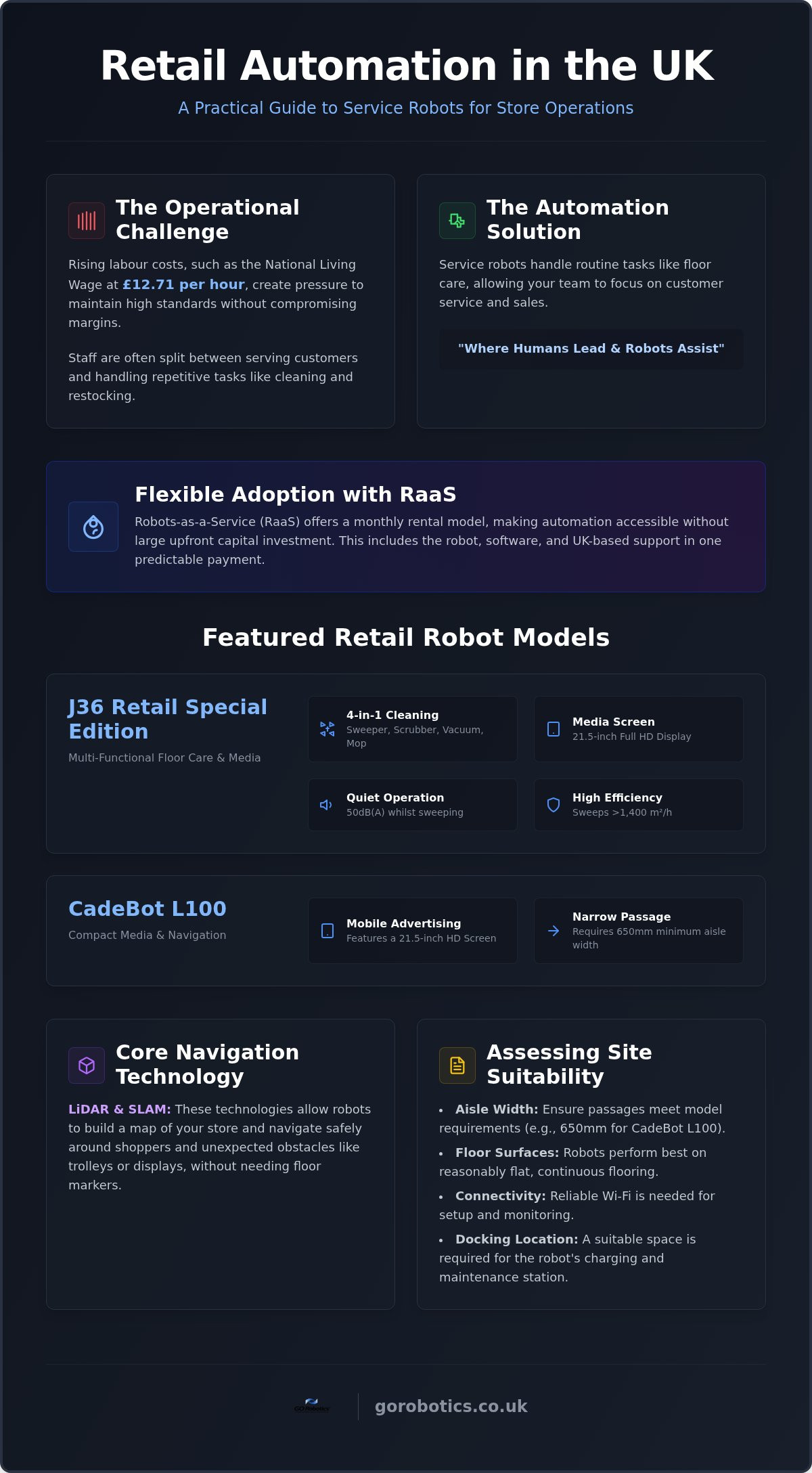
Maintaining a pristine shop floor while the National Living Wage sits at £12.71 per hour often feels like a choice between high standards and healthy margins. It's a common challenge for UK store managers who need to keep aisles clear and shelves stocked without disrupting the customer experience. Deploying a robot for retail UK environments is no longer a futuristic concept; it is a practical response to rising labour costs and staffing shortages.
You likely agree that consistent service is harder to achieve when your team is split between cleaning spills and serving customers. This guide shows you how autonomous service robots can take over repetitive tasks like floor care and stock replenishment whilst shoppers are in-store. We'll look at specific models that fit the retail environment, explain how to integrate them alongside your current staff, and examine why Robots-as-a-Service (RaaS), a monthly rental arrangement that includes the robot, software, and support, is becoming a preferred choice for British retailers. This is where humans lead and robots assist, helping your team focus on the shoppers who keep your business moving.
Key Takeaways
- Understand how a robot for retail UK handles repetitive floor care and stock tasks to help your staff focus on serving customers.
- Evaluate multi-functional units like the J36 Retail Special Edition, which combines floor cleaning with a full-height digital screen for in-store marketing.
- Learn how LiDAR and SLAM technologies allow robots to detect obstacles and navigate safely around shoppers without the need for floor markers.
- Assess your shop floor suitability by reviewing specific passage requirements, such as the 650mm minimum aisle width for the CadeBot L100.
- Discover how the Robots-as-a-Service (RaaS) model provides a flexible way to adopt automation through monthly rental and UK-based technical support.
Understanding the Role of Service Robots in UK Retail Operations
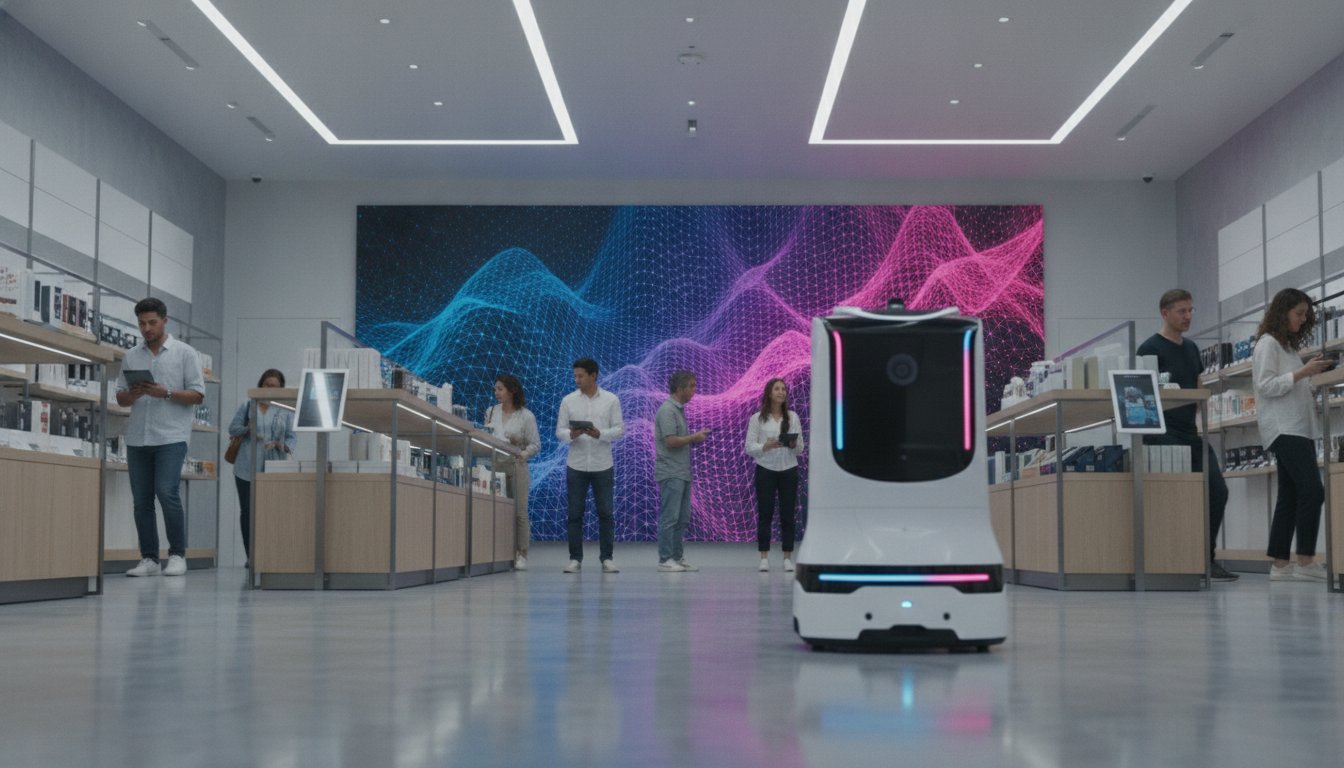
Service robots in a retail setting are autonomous tools engineered to handle specific, high-frequency tasks. They primarily focus on three areas: floor care, stock delivery, and interactive marketing. Unlike industrial machines confined to cages, a robot for retail UK is designed to navigate the dynamic environment of a busy high street store or supermarket. These units use several sensors to build a map of their surroundings, allowing them to move safely alongside people without the need for fixed tracks or wires.
These machines help businesses manage the increasing cost of operation. With the National Living Wage reaching £12.71 per hour in April 2026, retailers are looking for ways to maintain standards without overstretching their teams. The goal isn't to replace staff. Instead, it's about reallocation. This is a partnership where humans lead and robots assist, allowing your team to focus on the shoppers who drive your revenue. By automating the repetitive scrubbing of floors or the movement of stock from the warehouse, your employees can stay on the shop floor where they are most valuable.
Safety is the foundation of these deployments. When you introduce a robot for retail UK venues, it must be able to handle the unpredictability of a public space. Modern units use laser light and cameras to spot people and steer around them. They can detect small children, stray trolleys, and sudden obstacles in real-time. This allows them to work during peak trading hours, ensuring the environment remains clean and well-stocked whilst customers are present.
Why UK Retailers are Adopting Automation in 2026
Consistent service is the benchmark for success in 2026. Traditionally, floor cleaning happened after hours, often at a high cost or with inconsistent results. Autonomous floor care allows for continuous maintenance throughout the day. A clean environment improves the shopper's perception of the brand. When a robot handles the floor, your team stays on the shop floor to drive sales and provide expert advice. This shift ensures that physical stores remain competitive against online alternatives by offering a superior in-person experience.
The Concept of Robots-as-a-Service (RaaS)
Adopting new technology shouldn't require a massive initial investment. Robots-as-a-Service (RaaS) is a monthly subscription model that makes automation accessible to businesses of all sizes. It covers the hardware, the software, and ongoing technical support in one predictable payment. GO Robotics provides robots as a service UK wide, giving retailers the flexibility to scale their fleet based on seasonal demand. This model removes the risk of owning depreciating hardware while ensuring you always have access to the latest functional updates. Beyond the store interior, the broader category of autonomous delivery robots highlights how automation is streamlining the entire retail supply chain.
Core Categories: From Autonomous Floor Care to Interactive Media
Modern shop floor automation is specialised. When selecting a robot for retail UK stores, you'll typically choose between three functional categories: floor care, interactive advertising, and stock delivery. These units are no longer just single-purpose machines; they're becoming multi-functional assets that support your team throughout the trading day.
Autonomous Floor Cleaning for Large Sales Floors
The J36 Retail Special Edition is a 4-in-1 tool that acts as a sweeper, scrubber, vacuum, and dust-mop. It's built for large environments. The manufacturer quotes sweeping rates of over 1,400 m²/h and scrubbing rates exceeding 1,100 m²/h. Crucially for daytime use, it operates at a noise level of 50dB(A) whilst sweeping, which is quiet enough to avoid disturbing shoppers. Its 6-in-1 base station automates the maintenance cycle by handling charging, refilling, and draining without staff intervention. This ensures the floor remains pristine without pulling a cleaner away from other duties.
Moving In-Store Media and Advertising
Some units do more than clean or carry. The CadeBot L100 and the J36 Retail Special Edition both feature a 21.5-inch Full HD screen. This turns a functional tool into a mobile media asset. You can loop menus, promote loyalty sign-ups, or display supplier-funded advertisements. This capability aligns with the UK's national robotics strategy, which encourages the adoption of smart machines to drive economic value. By selling screen time to brands you stock, these robots can move from being an operational cost to a revenue-generating partnership. It's a way to engage customers with high-visibility marketing whilst they're already in the aisles.
For logistics, the PuduBot 2 serves as an everyday workhorse. It's designed for stockroom-to-shop-floor transfers, carrying heavy loads so your staff don't have to. Using multiple trays, it can transport replenishment stock or click-and-collect orders across the store safely. This reduces the physical strain on your team and keeps them available to assist shoppers. If you're unsure which category fits your layout, GO Robotics can recommend a model based on your specific operational needs and floor dimensions.
Navigating the Shop Floor: Safety, Sensors, and Shopper Interaction
Navigating a bustling shop floor requires precision. Every robot for retail UK deployment relies on a specialised array of sensors to move safely. Central to this is LiDAR, which uses laser light to detect people and obstacles in real-time. This is paired with SLAM, the mapping technology that lets a robot build a picture of its surroundings and navigate without fixed rails or wires. These systems provide 360-degree sensing, allowing the unit to spot a stray trolley or a shopper stepping out from an aisle instantly.
Retail environments are never static. Promotional pallets, seasonal displays, and dynamic aisle changes are constant. Modern service robots don't follow a rigid path; they calculate the most efficient route around temporary obstructions. This adaptability is a key focus of the UK's Smart Machines Strategy 2035, which highlights the importance of autonomous systems that can function safely in shared human spaces. By reacting to changes in seconds, these units maintain their workflow without requiring staff to clear a path.
Operating Safely Amongst the Public
Safety is paramount when working around children, the elderly, and pets. Units like the PuduBot 2 use multi-sensor fusion to reroute dynamically if a path is blocked. If a shopper stops to look at a shelf, the robot waits or steers around them with a wide berth. The BellaBot Pro takes this further with ground-projection safety patterns. It projects a light on the floor to alert guests at blind corners before it arrives. For added clarity, digital screens can display messages such as "sorry, we're cleaning" to communicate intent to shoppers clearly.
Marker-Free Deployment and Mapping
Older automation often required ceiling stickers or floor tracks. Modern hospitality robots UK venues use marker-free SLAM instead. This means your business avoids disruptive building works or unsightly rails. Setting up a robot for retail UK stores involves a technician walking the unit through the site to create a digital map. Models like the PuduBot 2 have a mapping capacity of up to 40,000 m², making them suitable for even the largest supermarkets and shopping centres. Once mapped, the robot knows its location within centimetres, ensuring it never gets lost even in complex, multi-aisle layouts.
Assessing Your Venue: Aisle Widths, Thresholds, and Connectivity
Before deploying a robot for retail UK stores, you must evaluate the physical constraints of your building. Aisle width is the primary factor that determines which model fits your environment. Compact units like the FlashBot Max require a minimum passage of only 600mm, whilst the CadeBot L100 needs 650mm to manoeuvre safely. For larger stockroom-to-shop-floor transfers, the PuduBot 2 requires a wider 800mm passage. These measurements ensure the unit can steer around shoppers and trolleys without causing congestion in high-traffic areas.
Floor surfaces and inclines also dictate performance. The J36 cleaning unit has a maximum climbing gradient of 8 degrees. This is sufficient for most standard ramps but may require a different route for steeper back-of-house inclines. Models like the CadeBot L100 feature automotive-grade suspension designed to absorb vibrations. This is particularly useful for crossing floor thresholds and the small gaps often found at lift entrances, protecting both the internal electronics and any stock being transported. If you are unsure whether your floor plan is suitable, you can request a site survey to get a professional assessment of your specific layout.
Connectivity and Fleet Management
Reliable operation depends on consistent data transfer. Most units require Wi-Fi or 4G connectivity to link with a cloud-based monitoring system. To prevent coordination issues in signal dead zones, some models use LoRa wireless as a backup. This ensures the fleet can still communicate and coordinate movements even if the main site Wi-Fi drops. Store managers can access a central dashboard to view live status updates, battery levels, and detailed task records. This visibility allows you to track cleaning coverage or delivery efficiency in real-time from a single tablet or computer.
Lift and Door Integration
Multi-floor retail environments require robots that can move between levels independently. Modern service units use IoT integration to call lifts and open automatic doors without human assistance. The FlashBot Max is a specialised choice for these settings as it requires no mechanical modification to the lift itself. These systems are compatible with major UK lift brands, including KONE and OTIS. This allows the robot to move between floors to clean different departments or deliver stock to various levels, ensuring that automation benefits every part of your store rather than being confined to a single floor.
Implementing Automation: The GO Robotics Approach to Retail Integration
Successful integration of a robot for retail UK stores starts with a detailed understanding of your specific environment. We begin every project with a site survey to evaluate your floor plan, customer traffic patterns, and network strength. This allows us to provide a written recommendation that matches a specific model to your operational goals. We don't just supply hardware; we provide a structured plan for how the unit will work alongside your existing team.
On-site staff training is a critical part of the deployment process. Your employees need to feel confident interacting with the unit, whether they are starting a cleaning shift or responding to a replenishment notification. Clear communication ensures that the robot is seen as a helpful tool rather than a complication. This reflects our approach where humans lead and robots assist, creating a professional partnership that improves store standards. We provide UK-based support and diagnostics to ensure your fleet stays active, rather than leaving you to deal with an overseas seller.
Evaluating Return on Investment (ROI)
Calculating the commercial value of automation requires looking at the time returned to your staff. Consider an illustrative example of a 3,000 m² store using a J36 floor care unit for two daily passes. This deployment might return approximately 5.5 cleaning hours per day to your team. Based on an illustrative fully-loaded labour cost of £15 per hour, which accounts for the £12.71 National Living Wage plus employer contributions, the annual labour value of this time is around £30,000. These figures are examples only; actual results depend on your specific venue, workflow, and how you choose to reallocate the released time.
Support, Maintenance, and Warranty
Reliability is essential for retail continuity. All units we supply for the UK market carry UKCA marking and a 12-month warranty as standard. Maintenance intervals are designed to fit around busy retail schedules. For example, the J36 typically requires a three-day gap between light maintenance tasks. We maintain a local stock of spares and provide UK-based engineers to handle any required repairs or software updates. For a more detailed look at autonomous floor care options, you can explore our commercial cleaning robot UK guide. If you are ready to see how these units fit your layout, GO Robotics can assess your site before recommending a service plan.
Modernising Your Retail Operations for 2026
Adopting a robot for retail UK stores is a strategic step toward a more efficient and consistent shop floor. Delegate repetitive tasks. By delegating floor care and stock replenishment to autonomous units, you allow your staff to focus on the high-value interactions that define the modern shopping experience. You've seen how models like the J36 and CadeBot L100 fit into different layouts, provided your aisle widths and connectivity are ready.
Transitioning to automation is straightforward with the right partner. As an authorised supplier of Pudu and UBTECH robotics, GO Robotics provides the expertise needed to integrate these machines into your daily workflow. Our RaaS models remove the barrier of high upfront costs; our UK-wide installation and technical support ensure your fleet remains productive.
Book a site survey with GO Robotics to assess your retail automation needs to discover which autonomous solution fits your venue. The future of retail is about precision and partnership. We're here to help you start that process today.
Frequently Asked Questions
How wide do the aisles need to be for a retail robot?
Passage requirements vary depending on the specific machine you select. The FlashBot Max needs a 600mm aisle, whilst the CadeBot L100 requires 650mm to manoeuvre safely. If you choose the PuduBot 2, you'll need at least 800mm for safe operation. These widths ensure the robot can navigate around shoppers without causing bottlenecks. We assess your specific layout during a site survey before recommending a robot for retail UK stores.
Can a retail robot operate safely around children and shoppers?
Safety is the primary design focus. Every robot for retail UK deployment uses LiDAR and 3D depth cameras to detect people and objects in real-time. This provides 360-degree awareness, allowing the unit to steer around children, trolleys, and staff instantly. Some models, such as the BellaBot Pro, also use ground-projection patterns to alert shoppers at blind corners before the robot arrives.
Do I need to modify my shop floor or lifts for the robot to work?
Most installations require no building works or mechanical changes. Modern units use marker-free SLAM technology to map your environment without ceiling stickers or floor rails. Lift integration with major brands like KONE and OTIS is handled via cloud-based or IoT hardware control, meaning no mechanical modification to the lift itself is necessary. This allows for a clean deployment that doesn't disrupt your existing infrastructure.
What happens if the robot breaks down or needs a spare part?
GO Robotics provides comprehensive UK-based support and technical diagnostics. If a unit requires attention, we maintain a local stock of spares and dispatch engineers to handle repairs. All robots we supply include a 12-month warranty as standard. Our team monitors the fleet via a cloud dashboard to identify and resolve many software issues remotely before they affect your daily trading.
Can a cleaning robot work during peak trading hours?
Cleaning units are specifically engineered for daytime operation. The J36 operates at a noise level of 50 dB(A) whilst sweeping, which is equivalent to a quiet conversation. This allows it to maintain the sales floor during peak trading hours without disturbing customers. Its 360-degree sensing ensures it moves smoothly around shoppers and temporary promotional displays whilst keeping the aisles pristine.
Is it better to buy a retail robot outright or use a RaaS subscription?
The choice depends on your capital strategy. Buying outright offers full ownership, but many UK retailers prefer the Robots-as-a-Service (RaaS) model. RaaS is a monthly subscription that covers the hardware, software, and technical support in one predictable payment. This avoids high upfront costs and provides the flexibility to scale your fleet or update to newer technology as your business grows.
How long does it take to train retail staff to use the robot?
Staff training is typically completed during the installation process. Because these units use marker-free deployment, commissioning time is reduced by roughly 75% compared with older systems. Your team will learn how to start tasks, respond to notifications, and perform light maintenance. Most employees feel confident using the robot after a single session, as the interfaces are designed for intuitive, daily operation.
Does the robot require a constant Wi-Fi connection to function?
Robots use Wi-Fi or 4G for cloud-based monitoring and task reporting. However, they don't necessarily stop if the signal is lost. Models like the CadeBot L100 use LoRa wireless as a backup to keep multiple units coordinated even if the site Wi-Fi drops. This ensures uninterrupted service and prevents collisions in areas with poor signal, such as deep stockrooms or reinforced lift lobbies.