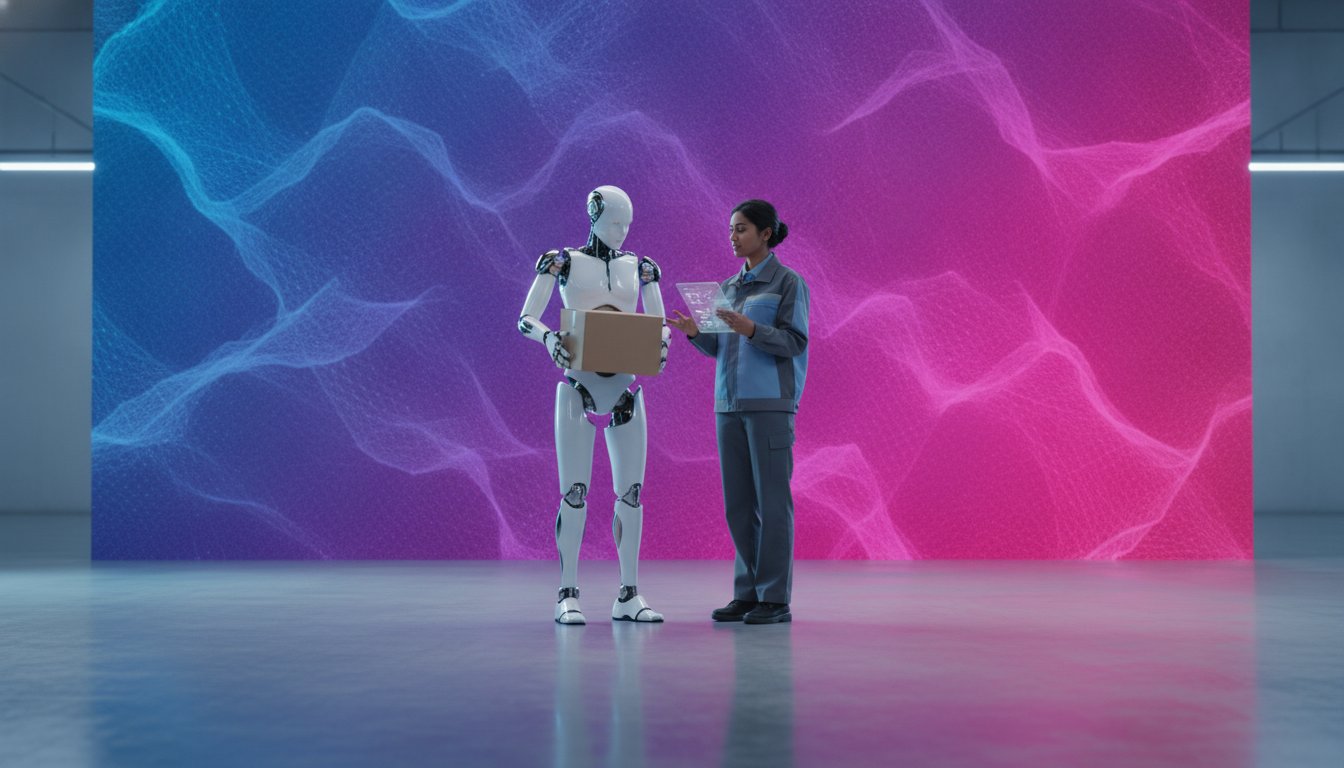
Unitree H1 UK: 2026 Guide to Humanoid Robot Applications
The sight of a 1.8-metre humanoid navigating a British warehouse is no longer a scene from science fiction; it's the 2026 reality for firms exploring Unitree H1 applications to outpace the competition. You've likely felt the pressure of rising labour costs, the National Living Wage, and the constant struggle to recruit for repetitive or hazardous roles. It's a common frustration to see operational costs climb whilst productivity plateaus because you can't find the right hands for the job. We understand that the jump to humanoid robotics feels like a massive leap, especially when you're weighing up the initial investment against long-term gains.
This guide shows you exactly how this 3.3 m/s record-breaker can stabilise your workforce and protect your margins. You'll discover how to integrate these units without the burden of high capital expenditure through a flexible Robotics as a Service model. We'll also detail how GO Robotics, incorporated on 24 November 2025, ensures your transition is seamless with nationwide support and expert installation. By the end of this article, you'll have a clear roadmap for deploying the H1 to assist your human team where they need it most, following our core philosophy: where humans lead and robots assist.
Key Takeaways
- Recognise why 2026 marks the definitive shift for humanoid robots from laboratory curiosities to essential assets in British industry.
- Identify high-impact Unitree H1 applications that solve labour shortages in logistics and industrial inspection by automating repetitive or hazardous roles.
- Evaluate the performance benefits of the M107 high-torque motors and how the H1’s record-breaking speed enhances your daily operational throughput.
- Compare the financial advantages of the Robotics as a Service (RaaS) model against traditional capital expenditure to optimise your company's cash flow.
- Gain peace of mind by partnering with GO Robotics, incorporated on 24 November 2025, for comprehensive UK-wide installation and professional site commissioning.
Understanding the Unitree H1: The Era of General-Purpose Humanoids in the UK
The Unitree H1 represents a seismic shift in how British enterprises approach automation. Standing at 1.8 metres, it's a full-sized, general-purpose humanoid designed to function in environments built for people. Whilst traditional robots often require expensive facility redesigns, the H1 integrates directly into your existing workflow. 2026 has become the tipping point for this technology. Rising labour costs and a scarcity of staff for repetitive or hazardous roles have made humanoid adoption a strategic necessity rather than a futuristic experiment. You can now deploy mobile, intelligent assistants that adapt to your space, rather than the other way around.
GO Robotics, incorporated on 24 November 2025, leads this transition with a clear philosophy: Where Humans Lead & Robots Assist. We don't view the H1 as a replacement for your team, but as a sophisticated tool that empowers them. By handling repetitive physical tasks, the H1 allows your staff to focus on high-value decision-making. Within our portfolio, the H1 sits alongside the Unitree Go2 and Pudu models, offering a versatile solution for complex Unitree H1 applications across diverse sectors like logistics and industrial maintenance.
What Makes the H1 Different from Traditional Automation?
The H1 breaks the "single-task" mould of 20th-century robotics. Most industrial robots are fixed to a floor or confined to a cage. In contrast, the H1 offers bipedal mobility. It navigates stairs, steps over thresholds, and moves through narrow warehouse aisles designed for human workers. This versatility is the core advantage. Instead of building a factory around a robot, you simply introduce the robot to the factory. It marks the transition from static machinery to a truly mobile, multi-tasking assistant that can switch from moving parcels to conducting site inspections without a hardware overhaul.
The Evolution of Unitree Robotics
The journey to the H1 is rooted in years of rapid iteration. You can explore the Unitree Robotics company history to see their progression from high-performance quadrupeds to the sophisticated humanoid form we see today. Unitree focuses on mass-production capabilities. This commitment drives down unit costs, making general-purpose robots accessible to UK firms of all sizes. In 2026, the H1-2 "Evolution" model stands as the gold standard, featuring enhanced joint torque and improved dexterity for demanding Unitree H1 applications in UK manufacturing. This model provides the reliability needed for continuous operation in busy commercial environments.
Technical Performance and Capabilities: Breaking Down the H1’s Specifications
The Unitree H1 is more than a feat of engineering; it's a powerhouse of industrial-grade components designed for the rigours of the British workspace. Central to its fluid movement are the M107 high-torque joint motors. These actuators provide a peak torque of 360 N.m, allowing the H1 to execute movements with a precision that mirrors human motion. This level of power density is vital for Unitree H1 applications that require the robot to carry payloads or exert force whilst maintaining its balance. The build quality reflects this industrial focus, utilising high-strength materials that ensure durability in busy warehouse or manufacturing environments.
Mobility and Speed: Setting New Standards
Speed is often the bottleneck in robotic adoption, but the H1 shatters these limitations. It holds a world record for full-sized humanoids with a walking speed of 3.3 m/s. In a practical UK facility, this means the H1 can keep pace with human colleagues, preventing logistical logjams. Its bipedal design is particularly advantageous in multi-floor UK heritage buildings or older industrial sites where narrow aisles and steep stairs make traditional wheeled robots impractical. The H1 handles uneven surfaces and external disturbances with ease; it remains stable even if bumped or if it encounters unexpected debris on a shop floor.
Sensing and AI: Navigating Complex UK Environments
Safe operation alongside your team is paramount. The H1 achieves this through a sophisticated fusion of 3D LiDAR and depth cameras, providing 360-degree obstacle avoidance. It uses real-time SLAM (Simultaneous Localisation and Mapping) to navigate without the need for floor markers or expensive infrastructure changes. This intelligence allows the robot to process environmental data instantly, adjusting its path to avoid moving people or equipment. If you are curious about how these sensors integrate into your specific layout, you can explore our technical consultation services for a detailed feasibility study.
To support full-shift operations, the H1 features an 864 Wh quick-swap battery. Whilst a single charge provides approximately 2 hours of continuous runtime, the ability to swap batteries in seconds ensures the robot stays active throughout the day. GO Robotics, incorporated on 24 November 2025, provides the necessary charging infrastructure and spare battery management as part of our comprehensive support package. This ensures that your Unitree H1 applications remain productive from the start of the morning shift until the final lights-out, providing a reliable robotic assistant that never tires.
Practical Business Applications for the Unitree H1 in 2026
By 2026, Unitree H1 applications have transitioned from experimental trials to essential operational workflows. British businesses are deploying these humanoids to tackle the 'three Ds': tasks that are dirty, dull, or dangerous. Unlike specialised machinery, the H1's general-purpose design allows it to adapt to various roles within a single shift. Whether it's supporting public sector facilities or enhancing private manufacturing, the focus remains on our core principle: where humans lead and robots assist. This approach ensures your staff are freed from high-risk or monotonous duties to focus on oversight and complex problem-solving.
Industrial Inspection and Hazardous Environments
Safety is the primary driver for adoption in the industrial sector. The H1 conducts routine checks in areas that pose significant risks to human health, such as high-voltage zones or chemical storage units. By integrating thermal imaging and gas sensors, the robot provides real-time facility monitoring without exposing your team to harm. This proactive safety measure does more than protect lives; it can lead to reduced insurance premiums by demonstrably limiting human exposure to high-risk zones. It's a pragmatic solution for UK firms looking to modernise their safety protocols whilst maintaining rigorous inspection schedules.
Logistics, Warehousing, and Complex Material Handling
Many UK warehouses are 'brownfield' sites, older buildings with tight corners and uneven floors that are not optimised for traditional Automated Guided Vehicles (AGVs). The H1 excels here. Its bipedal movement allows it to sort and move parcels in spaces where wheeled robots struggle. In large hospitality or multi-use venues, the H1 can work seamlessly alongside the Pudu BellaBot to manage back-of-house logistics. Because it can use human tools and operate standard trolleys without modification, it integrates into your current setup without requiring a total infrastructure overhaul.
Research, Development, and Future-Proofing
Beyond the warehouse floor, the H1 serves as the standard platform for UK university robotics departments and corporate R&D labs. Its open architecture allows for the development of bespoke AI behaviours tailored to specific corporate workflows. GO Robotics, incorporated on 24 November 2025, supports these pioneers by providing a stable hardware base for testing human-robot interaction in controlled environments. Investing in Unitree H1 applications today means your business is ready to lead as autonomous technology continues to evolve, ensuring your workforce remains at the cutting edge of global industry standards.
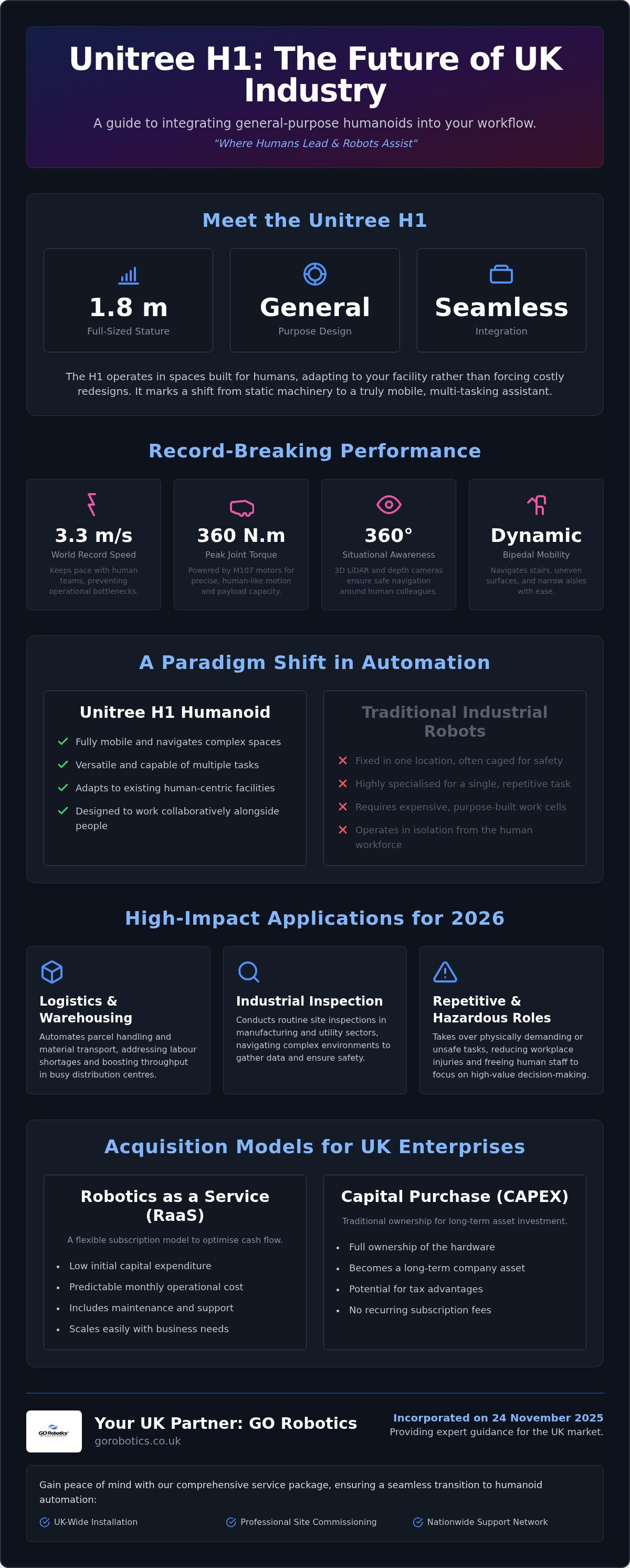
Buying Guide: RaaS vs Capital Purchase for UK Enterprises
Deciding how to fund your transition into humanoid robotics is as vital as the technology itself. In 2026, UK business leaders face a choice between traditional capital expenditure (CapEx) and the increasingly popular Robots-as-a-Service (RaaS) model. Whilst purchasing a unit outright offers long-term ownership, it requires a significant upfront investment and places the burden of maintenance on your internal teams. For many, the subscription-based OpEx model is the more agile choice. It allows you to deploy Unitree H1 applications immediately whilst preserving cash flow for other areas of business growth.
The Robots-as-a-Service (RaaS) Advantage
The RaaS model removes the primary barrier to entry: high initial costs. By choosing a subscription, you gain access to the H1 without a massive capital outlay. This flexibility is perfect for scaling your fleet; you can add units during peak periods or reduce them as demand fluctuates. A major benefit of this approach is the inclusive support. Our Robots as a Service UK package ensures that repairs, parts, and technical support are managed by experts. You don't have to worry about the robot becoming obsolete or facing unexpected repair bills, as your subscription typically covers the latest software updates and hardware maintenance.
Calculating ROI: Labour Costs and Efficiency Gains
Profitability hinges on a clear understanding of the return on investment. With the UK National Living Wage rising to £12.71 from April 2026, the financial argument for humanoid assistance is stronger than ever. A robot doesn't require pension contributions, holiday pay, or sick leave. When you compare the cost of a robot working multiple shifts against human shift patterns, the savings become apparent very quickly. However, the true value lies in 'hours returned' to your skilled staff. By offloading menial, repetitive tasks to the H1, your team can focus on higher-value roles that require human creativity and empathy. This shift often leads to improved staff retention and lower recruitment costs in sectors typically plagued by high turnover.
GO Robotics, incorporated on 24 November 2025, is dedicated to helping you navigate these financial complexities. We provide transparent models that factor in your specific operational needs and local labour market conditions. Our goal is to ensure your investment is both sustainable and high-performing from day one. To see how these figures apply to your specific facility, you can request a personalised ROI breakdown from our consultancy team. We'll help you determine which model best supports your long-term vision for a modern, assisted workforce where humans lead and robots assist.
Deploying the Unitree H1 with GO Robotics: Your UK Support Partner
Choosing the right hardware is only the first step in your automation journey. True transformation requires a partner who understands the local landscape and the specific demands of British industry. GO Robotics, incorporated on 24 November 2025, stands as that partner. We provide nationwide supply, professional installation, and the ongoing support needed to turn technical potential into operational reality. We handle the complex commissioning process, ensuring your robot is ready to perform from the moment it arrives on your shop floor. Our commitment is to provide a seamless transition that respects your existing infrastructure whilst preparing you for a more efficient future.
Professional site mapping is the foundation of every successful deployment. Our engineers conduct a detailed analysis of your facility to create a digital twin that the H1 uses for navigation. This ensures that the robot moves safely around staff and equipment, even in the most challenging Unitree H1 applications. We don't just deliver a machine; we integrate a sophisticated assistant into your workflow. To ensure you get the best possible start, we offer a free site survey and a tailored recommendation report for every prospective client. This allows you to understand the exact impact of humanoid robotics on your specific facility before making a commitment.
Nationwide Installation and Staff Training
Empower your workforce by involving them in the transition. Our training programmes are designed to ensure your team feels supported, not replaced. Following our core philosophy—where humans lead and robots assist—we teach your staff how to supervise and collaborate with the H1 effectively. We can customise the H1's voice and interaction style to match your brand's personality, making the robot feel like a natural extension of your team. This collaborative approach reduces friction and ensures that your staff can focus on the high-value tasks that require human decision-making and expertise.
Ongoing Maintenance and Technical Assistance
Secure your investment with our comprehensive UK-based support network. We provide remote monitoring and diagnostics to identify and resolve potential issues before they cause downtime. Regular software and firmware updates are included to enhance your robot's capabilities and ensure your Unitree H1 applications stay at the cutting edge of performance. Our service model provides you with peace of mind through:
- Rapid-response technical support: UK-based experts ready to assist with any operational queries.
- Local spare parts inventory: Ensuring minimal delays if hardware repairs are required.
- Preventative maintenance schedules: Regular check-ups to keep your H1 in peak physical condition.
Optimise your layout and secure your future by partnering with a provider that prioritises your operational continuity. We are here to guide you through every stage of the adoption process, from the initial survey to the long-term scaling of your robotic fleet. Take the first step toward a more modern, assisted workforce by booking your site assessment today.
Lead the Future of British Industry Today
The transition to humanoid robotics is no longer a distant prospect; it's a strategic imperative for 2026. By leveraging the advanced motor torque and record-breaking mobility discussed earlier, you can automate hazardous and repetitive tasks with unprecedented precision. Exploring diverse Unitree H1 applications allows your business to offset rising labour costs whilst empowering your existing staff to focus on higher-value oversight. Choosing the Robots-as-a-Service model ensures you can scale without the burden of heavy capital expenditure.
GO Robotics, incorporated on 24 November 2025, provides the expert guidance you need to succeed. We offer comprehensive nationwide coverage, including professional installation, staff training, and UK-based diagnostics to keep your operations running smoothly. We're here to ensure your journey into automation is both reliable and seamless. Book a Free Site Survey for your Unitree H1 Deployment today and discover how we can help you build a more efficient, assisted workforce. The future of your operations starts with a single, expert step.
Frequently Asked Questions
What is the maximum payload the Unitree H1 can carry?
The Unitree H1 is designed for agility and precision, offering a payload capacity of approximately 7 kg. Whilst this is lower than heavy-duty delivery models like the PuduBot 2, it's perfectly suited for the intricate tasks found in research and industrial inspection. This capacity allows it to carry specialised sensors, thermal cameras, or small tools through complex environments that are inaccessible to traditional wheeled automation.
Can the Unitree H1 climb stairs in a typical UK office or hotel?
Yes, the H1's bipedal design allows it to navigate stairs, thresholds, and slopes that would stop a wheeled robot. This makes it an ideal choice for older UK buildings where floor levels are often uneven. Its sophisticated balance algorithms ensure it remains stable whilst ascending or descending, allowing it to move between different levels of an office or hotel without requiring expensive structural modifications for every small step.
How long does the battery last on a single charge during active use?
You can expect approximately 2 hours of continuous runtime from the H1's 864 Wh quick-swap battery. To support full-shift operations, we recommend using a rotation of batteries that can be swapped in seconds. This ensures your Unitree H1 applications remain active throughout the day without significant downtime. Charging a depleted battery to full capacity takes around 2.5 hours, allowing for a seamless cycle of power management in busy commercial settings.
Is the Unitree H1 safe to operate around the general public?
Safety is built into the H1's core through a fusion of 3D LiDAR and depth cameras. These sensors provide 360-degree awareness, allowing the robot to detect and avoid people, furniture, and unexpected obstacles in real-time. Whilst it's highly capable, we usually recommend initial deployment in controlled industrial or research environments. This ensures your team becomes comfortable with the robot's movements, following our philosophy where humans lead and robots assist.
Do I need to modify my building to use a humanoid robot?
No structural modifications are required to begin using the H1 in your facility. Unlike older robotic systems that rely on floor tracks or ceiling markers, the H1 uses advanced marker-free SLAM technology to map and navigate its surroundings. It's designed to function within existing human infrastructure, meaning it can use the same doors, corridors, and stairs as your staff. This significantly reduces the initial setup time and cost for most UK businesses.
What is the difference between the Unitree H1 and the Unitree Go2?
The primary difference lies in their physical form and intended use cases. The Unitree H1 is a 1.8-metre tall humanoid robot designed for general-purpose tasks that require a human-like reach and bipedal movement. The Unitree Go2 is a quadruped robot, often referred to as a robotic dog, which excels in high-speed traversal over rough terrain and low-profile inspections. Both models share the same high-quality engineering and advanced sensing capabilities found in our portfolio.
How does the GO Robotics RaaS model work for humanoid robots?
Our Robots-as-a-Service (RaaS) model allows you to access cutting-edge technology via a predictable monthly subscription. This covers the hardware lease, software licensing, and cloud management tools, effectively turning a large capital expense into a manageable operational cost. GO Robotics, incorporated on 24 November 2025, includes comprehensive maintenance and remote technical support within this package. This ensures your fleet remains future-proof with regular updates and expert assistance without the worry of unexpected repair bills.
What kind of maintenance does a humanoid robot require?
Humanoid robots require a combination of preventative hardware checks and regular software updates. Our team handles the technical heavy lifting, providing remote monitoring and diagnostics to ensure peak performance. Physical maintenance involves checking joint actuators, cleaning sensors, and inspecting the chassis for wear. By choosing our support package, you gain access to UK-based technical assistance and a local inventory of spare parts, ensuring your Unitree H1 applications remain a reliable asset for years to come.


