Ways to Reduce Employee Workload in Hospitality: Practical Ideas for UK Venues
The busiest parts of a hospitality shift can leave staff juggling routine jobs while guests wait for attention. The most useful ways to reduce employee workload in hospitality start with identifying tasks that can be simplified, shared or supported by equipment, without taking service decisions out of people’s hands.
When workloads peak, repetitive duties can crowd out guest-facing work and make everyday routines harder to manage. Reducing that pressure doesn’t have to mean replacing staff. It means looking closely at how work is organised, what can be reassigned and where a practical change could give the team more room to focus.
This article compares process changes with targeted automation, including how the J20 can assist with guest-room floor cleaning alongside housekeepers. You’ll find ways to assess which tasks may suit automation, protect time for work that needs human judgement and decide whether a robot fits your venue and its layout.
Key Takeaways
- Find ways to reduce employee workload in hospitality by identifying repetitive tasks that interrupt guest-facing work, then simplify or rebalance them rather than cutting headcount.
- Try practical changes such as clearer task ownership, better shift handovers and consistent routines before investing in equipment.
- Compare process changes, digital tools and robots by task fit, staff involvement, setup needs and ongoing support.
- Introduce change in stages: define the task, consult staff, assess options, run a trial and review what happens.
- The J20 can assist with guest-room floor cleaning alongside a housekeeper or finish the room after they leave. It supports, rather than replaces, the housekeeping team.
Ways to reduce employee workload in hospitality start with finding the pressure points
During a busy hotel check-in, a receptionist may be answering guest questions, handling repeated booking checks and leaving the desk to collect paperwork. The pressure may not come from staffing levels alone. Routine steps can interrupt guest service, while unclear task ownership can leave two staff members checking the same thing or assuming someone else has done it.
Reducing workload means removing avoidable friction and sharing tasks more clearly, not cutting headcount. Start by separating temporary peaks, such as a breakfast rush, from routines that create pressure every shift. Then distinguish repeatable work from tasks that call for judgement, care or a personal conversation with a guest. For a useful starting definition, understanding employee workload means considering both the amount of work and how demanding it feels to the person doing it.
Which hospitality tasks create avoidable pressure?
Map recurring work across front-of-house, housekeeping and back-of-house. Note which tasks involve direct guest contact and which involve routine movement, cleaning or administration. A housekeeper preparing a room, for example, may need to walk back and forth for supplies. A restaurant team member may be interrupted by repeated trips to collect items stored away from the service area.
Ask staff where the shift regularly slows down, then observe a typical service period to see what happens in practice. Staff feedback can reveal friction that’s easy to miss from a rota or procedure document. Observation helps show whether the cause is a busy period, a poorly placed item or a handover that leaves responsibilities unclear.
How to identify the right starting point
For each recurring task, record who does it, when it happens and what it interrupts. Look for duplicated checks, gaps between shifts and repeated trips between work areas. These signs don’t automatically mean you need a new tool or piece of equipment. They indicate where a closer review may help.
Use this checklist to decide whether a workflow deserves attention:
- Staff regularly pause guest-facing work to complete routine tasks.
- The same information or work gets checked more than once.
- Handover notes leave responsibility or next steps unclear.
- Team members make repeated trips for supplies, equipment or paperwork.
- A task is delayed or missed during predictable busy periods.
Choose one frequent, clearly defined task to review first. That gives you a manageable starting point and makes it easier to understand whether a change helps. The most practical ways to reduce employee workload in hospitality begin with work your team can describe and observe, not assumptions about what should be automated.
Five practical ways to reduce hospitality workload before buying equipment
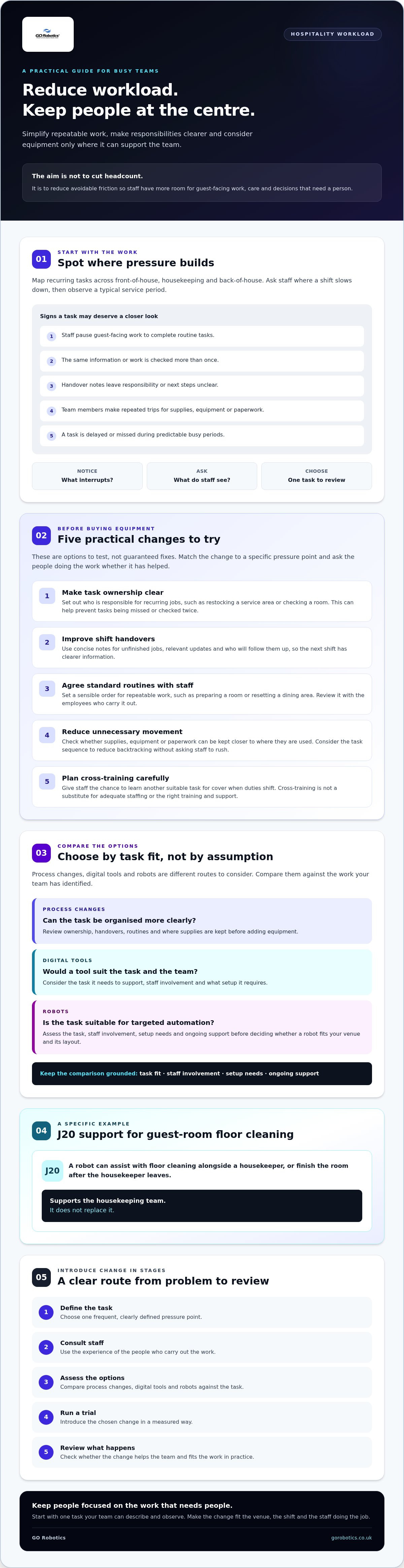
Before investing in equipment, look at how tasks are assigned and carried out. These five changes are options to test, not guaranteed fixes. Choose the one that addresses a specific pressure point in your venue, then ask the staff doing the work whether it has helped.
- Make task ownership clear. Set out who is responsible for recurring jobs, such as restocking a service area or checking a room. Clear ownership can prevent tasks being missed or checked twice.
- Improve shift handovers. Use concise notes to record unfinished jobs, relevant updates and who will follow them up. A consistent handover can help the next shift avoid repeating questions or checks.
- Agree standard routines with staff. Set out a sensible order for repeatable work, such as preparing a room or resetting a dining area. Review the routine with the employees who carry it out, so it reflects how the job works in practice.
- Reduce unnecessary movement. Check whether supplies, equipment or paperwork can be kept closer to where they’re used. Consider the task sequence too. Grouping related jobs may reduce backtracking without asking staff to rush.
- Plan cross-training carefully. Giving staff a chance to learn another suitable task can help with cover when duties shift during service. It shouldn’t be treated as a substitute for adequate staffing or as a reason to assign work without the right training and support.
Simplify schedules, handovers, and recurring routines
Make shift priorities visible and specific. Rather than relying on a general instruction to “prepare for service”, clarify which tasks need attention and who owns each one. Keep handover notes brief enough to use during a busy shift, but clear about what remains to be done. Review written routines with the team and adjust them where steps cause confusion or unnecessary delays.
Remove avoidable repetition without rushing service
Look for information being recorded in more than one place, repeated checks without a clear reason, or tasks being done in an order that creates extra trips. A suitable digital tool may help if it removes a defined manual step. Adding software without changing the process, however, can create another task to manage. Keep safety checks and personal assistance for guests under appropriate human oversight.
Make one change first. Explain what you’re testing, invite staff feedback and review whether task completion, handovers or interruptions have changed before extending the approach to other shifts. If automation is also under consideration, you can review commercial robots for hospitality as one option alongside process changes.
Compare process changes, digital tools, and robots for hospitality teams
The right choice depends on what’s causing the pressure. If staff are unclear about who does a task, a robot won’t fix the handover. If a clearly defined job involves repeated movement or cleaning, a tool or robot may be worth assessing. Practical ways to reduce employee workload in hospitality start with matching the intervention to the task, the venue and the way each shift operates.
| Approach | Best task fit | Staff involvement | Setup and ongoing support |
|---|---|---|---|
| Process redesign | Unclear ownership, duplicated checks or work done in an awkward order. | Staff agree and follow clearer steps; people retain responsibility for decisions and guest care. | Review the existing routine with the team, then check that the revised process works during service. |
| Digital tools | A defined manual step, such as recording or sharing task updates, that a suitable tool can handle more clearly. | Staff enter, review or act on information. The tool supports the process rather than taking responsibility for judgement. | Choose a tool that fits the task and consider how staff will learn and use it alongside existing procedures. |
| Robotic assistance | Suitable repetitive physical work, such as carrying items or cleaning, where the venue and task allow. | Staff prepare and oversee its use, while handling guest care, exceptions and decisions that need human judgement. | Check the venue layout, task, route and operating requirements. Plan for setup, staff instruction and ongoing support. |
When a process change is enough
If confusion or duplicated effort is the main issue, start with the process. Clarify who owns each step and put tasks in an order that makes sense for the shift. That may address the source of pressure without adding equipment. Review the change with the employees who carry out the work, and don’t assume it will save a set amount of time without measuring it in your own venue.
When a robot may assist with repetitive work
A delivery robot might suit a defined task moving items along an appropriate route. A cleaning robot may be worth considering for recurring floor-care work. Neither is right for every venue. Staff still handle guest conversations, unusual situations and work requiring judgement. They may also need to supervise a task or system as it is introduced.
Assess the route, layout and day-to-day operating requirements before deciding. For more context on possible uses and considerations, see Hospitality Robots UK: The Comprehensive Guide to Service Automation in 2026. Treat it as a starting point for assessment, not a substitute for checking whether a particular robot fits your venue.
How to choose and introduce a workload-reduction approach
A change is more likely to help when it addresses a specific task rather than a general feeling that the team is stretched. Use a simple sequence: define the task, consult the people who do it, assess possible changes, trial one approach, then review what happened. This keeps the decision grounded in how your venue actually runs.
- Define: Describe the task, when it occurs, who handles it and what it interrupts.
- Consult: Ask staff where the process causes delays, repeated effort or uncertainty.
- Assess: Consider whether clearer steps or task ownership would help before adding a digital tool or equipment.
- Trial: Test one change in a suitable part of the operation and make responsibilities clear.
- Review: Check whether tasks are completed as intended, handovers are clearer and staff feedback supports keeping the change.
Look at both the work and its effect on the team. A task may be completed but still cause avoidable interruptions or leave staff unclear about what happens next. Agree what you’ll observe before the trial, then use staff feedback alongside practical checks rather than assuming the change has worked.
Assess the task and the venue before selecting technology
For automation, map the task from start to finish, including the route, working environment and points where a person must step in. Consider normal operating conditions as well as busy periods. First ask whether a process change could address the issue. Equipment won’t resolve unclear ownership or a poorly planned routine.
A suitable assessment can help determine whether a particular type of equipment fits the task and venue, and what setup may be needed. Let the requirements you’ve identified guide the recommendation, rather than choosing equipment first and trying to fit it into the process.
Introduce changes with staff involvement
Include the employees who perform the task in planning and trial feedback. Explain what is changing, who is responsible for operating or overseeing it, and when staff should handle exceptions. If equipment is involved, arrange suitable instruction before relying on it in day-to-day work. For more on preparing a team for this stage, see Robot Installation and Staff Training: What to Expect.
After the trial, review task completion, handover clarity and staff comments. Keep, adjust or stop the change based on what you observe. These ways to reduce employee workload in hospitality work best when the team can see how a change supports service rather than adding another process to manage.
If you’re considering automation, discuss your venue’s requirements with GO Robotics before choosing equipment.
Use the J20 to support guest-room housekeeping, not replace the team
Housekeeping involves more than floor cleaning. Staff prepare rooms, check details, respond to changing priorities and make sure each space is ready for the next guest. A cleaning robot can assist with a defined, repetitive part of that work, but it can’t take over the housekeeper’s wider responsibilities or the judgement those tasks require.
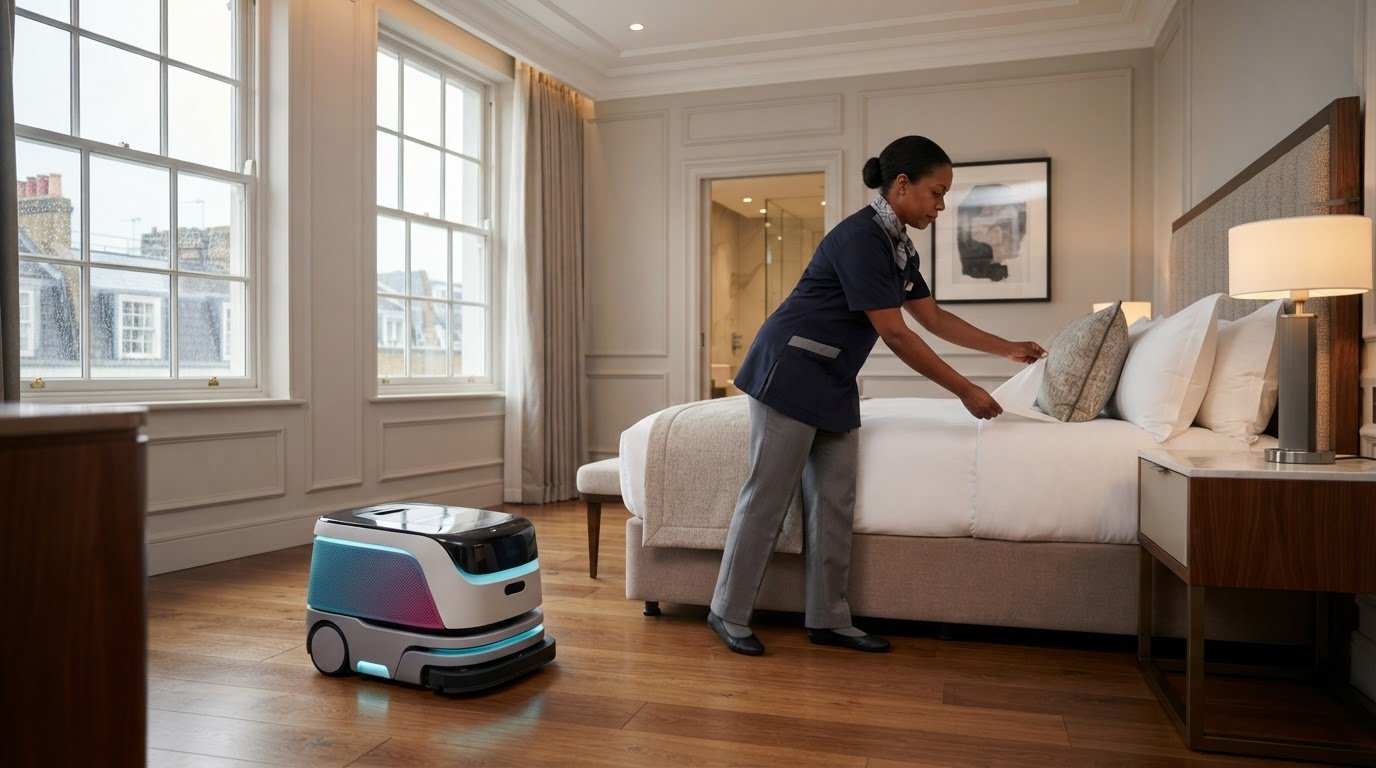
The J20 is a commercial cleaning robot for guest rooms in UK hospitality venues. It can work alongside a housekeeper or finish cleaning the room after the housekeeper leaves. Staff involvement is needed until the robot is running as intended.
Which housekeeping task the J20 is designed to assist with
Keep the use case specific: guest-room floor cleaning, rather than general hotel cleaning. The brochure states “5 + min” of housekeeper time saved per room and “25 %” less time to turn a guest room. These are brochure figures, not guaranteed results for every hotel. Suitability and performance depend on the room, routine and working conditions.
The aim is to support housekeeping staff with a repetitive task, not replace their role. Housekeepers remain responsible for preparing rooms, checking their condition, responding to exceptions and completing work that calls for a person’s judgement.
What to assess before considering a cleaning robot
Before choosing equipment, review room layouts, floor areas and existing cleaning routines. Consider where the robot would operate, how its task fits around the housekeeper’s work, and which steps need a person to start or check the process. Discuss how staff involvement will work as the robot is introduced.
GO Robotics provides installation, mapping, commissioning and staff training. Discuss these practical requirements alongside the brochure figures, and agree how you’ll review a trial with housekeeping staff. For further background on autonomous floor care, see Commercial Cleaning Robot UK: The 2026 Guide to Autonomous Floor Care.
The J20 is one possible part of a broader plan to reduce employee workload in hospitality. If guest-room floor cleaning is a recurring pressure point, assess the task, layout and staff workflow before deciding whether a robot is a suitable fit.
Start with one practical change for your team
The most useful ways to reduce employee workload in hospitality begin with finding where routine tasks interrupt service. Clarify task ownership, improve handovers and review recurring routines with the staff who carry them out. If a process change isn’t enough, compare suitable digital tools or automation against the specific task and your venue’s requirements.
Keep people at the centre of the decision. Robots can assist with repetitive work, but guest care, exceptions and decisions that need human judgement remain with your team. For housekeeping, the J20 brochure states “5 + min” of housekeeper time saved per room. GO Robotics provides installation, staff training and ongoing technical assistance, so you can consider the task and setup before deciding whether it fits.
Start with one task and involve your staff in reviewing the result. Discuss your venue’s requirements with GO Robotics to explore whether the J20 could suit guest-room floor cleaning.
Frequently Asked Questions
What are practical ways to reduce employee workload in hospitality?
Start by identifying recurring tasks that interrupt service, then check whether clearer processes can reduce the pressure. Assign ownership for routine duties, make shift handovers concise, agree practical steps with staff and reduce unnecessary trips between work areas. If a task still creates a repeated burden, assess whether a suitable digital tool or robot could assist. Trial one change and review task completion and staff feedback before making it standard practice.
Can robots reduce workload without replacing hospitality staff?
Yes. Robots can assist with specific repetitive tasks while staff continue to manage guest care, exceptions and decisions that need human judgement. For example, the J20 is designed to assist with guest-room floor cleaning alongside a housekeeper or finish the room after they leave. Staff involvement is needed until the robot is running as intended. Assess the task and venue first rather than assuming automation suits every team.
How can hotels reduce housekeeping workload?
Hotels can review room-cleaning routines, clarify task ownership, improve handovers and consider whether supplies or steps can be arranged to reduce unnecessary movement. For guest-room floor cleaning, the J20 brochure states “5 + min” of housekeeper time saved per room. This is a brochure figure, not a guaranteed result for every property. Housekeepers remain responsible for preparing rooms, checking their condition and handling work that needs human judgement.
Is a cleaning robot suitable for every hospitality venue?
No. Suitability depends on the specific cleaning task, room layout, floor area, staff workflow and operating requirements. A robot intended to assist with guest-room floor cleaning may not suit a venue’s rooms or routines. Before choosing equipment, review where and when it would be used, how staff involvement would work and whether a process change could address the issue instead. Discuss the proposed use and venue requirements before deciding.
How should a hospitality business decide which tasks to automate?
Choose a frequent, clearly defined task that involves repeatable work, then map who does it, when it occurs and what it interrupts. Ask staff whether clearer ownership or a revised process could solve the problem before considering equipment. If automation remains an option, assess the venue, route and operating requirements. Trial one change, then review whether the task is completed as intended and gather feedback from the employees involved.
Does reducing employee workload mean asking staff to do more?
No. Workload reduction should mean removing avoidable friction or balancing responsibilities more clearly, not adding duties without support. Cross-training may help with cover when tasks shift, but it shouldn’t replace adequate staffing or suitable training. Involve employees when reviewing routines and ask whether a proposed change reduces interruptions or creates extra steps. If the workload remains difficult to manage, revisit task priorities and staffing needs rather than expecting staff simply to work faster.
What should a hotel check before introducing a housekeeping robot?
Check room layouts, floor areas, cleaning routines and how the robot’s task would fit into a housekeeper’s workflow. Decide which steps need a person to start or check the work, and ask staff to identify practical concerns before a trial. For the J20, compare the hotel’s guest-room floor-cleaning needs with the role described in its brochure. Agree how you’ll review task completion and staff feedback, and discuss whether the proposed use fits your venue.