How Service Robots Improve Hygiene Through Targeted Cleaning
Service robots can support hygiene standards by carrying out routine floor cleaning on planned routes and limiting unnecessary foot traffic in designated areas. They support a cleaning programme, but sweeping, vacuuming or scrubbing does not disinfect a surface.
That distinction matters in hospitals, care settings and food operations. Floors and high-touch surfaces need different cleaning approaches, while spills and contamination require appropriate procedures. A completed robot route does not prove that every area meets the required standard, so inspection and follow-up remain essential. Automation supports the cleaning team; staff judgement is still needed.
This article explains how service robots fit into routine floor cleaning, how planned cleaning can reduce disruption, and how inspection robots may help limit entry into designated areas. It also explains why disinfection, high-touch cleaning and specialist contamination procedures remain part of a wider programme, particularly in healthcare. The key is to use automation for suitable routine tasks while people and established processes guide the overall hygiene programme.
Key Takeaways
- Define which routine floor-cleaning tasks a robot can carry out, and keep high-touch surfaces and specialist contamination procedures within the wider cleaning programme.
- Use robots to reduce unnecessary staff movement through product-dedicated areas, while keeping people responsible for cleaning decisions and oversight.
- Plan cleaning around the needs of each space, including when routes run and which areas need attention.
- Choose a robot according to the task: floor-cleaning machines and disinfection equipment do different jobs.
- Treat a completed route as a record of activity, not proof that every area meets the required standard; retain inspections and follow-up.
Separating routine floor cleaning from high-touch surface cleaning
How do robot cleaning results compare with manual cleaning? A robot can repeat an assigned floor route, while a person can assess changing conditions and respond to unusual mess. Teams can review route records to assess routine coverage, then inspect areas needing attention. Neither method alone shows that every surface has been cleaned to the required standard.
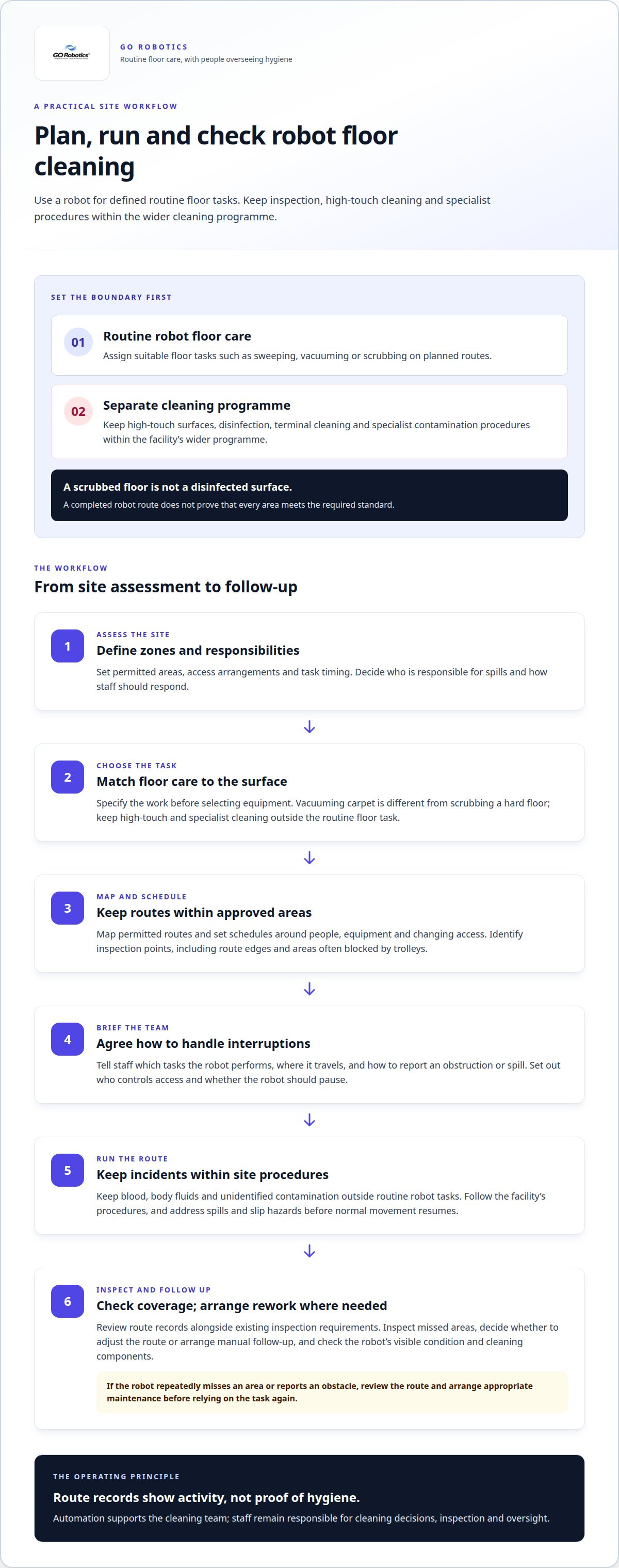
Floors and high-touch points have different roles in a cleaning plan. A corridor floor receives different contact from a bedrail, door handle or shared touchscreen. Assign a robot only floor-care tasks such as sweeping, vacuuming or scrubbing, and keep touchpoints on a separate cleaning schedule. A scrubbed floor is not a disinfected bedrail.
What UK hygiene and infection-control rules apply to service robots? Healthcare facilities should use robots only for floor tasks approved in their own infection-control procedures, keeping high-touch cleaning, terminal cleaning and specialist contamination within the wider programme. IEC 63327 covers safety requirements for automatic commercial floor-treatment machines; it does not establish that a healthcare cleaning task has been completed correctly.
Complex sites need clearly defined zones and routes. A hospital corridor, consultation room and treatment area may have different access arrangements and cleaning priorities. Before mapping a route, define permitted areas, task timing and who is responsible for spills. Keep blood, body fluids and unidentified contamination outside routine robot tasks, and follow the facility’s procedures for these incidents.
What steps are needed to deploy and maintain a hygiene service robot? Assess the site, approve the robot’s floor-care tasks, map routes, set schedules and compare results with existing inspection requirements. Include equipment checks in routine maintenance, such as checking its visible condition and cleaning components. If it repeatedly misses an area or reports an obstacle, review the route and arrange appropriate maintenance before relying on the task again.
How do service robots help manage cross-contamination risks and check cleaning quality? Defined zones and task-specific equipment help separate routine floor care from high-risk cleaning, while staff oversee methods and inspect results. A route record shows activity, not proof of hygiene. Inspections should identify missed areas and prompt rework where needed.
Soft floors need a method suited to their material. Vacuuming carpet is distinct from scrubbing a hard floor, so specify the required task before selecting equipment. If considering the co-botic 1700, don’t infer HEPA filtration from its name or assume filtration proves surface disinfection. HEPA describes air filtration; it does not show that a floor or high-touch surface has been disinfected.
In busy public corridors, scheduled floor care can support consistent routines, but routes must account for people, equipment and changing access. Set inspection points at route edges and areas often blocked by trolleys. These give staff specific places to assess coverage and decide whether to adjust the route or arrange manual follow-up.
Reducing human presence near products to minimise contamination
In food production, inspection robots may reduce unnecessary human entry into designated areas. This can help when staff would otherwise walk through a controlled zone simply to check a location. For example, an autonomous inspection route along an approved aisle can gather routine observations, leaving people to investigate flagged issues or carry out tasks requiring direct handling. The robot supports site controls; it does not prevent contamination by itself.
Plan the robot’s route around the production process. Keep it away from exposed ingredients, packaging work and changeover activity unless facility procedures allow access. A practical deployment plan identifies permitted areas, inspection points and the staff member responsible for responding to findings. If a production line changes, review the route before restarting the task so the robot does not enter a newly restricted area.
Assess water and chemical use from records rather than assuming automation reduces consumption. For a floor-cleaning task, record the solution prepared, the area treated and any repeat passes. Compare records for the same type of shift and area, then check whether the method suits the floor and the approved site procedure. An autonomous routine may help apply a consistent process, but it does not prove lower consumption.
Plan for slip hazards as part of cleaning. In a loading area, a spill may need immediate attention before a scheduled route reaches it. Set out how staff report the hazard, who controls access and whether the robot should pause. Once the area is safe to clean, assign the appropriate task and inspect the floor before normal movement resumes. This connects floor cleaning with hazard response instead of treating them as separate concerns.
Integration with existing work practices matters. Tell staff which tasks the robot performs, where it travels and how to report an obstruction or spill. For example, a supervisor can review an inspection alert at shift handover and assign follow-up to the appropriate team member. Retain manual checks for exposed products and equipment that require people to assess cleanliness directly.
Use a trial area to assess whether the arrangement suits the production setting. Record staff movement, route interruptions, water or cleaning-solution use, and any slip hazards reported during the task. Review the observations with the team before changing the route or extending its use. This gives managers a practical basis for assessing efficiency and limiting unnecessary entry without treating automation as a substitute for site hygiene controls.
Heightened hygiene expectations
In a hotel, guests form impressions of cleanliness before reaching their room: the entrance, reception area and lift lobby all matter. A planned cleaning programme can assign routine floor care to suitable equipment while staff handle tasks requiring direct attention. To understand how service robots improve hygiene standards, consider how automation fits these visible, everyday expectations.
Expectations vary with how a space is used. A restaurant dining room may need floor care scheduled between service periods, whilst a school entrance faces changing conditions as pupils arrive. Set cleaning tasks around opening hours, food service, room use and access restrictions. This makes deployment relevant to the venue rather than imposing one routine across every environment.
Consistency also depends on clear ownership. A facilities manager can assign responsibility for setting schedules, preparing equipment and responding when a task is interrupted. For example, a hotel housekeeping team can coordinate routine floor care with room turnover, avoiding conflicts with trolleys and linen deliveries. Staff retain clear roles, and the robot handles only its assigned tasks.
Choose methods that suit the surface and setting. A tiled entrance, carpeted meeting room and restaurant floor may need different equipment and cleaning approaches. Before deployment, identify floor types, furniture and usual movement through each space. These details help determine which tasks suit automation and which should remain part of staff routines.
Changing conditions need practical arrangements too. Rain tracked into a shop entrance, a rearranged conference room or a delivery left in a corridor can affect planned cleaning. Establish who can pause or reschedule a task and how staff communicate changes across shifts. Where a robot detects an obstacle, staff should know how that interruption affects the agreed schedule.
Hygiene expectations are easier to manage when the programme is clear to the people delivering it. Explain the robot’s assigned tasks during staff induction, including where it operates and how it fits around normal work. A short handover note can record a temporary change, such as a banquet setup blocking part of a hotel function room.
To decide whether automation fits your requirements, start with one clearly defined setting, then review whether it remains practical as conditions change. In a 2021 American Cleaning Institute study, 85% of Americans planned to continue their heightened cleaning practices, underscoring why dependable routines matter beyond immediate disruption.
GO Robotics reports that evolving public health requirements have led many companies to invest in equipment intended to halve the time needed to clean complex surfaces. More regular attention to demanding areas may be useful, but scheduling, surface suitability and staff coordination still determine whether equipment contributes to the hygiene standard expected in each venue.
Which service robots are used for cleaning and disinfection?
Commercial cleaning robots generally fall into two groups: floor-care machines and equipment designed to apply a disinfection method. The distinction matters in a hospital, school or transport hub. A machine that vacuums or scrubs floors performs a different task from one configured to disinfect, and neither should be assumed to cover every surface.
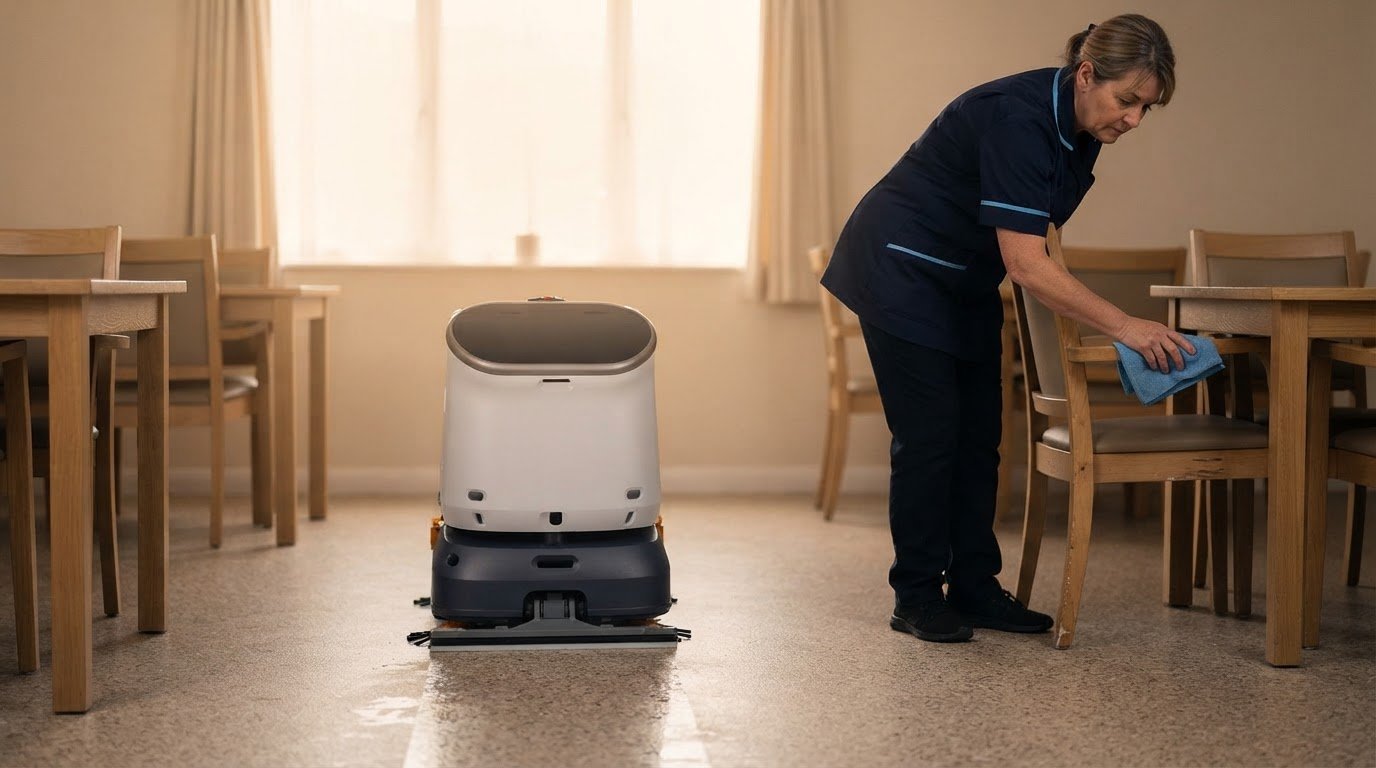
Floor-care robots carry out routine work such as sweeping, vacuuming, mopping and scrubbing. A facilities team can assign routes through areas such as a public corridor, school foyer or logistics centre. Depending on the model and its configuration, the robot may work alongside staff or run independently in a mapped area. Its job is to maintain floors, not clean door handles, bedrails or worktops.
Some cleaning systems can also apply disinfectants. In healthcare, the facility’s approved cleaning programme should specify the product, method, target surfaces and permitted areas. The robot must be configured for that task, and its instructions followed. Applying a disinfectant is not enough by itself: coverage, contact time and surface suitability also matter.
Heavy-duty machines suit floor-care tasks in demanding environments such as manufacturing plants and logistics centres. Smaller or more manoeuvrable equipment may fit public areas with changing foot traffic, such as a transport hub. These are use-case distinctions, not guarantees about a particular model. Floor type, obstacles, operating hours and the size of the area all affect which equipment fits.
For a healthcare facility, start by separating the tasks in its cleaning schedule:
- Routine floor care, such as scrubbing a public corridor.
- High-touch cleaning, such as wiping a bedrail or door handle.
- Disinfection tasks, using the facility’s chosen method and product.
- Specialist response, such as blood or body-fluid contamination.
This division helps staff assign each task to suitable equipment or people. It also prevents a floor-cleaning route from being mistaken for a full-room clean.
Cleaning robots can be programmed for specific areas and times, including one or more passes. Some systems record route completion, areas covered and cleaning-solution use. These records help teams review activity, but do not prove that every surface received the required treatment. Staff inspections and follow-up remain part of the programme.
Choose equipment by the task, not by a broad label such as “disinfection robot”. Check what surfaces it treats, which cleaning method it uses and whether that method fits the facility’s procedures. In a hospital, school or public building, the right arrangement may combine floor-care automation with manual high-touch cleaning and separate specialist procedures.
How effective are UV-C and autonomous floor-cleaning robots at reducing germs?
UV-C systems and floor-cleaning robots use different methods, so assess their results separately. A scrubber can clean a mapped corridor, while a UV-C unit applies ultraviolet light to designated areas. Neither a completed route nor an operating lamp proves that every relevant surface received the required treatment.
UV-C effectiveness depends on exposure reaching the target surface. A bedrail in direct view has a different exposure path from a handle hidden behind a curtain or equipment. Shadows block light, so a route through a room is not evidence that every surface was reached. Continue manual cleaning in places the equipment cannot expose.
Floor-cleaning robots address floors, not every surface in a room. In a hospital corridor, a machine can scrub its assigned route, but door handles and bedrails need separate attention. Sweeping, vacuuming and scrubbing do not establish disinfection by themselves. Keep task descriptions clear, particularly when reviewing cleaning records.
Assess performance against the facility’s existing inspection process. Compare the robot’s route record with physical checks in the same areas, noting missed edges, blocked sections or visible residue. If an inspection finds a missed area, assign follow-up cleaning and review the route. This checks what happened on the floor instead of relying only on a completion log.
For UV-C equipment, define the treated area and the surfaces within its intended exposure path. Remove or reposition obstacles where facility procedures allow, then use the device according to its operating instructions. Keep the room’s usual cleaning tasks in place. A UV-C cycle does not remove visible soil or replace the steps required for spills and contamination.
Safety and equipment suitability also matter. IEC 63327 covers safety requirements for automatic floor treatment machines for commercial use; it does not establish that a floor is disinfected. Assess the machine’s intended task, route and operating conditions separately from hygiene outcomes. In healthcare, staff should retain responsibility for approving tasks and handling specialist contamination.
Use the results to refine deployment: review route completion, inspect target areas and assign rework when checks find gaps. For UV-C, assess exposure and obstructions; for floor care, inspect the cleaned surface and route coverage. These measures give your team a clearer basis for deciding whether each method fits its assigned task. Discuss floor-cleaning robot options for your site.
GO Robotics
GO Robotics can help you assess where service robots fit alongside your existing cleaning and disinfection programme. The Pudu BellaBot, Pudu KettyBot and Pudu HolaBot are options to discuss for service workflows, not substitutes for floor cleaning, high-touch cleaning or infection-control procedures.
The right role depends on your site, the tasks you want to support and how people move through the space. A site survey can help establish whether a robot suits your layout and how it would fit alongside staff routines. Keep responsibility for cleaning standards, inspections and disinfection within your established programme.
If you’re considering service robots for your facility, contact GO Robotics to discuss your requirements.
Make your next cleaning decision measurable
Understanding how service robots improve hygiene standards starts with assigning each machine a defined task and deciding how to assess the results. Before choosing equipment, identify the area you want to address, the work staff will continue to manage and the evidence that will show whether the arrangement works for your site.
That gives your team a practical basis for discussing automation without treating every service robot as a cleaning or disinfection machine. GO Robotics can help you consider options including Pudu BellaBot, Pudu KettyBot and Pudu CC1 in the context of your venue and operational requirements.
If you’re planning a change to your cleaning programme, contact GO Robotics to discuss the right next step for your site. A clear task and review plan can help you move forward with confidence.
Frequently Asked Questions
Can cleaning robots replace disinfection?
No. A floor-cleaning robot can remove dirt using its assigned method, but that does not automatically disinfect the floor or other surfaces. Disinfection requires a suitable method and product used as directed. For example, after routine floor care in a treatment area, staff must still follow the facility’s separate disinfection procedure for relevant surfaces. Keep task records distinct so a completed floor-cleaning run is not mistaken for disinfection.
What types of cleaning solutions can robotic systems use in healthcare settings?
Robotic systems can use healthcare-approved disinfectants, antimicrobial cleaners or solutions specified by the facility, provided the equipment is designed for that use. The product and method should suit the task, surface and facility procedure. For example, a solution intended for a hard floor may not suit another material. Follow the equipment instructions and facility procedures for preparing, handling and replacing cleaning solution.
How do service robots improve hygiene standards in hospitals, hotels and restaurants?
Service robots can help teams schedule repeatable tasks in areas suited to automation, such as hotel corridors, restaurant floors or hospital public spaces. The practical benefit depends on matching the robot’s task to the venue: a restaurant may schedule floor care between service periods, while a hotel may plan around guest movement. Staff still manage spills, inspect results and carry out work requiring human judgement.
What evidence or studies show that service robots improve hygiene?
No study is presented here showing that service robots themselves improve hygiene. Site records can show areas covered and cleaning activity, but inspections and follow-up are needed to check whether areas meet the required standard.