RaaS pricing models: upfront payment or monthly subscription
The payment structure is part of the automation decision, not an administrative detail to leave until the end. It affects how you plan, who manages the robot and what happens if your operation changes. RaaS subscription arrangements in the UK can matter as much as the robot’s day-to-day role.
Before comparing options, define the task and how you will judge whether the deployment suits your operation. Consider who will oversee the robot, which teams will work alongside it and how much flexibility you need if tasks or sites change. These practical points keep the decision grounded in your business, rather than in the payment label alone.
This guide compares upfront payment, monthly subscriptions, outright purchase, contract flexibility and hybrid arrangements. It explains what to examine in each agreement, including responsibilities, included services and the terms for changing or ending an arrangement. Use these distinctions to narrow your options and prepare for a focused discussion about bringing robotics into your workplace.
Key Takeaways
- Distinguish time-based, task-based and performance-based subscriptions, then consider which best reflects how your robot will be used.
- Compare upfront ownership with fixed monthly payments by looking at your budgeting preferences and the support included in the agreement.
- Check who owns the robot during a subscription and how each arrangement affects working capital and ongoing responsibilities.
- Review renewal, exit and technology refresh terms so the contract can keep pace with changes in your operation.
- Explore how GO Robotics’ purchase, lease and RaaS options could fit your site and the robot you need.
What Is Robotics-as-a-Service (RaaS)?
Robotics-as-a-Service (RaaS) is a subscription arrangement that gives a business access to a robot, often alongside software and support. Contracts may base payment on time, tasks, usage or agreed outcomes, so the billing method should match the work being done.
Deployment- and usage-based monthly fees
For a retail deployment, a monthly subscription may reflect the number of robots, where they operate and how often they are used. A unit assigned to one shop floor may have different requirements from a group deployed across several branches. Agree how changes to locations, operating schedules or robot numbers affect the subscription, and record the terms in the contract.
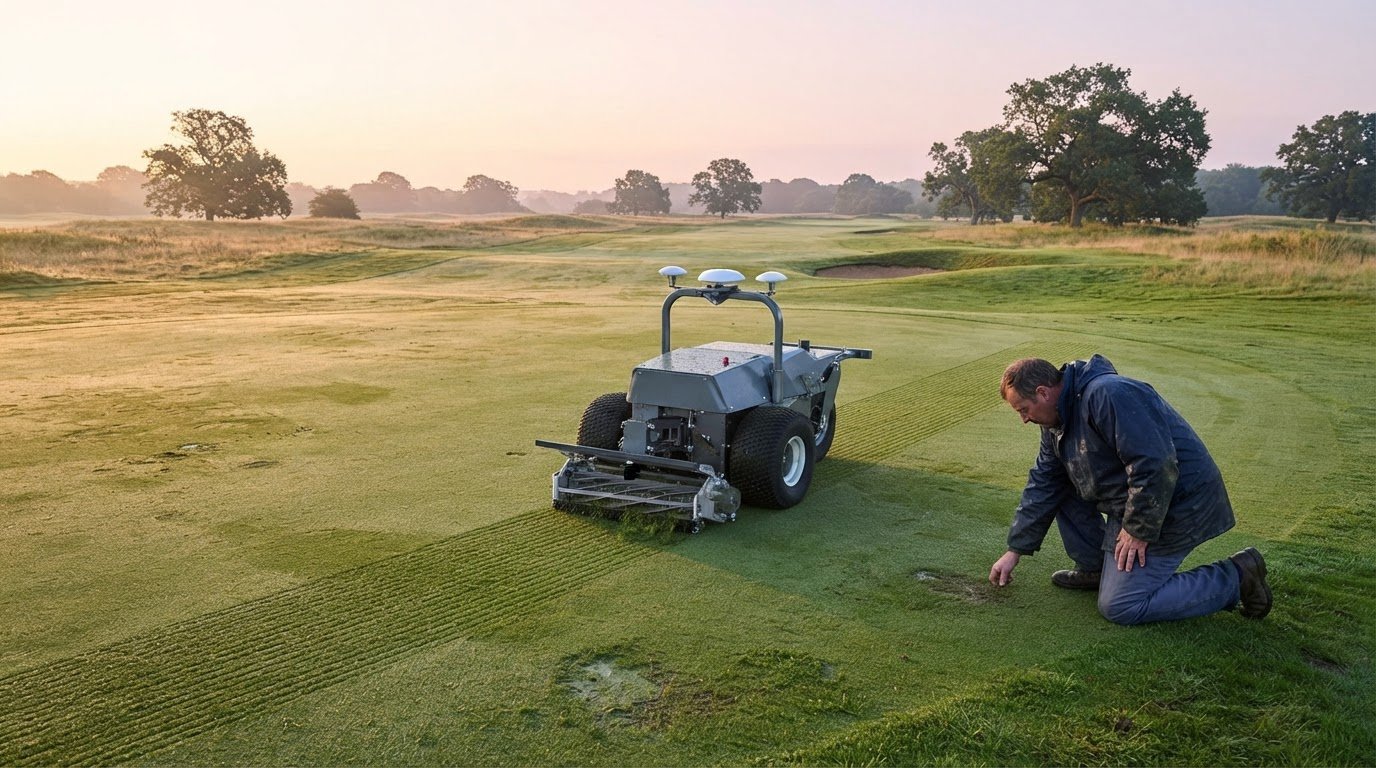
Usage can also be measured by output rather than time. For example, a robotic lawnmower arrangement could bill by the area mown, linking payment to the area covered. This differs from a fixed subscription, where the payment schedule does not necessarily change with the amount of work completed.
Time- and task-based subscriptions
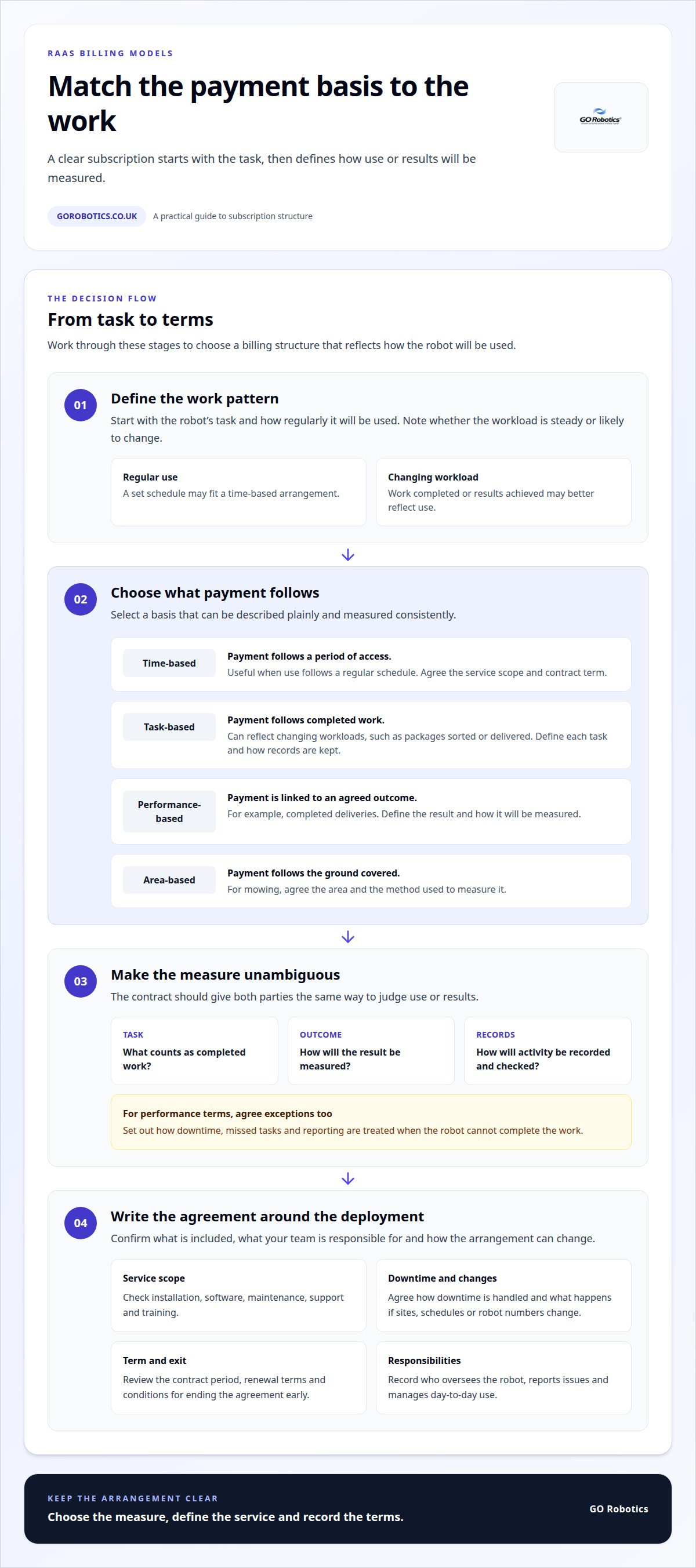
A time-based subscription charges for an agreed period of access. A task-based arrangement links charges to completed work, such as packages sorted or delivered in logistics. Time-based terms may suit regular use; task-based billing can reflect changing workloads. Define what counts as a completed task, how records are kept and how exceptions are handled.
Performance-based arrangements connect payment to an agreed outcome, such as completed deliveries. Provider accountability depends on defining the result, how it is measured and what happens when the robot cannot complete the work. Set out how downtime, missed tasks and reporting are treated, so both parties use the same performance measure.
VAT, tax and accounting treatment depend on your business circumstances and the contract. Keep the agreement and supplier invoices as records, and have your accountant assess the treatment for your organisation. A subscription and an outright equipment purchase may be recorded differently, so distinguish the arrangement clearly in your accounts.
Before signing, look for terms covering installation, software, maintenance, support, training, downtime and early exit. These can affect your commitment beyond the subscription itself. A written scope should identify what is included, whether the provider uses a standard subscription or prepares a proposal around the robot, deployment and intended use.
| Model | Payment basis | Useful when | Agree in the contract |
|---|---|---|---|
| Time-based | Period of access | Use follows a regular schedule | Service scope and term |
| Task-based | Completed work | Workload varies | Task definition and records |
| Performance-based | Agreed outcome | Results can be measured | Target and exceptions |
| Area-based | Ground covered | Mowing is measured by acreage | Area and measurement method |
Choose a structure that fits your budgeting preference and gives both parties a clear way to measure use or results.
Upfront payment and fixed monthly subscriptions
An upfront purchase and a fixed monthly subscription suit different budgeting preferences. Compare how each approach fits your planning cycle and the work the robot will perform.
Upfront capital payment
GO Robotics describes outright robot purchase as capital expenditure, typically depreciated as a business asset. This can suit a stable deployment where you expect to use the same equipment over an extended period. Plan separately for software, maintenance, support and staff training if these are not included in the purchase agreement. Also consider who will arrange servicing if the robot needs attention.
Fixed monthly subscription
A fixed monthly subscription sets recurring payments for the agreed contract period. It can make budgeting more predictable than a large initial purchase, provided you understand what the fee covers. Some agreements include hardware, software, maintenance and support; others define these separately. Check the service schedule, software access, issue-reporting process and end-of-term arrangements before comparing the monthly commitment with ownership.
Subscription arrangements by robot type
Monthly subscription terms differ across robot types because their roles and deployments vary. A food delivery robot in a hotel, a cleaning robot covering a commercial floor and a warehouse robot moving goods have distinct operating requirements. A proposal may reflect the model, number of units, configuration, site work, software and support. Compare like with like by reviewing included services and responsibilities.
Businesses in hospitality, retail, cleaning, warehousing and logistics may use RaaS, but there is no single monthly amount for every industry. The robot’s task, deployment pattern, contract length and included services shape the arrangement. A proposal should reflect the specific operation, not just its industry label.
For VAT, tax and accounting, the contract and invoices provide relevant details for your finance team. Treatment depends on the agreement and your business circumstances. Ask your accountant how to record the arrangement and distinguish subscription services from equipment ownership in your accounts.
Before agreeing to terms, list the support your operation needs and compare it with the contract. Check how software access, maintenance, training, installation, downtime and contract changes are handled. A fixed monthly commitment is easier to plan when both included services and your team’s responsibilities are clear.
Robot purchase versus RaaS subscription
Buying a robot gives your business ownership and control of the asset. A RaaS subscription provides access under a contract, which may suit different working-capital needs and deployment plans.
RaaS subscription charges
RaaS charges may be set by time, usage or agreed outcomes. A security robot, for example, might be billed for its operating hours, while another agreement may use a recurring subscription. Hourly billing can suit changing patrol schedules, but the contract should define operating hours, service coverage and how downtime affects billing.
Robot ownership during a contract
During a RaaS contract, the provider generally retains ownership; your business pays for access and agreed services. The contract should specify who handles maintenance, software and repairs, and what happens when the term ends. With a purchase, your business owns the robot and arranges any ongoing support or upgrades separately.
For a single robot, the decision may come down to whether you want to own and manage equipment or pay for access with specified support. A purchase commits capital to an asset. RaaS can preserve working capital for other operational needs, though recurring charges continue throughout the contract.
Multi-robot deployments add coordination questions. If you deploy several units across a hotel, warehouse or retail group, establish whether each robot has a separate agreement or sits under one fleet contract. Clarify how the terms cover replacement, software access and service if a unit is withdrawn or added.
RaaS providers may also use revenue-based financing, securing working capital against future customer payments. This is a financing arrangement for the provider, not a change to your ownership rights. Your contract remains the key document for establishing who owns each robot and what access your team receives.
To compare the two routes, map the whole deployment: the number of robots, expected use, support responsibilities, software access and end-of-contract arrangements. Then consider whether your organisation can commit capital to ownership or prefers ongoing payments for access. The right structure depends on your operating plans and the services included.
A discussion of robot purchase and rental options can help frame the decision around your site and deployment needs.
Contract flexibility and technology refresh rights
A RaaS contract sets how long automation remains in place, what ongoing payments cover and how either party can change the arrangement. For a hotel adding delivery robots or a warehouse adjusting its workflow, flexibility depends on the written terms, not the subscription label.
Start by checking the contract’s renewal and exit clauses. Look for the notice process, conditions for ending early, and what happens to the robot, software access and site data when service ends. A clear exit route matters if a venue closes, a deployment changes or the robot no longer suits the task.
Technology refresh rights also need clear wording. A contract might allow an older robot to be replaced during the term, but replacement is not automatic unless the agreement says so. Check what triggers a refresh, whether the replacement must meet agreed capabilities, and how installation, staff training and software migration are handled.
- Scope changes: Set out how adding a robot or changing its tasks affects the agreement.
- Service changes: Define how support, maintenance and software updates continue during any refresh.
- Renewal: Record whether the contract renews automatically and how you can decline renewal.
- Exit: Clarify equipment return, data access and any outstanding responsibilities.
These details help align payment with changing operations. For example, a retailer may need more robots during a busy season, then return to a smaller deployment. Without a change mechanism, a fixed arrangement could leave the business paying for unused capacity. A flexible contract should explain how adjustments are requested and recorded.
Compare the full term, not just the initial agreement. Check whether payments remain fixed after a refresh, whether a new term begins and how older equipment is handled. For a multi-site business, confirm whether each location can change independently or must follow one central contract. These details make flexibility practical and measurable.
Before signing, write down likely changes to your automation plan, such as adding a site, changing robot tasks or ending a deployment. Then match each scenario to a specific contract clause. If the refresh or exit process is vague, the agreement may not provide the flexibility your operation needs.
Hybrid subscription structures
A hybrid subscription combines elements of rental and purchase arrangements. It can group robot hardware, software access, updates and support into a predictable payment plan, while setting separate terms for particular services. For a hotel testing delivery automation, this structure can clarify responsibilities from the start.
The agreement should name each included element. For example, it might cover the robot and software while listing installation, staff training or maintenance separately. This distinction helps your operations team understand what the provider handles and what remains your responsibility.
Updates need specific terms, too. A contract can state whether software updates are included, how they are delivered and whether hardware changes require a new agreement. If a warehouse changes its workflow, clear wording can show whether the existing robot remains suitable or needs a different configuration.
- Hardware: Identify the robot, its ownership status and replacement arrangements.
- Software: Set out access, updates and any limits on use.
- Support: Describe maintenance responsibilities and how service issues are handled.
- Payment: Record the schedule and any circumstances that change it.
A hybrid structure can also pair a fixed subscription with a variable element tied to use. A retail operator, for instance, might pay for access to a robot while agreeing separate terms for additional deployment at another site. The contract should explain how the change affects the payment schedule.
For adoption, start with a defined task and site. Set out what the robot will do, which software and support are needed, and how you will review whether the arrangement still fits. This gives your team a practical basis for discussing changes without assuming every update is included.
Compare hybrid terms with a straightforward monthly rental by checking ownership, updates, support and exit arrangements. A predictable payment is useful only when its scope is clear. Record exclusions and agree how changes to the robot, location or service will be handled.
Discuss a hybrid robot subscription in the context of your site and planned use.
GO Robotics
GO Robotics can help match a robot and payment approach to your site, tasks and support needs. It offers outright purchase, lease and monthly robots-as-a-service (RaaS) rental, giving you different ways to bring commercial service robots into your operation.
The choice starts with the work you need done. Consider the tasks, operating environment, expected use and whether you prefer to own equipment or pay for access under a contract. A site survey helps inform the model recommendation, rather than selecting a robot by name alone.
For hospitality and service settings, GO Robotics offers the Pudu BellaBot, Pudu KettyBot and Pudu HolaBot. The suitable model depends on the task and site. A recommendation should follow a discussion of your intended use, layout and deployment, rather than assumptions about what a robot can do in every venue.
Payment structure is part of that conversation. An outright purchase gives you ownership, while a lease or RaaS rental sets out access and payments in an agreement. Compare what each arrangement covers, including installation, integration and ongoing support, then consider how the contract handles maintenance and deployment changes.
Before settling on an approach, gather the operational details: where the robot will work, what tasks it will support, who will manage it day to day and what help you need after installation. These details help shape a practical discussion about the model, deployment and contract terms. They also give your team a clearer basis for comparing ownership with recurring payments.
GO Robotics supplies, installs, integrates and supports commercial service robots. This can help if you are moving from general research to a site-specific recommendation, or if you already have a task in mind and want to discuss suitable equipment and payment options. The next step is a conversation about your operation and requirements.
Contact GO Robotics to discuss your site and robot requirements.
Choose a payment route that fits your next step
Make the decision practical by starting with the task, site and people who will work alongside the robot. Set out what a successful deployment needs to achieve, which support matters to your team and how your requirements could change. This gives you a clearer basis for choosing an ownership or subscription arrangement.
When comparing RaaS subscription arrangements in the UK, look beyond the payment schedule. Consider who owns the hardware, what the agreement includes and how it handles changes to your operation. The right structure should clarify responsibilities and fit the way your organisation plans and budgets.
For commercial venues weighing up robot options, GO Robotics offers the Pudu BellaBot, Pudu KettyBot and Pudu CC1. A conversation about your site and intended use can help connect the choice of model with a suitable purchasing, lease or RaaS route.
Discuss your RaaS plans with GO Robotics. A well-defined first step can help your team approach automation with clarity and confidence.
Frequently Asked Questions
Does RaaS include maintenance and support?
What RaaS includes depends on the specific agreement. Check whether it covers robot hardware, software licensing, cloud management tools, maintenance and remote technical support, and how it handles damage, replacement parts, software access and changes at your site. For example, if you move a robot to another floor, confirm whether that affects the service arrangements or deployment plan.
How do RaaS payment structures compare with buying?
The answer depends on how long you use the robot and what ownership entails. With a purchase, compare the hardware investment with separate software, maintenance and support arrangements. With RaaS, consider the services included throughout the contract and what happens when it ends. A steady, long-term deployment may favour ownership, while changing requirements may make rental flexibility more valuable.
Is there a minimum term for RaaS?
The initial term is set by each RaaS contract, not by a single duration for every arrangement. Read the term alongside renewal, notice and early-exit clauses. If you expect seasonal changes, such as a hotel’s quieter period, see how the agreement treats reduced use or a change in deployment. Also clarify whether returning the robot ends the contract or triggers further obligations.
What should I consider when arranging robot rental?
GO Robotics can discuss RaaS rental arrangements, with inclusions confirmed in the specific agreement. The proposed arrangement depends on the robot and how you plan to use it. For a useful discussion, identify the tasks, operating environment and support your team needs. This helps frame the rental terms around your operation rather than a generic robot-hire description.
What affects RaaS contract terms?
RaaS contract terms depend on the robot model, deployment, contract length and agreed services. Software access, cloud management, maintenance, remote support and site integration may also shape the agreement. A robot assigned to one task at one site may need different terms from a fleet serving several locations. Compare the written scope, including exclusions and deployment changes, to understand what the subscription covers.
What RaaS payment structures are available in the UK?
RaaS arrangements may use fixed monthly subscriptions, time-based rental, task or usage billing, and performance-linked terms. Hybrid contracts can combine a regular subscription with an element linked to deployment or measured work. The payment structure depends on the robot, configuration, contract and agreed services. GO Robotics offers monthly rental arrangements, with terms tailored to the proposed agreement rather than a universal structure.
How do UK RaaS contracts handle setup, integration, maintenance and support?
The agreement should specify setup and integration, including any site mapping, configuration or staff training. Check whether these activities are covered by the subscription or have separate terms, and make sure the contract explains how maintenance and support apply after installation.
How do RaaS agreements compare with buying or leasing robots in the UK?
RaaS provides access under an agreed recurring arrangement; buying gives your business ownership, while leasing sets out access under a separate contract. Compare what each option includes, such as software, maintenance, support, installation and end-of-term responsibilities. The most useful comparison reflects your planned deployment period and your team’s capacity to manage equipment. Include separate service arrangements when weighing ownership against rental.