Robotic automation for small businesses: costs and benefits
Small businesses don’t need to automate every task to benefit from robotics. Whether robotic automation is worth it for a small business depends on whether a robot addresses a clear business need and fits the way the operation works. Start by identifying what slows work down, then assess whether a robot could help without adding unnecessary complexity.
It’s understandable to question whether robotics belongs in a smaller operation, where time, staff and investment all need careful planning. Start with the work that needs doing, not the technology itself. Automation should support employees and give the business more capacity to respond to changing demands.
This article explains how robots can support productivity, ease pressure on staff and give employees more time for work that benefits from human judgement. It also considers how automation may support growth, which options small businesses can explore and what to weigh when deciding whether robotics fits their operation.
Key Takeaways
- Assess whether a robot can take on repeatable work without creating bottlenecks elsewhere in your operation.
- Plan how employees could use the time freed by automation for customer service, problem-solving and other higher-value tasks.
- Map where demand, workflows and space constraints may affect the case for automation as your business grows.
- Compare practical options, from delivery robots to floor-cleaning models, against the tasks you need to address.
- Explore whether Pudu BellaBot, Pudu KettyBot, Pudu CC1 or Pudu HolaBot fits your business and setting.
Robots helping SMEs increase productivity and address skills shortages
Robots can improve productivity when they take on repeatable physical work that limits staff capacity. For a small business, the test is whether automation supports the whole operation, not just one isolated task. If you’re asking whether robotic automation is worth it for a small business, start by identifying the work that holds up other tasks.
Productivity gains from autonomous processes
An autonomous process lets a robot complete a defined task with limited hands-on control. In a hotel, for example, a mobile robot can move items between service areas while staff focus on guest requests. The benefit depends on how well the robot fits existing routes and handovers.
A robot can perform a defined physical task, while an employee adapts to changing priorities and customer needs. Software automation handles digital work, such as moving information between systems, rather than physical tasks such as carrying stock or cleaning floors.
Production capacity and scalability
Robotic automation can increase capacity by taking on a repeatable step, such as moving materials between workstations. A small manufacturer could then assign employees to quality checks or jobs requiring judgement. This can matter when orders rise but floor space, staff availability or production time remain constrained.
Assess the whole process before automating. A robot that speeds up packing may simply move the bottleneck to dispatch. Small-batch production can still suit automation if tasks remain consistent across batches or equipment can accommodate product changes. Base capacity planning on the actual flow of work.
Automation costs and payback
Payback depends on the total cost of acquiring, operating, maintaining and disposing of an asset over its useful life. Include integration, staff training, maintenance and workflow changes, then compare those costs with the value of work completed and capacity gained.
In a small-batch workshop, frequent product changes may make a fixed process harder to justify. A task repeated throughout each production run may offer a clearer case. Assess how the robot would fit into the full process, not just one workstation.
For UK tax relief, the annual investment allowance (AIA) lets businesses deduct the full cost of qualifying capital assets in the year of purchase. Grants and other funding depend on the scheme, sector and location, so distinguish grant support from tax relief when planning an investment.
Choosing tasks for robotic automation
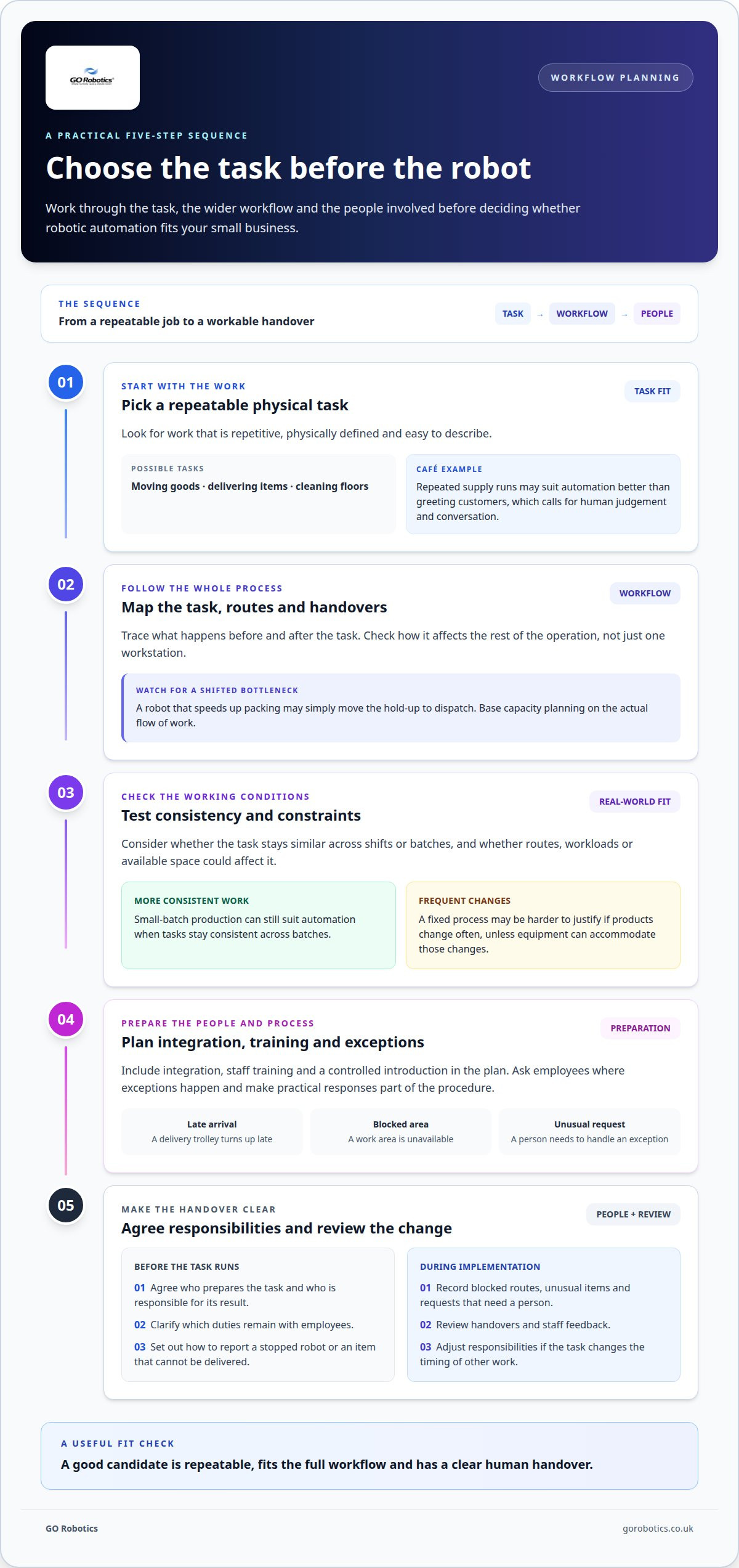
Tasks best suited to robotic automation are repetitive, physically defined and easy to describe, such as moving goods, delivering items or cleaning floors. In a café, repeated supply runs may be a better candidate than greeting customers, which depends on human judgement and conversation.
Before choosing equipment, map the task, its handovers and its effect on the wider process. Then plan integration, staff training and a controlled introduction. A decision about whether robotic automation is worth it for a small business should also account for the risk of bottlenecks if routes or workloads are poorly planned.
Redirecting employees to higher-value tasks
Automation helps employees only when the work around the robot is planned as carefully as the task it performs. Before implementation, identify who handles that task now, what happens when demand changes and which responsibilities still need human attention. For example, a small food producer could redirect staff from routine crate movements to checking order labels and resolving quality queries.
Define the new work clearly. “More time for customers” is too vague to guide a shift. A clearer plan might assign an employee to answer product questions, prepare orders that need special handling or follow up on a delayed delivery. These duties can draw on communication and judgement, areas where employees may still be needed.
Include employee input in the change. People who perform repetitive tasks often know where exceptions occur, such as when a delivery trolley arrives late or a work area is blocked. Ask them to describe these situations during planning, then include practical responses in the operating procedure. This helps account for real working conditions, not just the ideal route.
Training should clarify the boundaries of each role. In a care setting, for instance, staff need to know which routine movement the robot handles and which requests remain their responsibility. They also need a clear way to report a stopped robot or an item that cannot be delivered. That keeps exceptions visible and helps employees respond confidently.
Keep the allocation of duties flexible. A small team may need to switch between order preparation, customer support and stock checks as workloads change. Managers can review handovers and staff feedback during implementation, then adjust responsibilities if the robot’s task changes the timing of other work. The aim is a workable division of duties, not simply filling every minute saved.
- Agree the handover: Decide who prepares the task and who takes responsibility for its result.
- Record exceptions: Note blocked routes, unusual items and requests requiring a person.
- Review staff experience: Ask whether the new duties are clear and fit the shift’s actual workload.
These checks help keep employees involved as automation solutions become part of daily work. If you’re considering a robot for a particular task, discuss how robotics could fit your business operations and the roles your team needs to prioritise.
Robotics as a tool for business scalability
Scalability means handling more work without expanding every part of the operation at the same pace. A small manufacturer might first automate a repeated movement between workstations, while a hotel could plan for more deliveries during busy periods. Focus on where growth is likely to pressure the existing process, not simply on how many robots to add.
Increasing capacity was an objective for 61% of automation projects tracked globally by HowToRobot in 2023. For a growing business, capacity can mean completing more orders, handling seasonal peaks or reducing queues between stages. A robot contributes only if the next step can accept its output. Faster movement at one point may otherwise leave goods waiting elsewhere.
Map the full workflow before choosing where automation fits. In a small food-production site, trace an item from preparation through packing, storage and dispatch. Note where workers wait, where materials collect and which handovers slow the flow. This shows whether a robot could address a genuine constraint or merely shift the delay elsewhere.
Demand can also vary by day or season. Some providers let businesses pay for autonomous mobile robots by the hour, leaving them parked and charging when they are not needed. This may suit a site with concentrated delivery or transport work during particular periods. The operating plan still needs to account for storage, charging and the time needed to put the robot into use.
Production variety matters, too. Repetitive, high-volume work can suit automation, but technology can also adapt to high-mix, low-volume production as demands change. A workshop making varied items should distinguish between steps that change with each order and those that stay consistent. Automating the stable part may support a wider product mix without forcing every item through the same rigid process.
For businesses operating across a facility, map possible applications and compare their benefits and risks. A retailer could consider stock movement, back-of-house transport and routine floor care, then prioritise the task that best fits its growth plan. Before extending automation, consider how people, equipment and existing systems interact.
Set a clear objective for each stage of expansion. It might be to manage more orders, reduce a particular queue or make a service route easier to schedule. Review the effects on the surrounding process, including handovers, available space and staff responsibilities. This gives you a sound basis for deciding whether to expand automation or address another constraint first.
Scaling doesn’t always mean deploying the same robot everywhere. A second site may have different routes, task patterns or customer demands. Treat each location as a distinct operation and use lessons from earlier implementations to shape the next one. This measured approach helps growing businesses increase capacity while keeping decisions grounded in actual work.
Space savings and accident reduction
Robots can affect how a small business uses floor space and manages routine workplace risks. They may reduce the need for some fixed equipment or repeated manual movements, but the result depends on the task, layout and people sharing the area.
Improving the working environment was an objective in 31% of automation projects tracked globally by HowToRobot in 2023. For a small warehouse, that could mean reviewing how staff move stock through a narrow picking area. A robot does not automatically create more room; its route, turning space, charging point and handovers all need to fit the site.
Start with a simple layout review. Mark shelves, workstations, doors, customer areas and places where people regularly stop. In a café, for example, a delivery route that crosses the serving queue may create an obstruction instead of reducing staff movement. In a stockroom, a route through a clear aisle may make better use of existing space than adding a fixed conveyor.
Accident reduction is not automatic. A robot introduces moving equipment into a space used by people, so assess contact risks, visibility, blind corners and changing obstacles. A warehouse team should consider what happens when a worker carries a large box across the robot’s route or stock temporarily blocks an aisle. Safe operating arrangements need to account for these everyday conditions.
In the UK, workplace robot use should be assessed against relevant health and safety requirements, including risk assessment and safe working arrangements. The checks depend on the robot, task, site layout and people nearby. For example, a robot operating around hotel guests raises different practical considerations from equipment in a restricted production area.
Use the assessment to identify controls before operation begins. These may include separating routes, marking crossing points, keeping walkways clear, training staff and agreeing what to do when the robot stops or its route becomes obstructed. A growing business should review those arrangements when it changes the layout, introduces new equipment or redirects workers to different tasks.
- Map the route: Include storage, doorways, queues and places where employees pause.
- Look for interactions: Consider visitors, workers carrying items and temporary obstacles.
- Review the result: Check whether the robot reduces unnecessary movement without creating new pinch points or blocked routes.
Good planning can help a business achieve a clearer flow of people and goods while keeping staff involved in everyday safety checks. Judge the result by how the full work area operates, not by the robot’s path alone.
What types of robotic automation are practical for small businesses?
Practical options depend on the work, site and people involved. A small hotel, warehouse and manufacturer face different tasks, so start with the process that causes repeated delays or takes staff away from other duties.
Autonomous mobile robots move goods or supplies through a facility. They can navigate without wires or magnetic strips, which can reduce disruption and the need to reconfigure the space. For example, a warehouse could use one to move items between storage and packing, provided the route suits its everyday traffic.
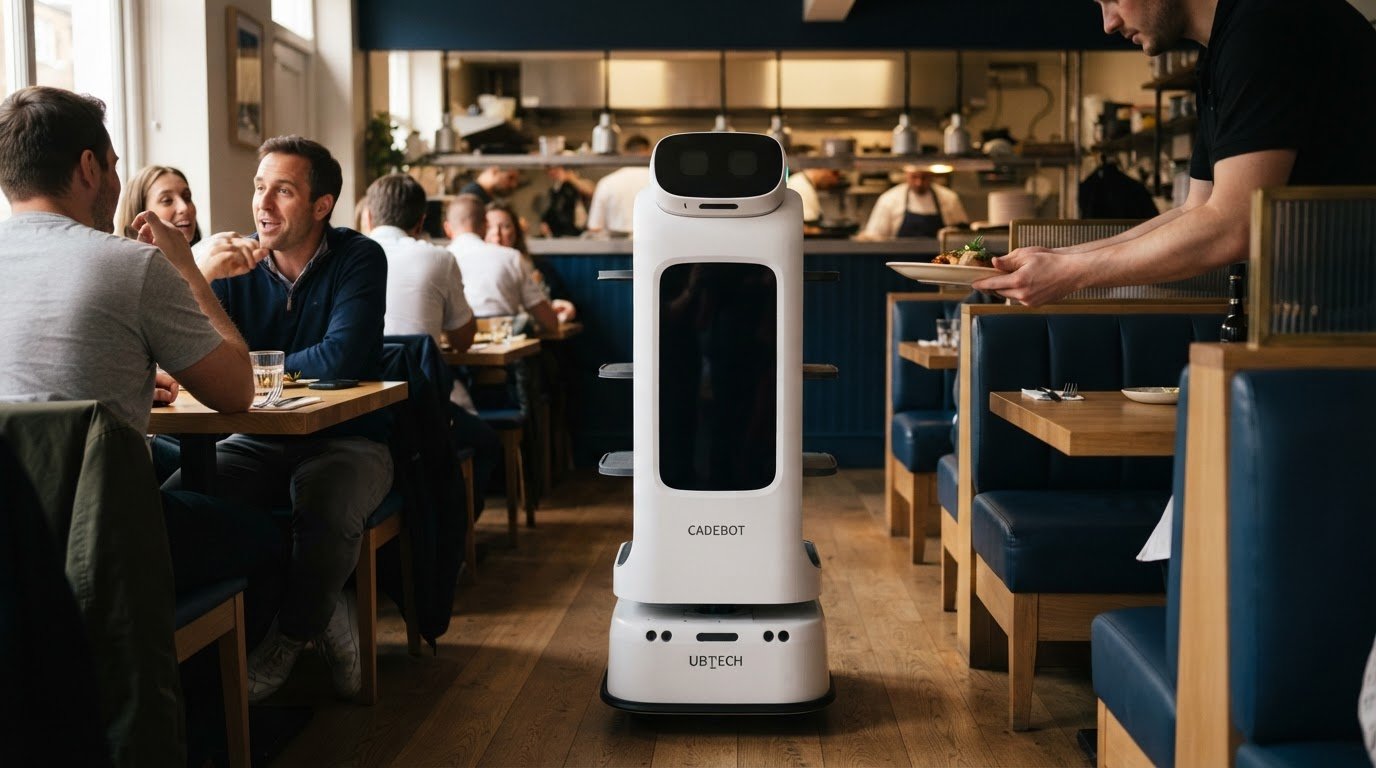
Service robots can support delivery and hospitality tasks in venues such as hotels, restaurants and care settings. A hotel might use a delivery robot to move items between service areas while employees remain responsible for guest requests and exceptions. The practical fit depends on the task, route and handovers, not just the robot category.
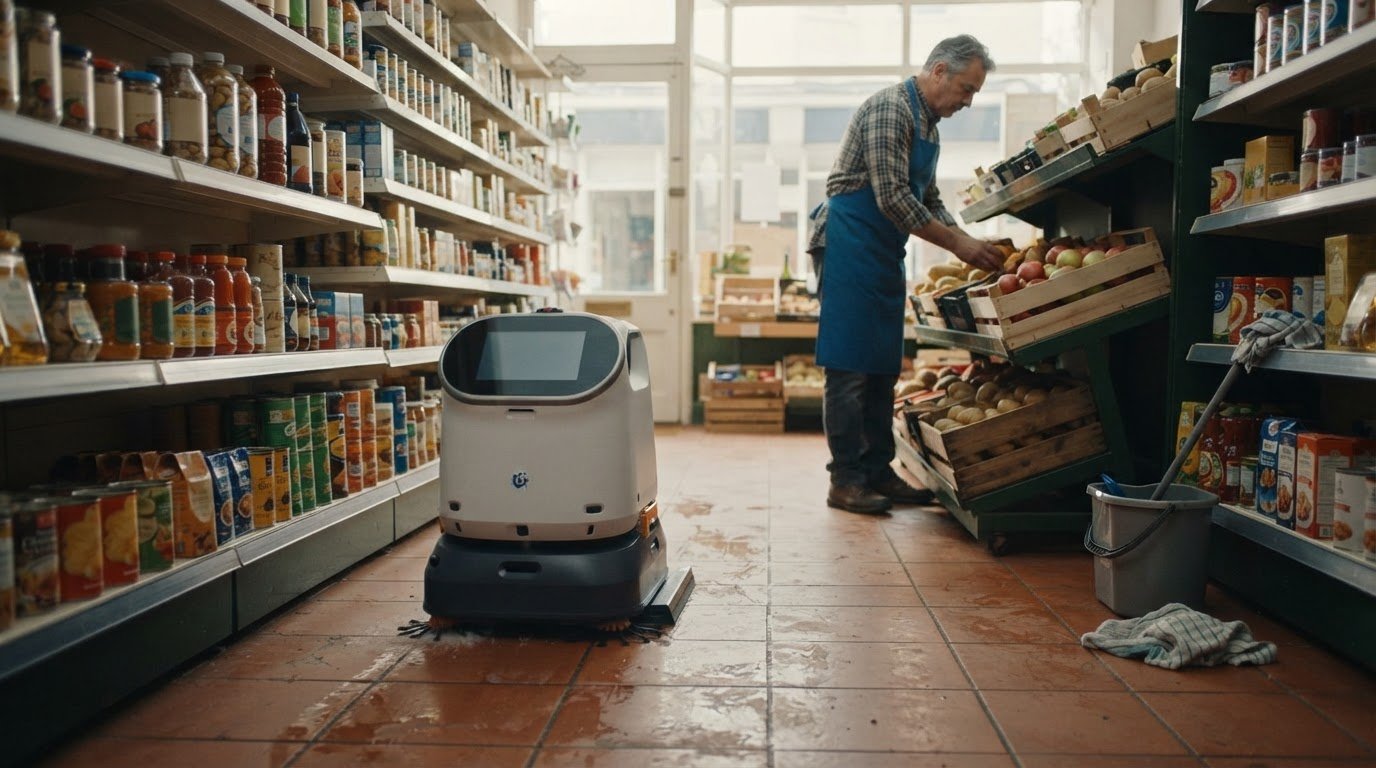
Floor-cleaning robots suit businesses with large floor areas and recurring cleaning routines, such as retail sites or shared facilities. Consider how furniture, customers and staff affect the cleaning area. A clear operating plan matters: the robot’s work must fit around opening hours, cleaning priorities and people using the space.
Manufacturers may consider robotic arms for repeated handling or processing steps. A small production business could assess whether the same movement occurs reliably across jobs. Frequent changes in product size or process can affect suitability, so identify where variation occurs before selecting equipment.
Reception robots are another option for venues that need support with routine visitor interactions. They may suit a defined role, such as directing visitors, but should not replace staff judgement when requests are unusual or sensitive. Decide which interactions remain with employees and how the robot fits into the existing reception process.
To narrow the options, connect each type to a real operational need:
- Moving items: Consider a mobile robot for repeat routes between work areas.
- Cleaning floors: Assess a cleaning robot against floor layout and daily use.
- Handling products: Review robotic arms where production includes repeated movements.
- Welcoming visitors: Define a reception task that complements staff support.
Compare each option with the task, site conditions, staff workflow and likely changes in demand. Arrange a site survey to discuss which type of commercial robot could fit your premises and routine.
Before choosing an application, clarify why you’re automating and what you want to achieve. Then assess which task best supports that goal.
GO Robotics
GO Robotics can help you assess whether a commercial service robot fits a defined task and your site. We survey the premises and consider how the robot would fit existing work, staff movement and customer areas. This practical assessment helps you weigh potential benefits against the changes needed to put automation into use.
For hospitality and service settings, GO Robotics offers Pudu BellaBot, Pudu KettyBot and Pudu HolaBot. The right model depends on the task you want to address and the conditions on site. GO Robotics supplies, installs, integrates and supports its robots, helping you beyond equipment selection.
If you’ve identified a repetitive task and want to discuss whether a service robot could suit your business, contact GO Robotics.
Put your next automation decision on solid ground
Whether robotic automation is worth it for a small business comes down to a clear operational purpose. Before choosing equipment, define the task, the people it affects and what a better working day would look like. That gives you a practical basis for deciding whether automation belongs in your plans now or later.
For hospitality and service environments, GO Robotics offers Pudu BellaBot, Pudu KettyBot and Pudu CC1. Each may suit different needs, so the useful next step is to discuss your setting and the work you want to address rather than choose by model name alone.
Discuss automation with GO Robotics and explore which option could fit your operation. A clear starting point can help you make your next decision with confidence.
Frequently Asked Questions
Can small businesses afford not to automate?
Small businesses can choose not to automate, but recurring manual work may limit what their existing team can handle. Robotic automation is worth considering when a defined task takes time away from customer service, fulfilment or other essential work. For example, a retailer could assess whether repeated stock movements limit staff availability on the shop floor. The decision should rest on a clear business need, not pressure to adopt technology.
What are the arguments in favour of using robots in SMEs?
Robots can take on predictable physical tasks, support consistent service and help a business manage demand without assigning every routine movement to employees. This can be useful in a hotel moving supplies or a care setting delivering items along established routes. Automation can support staff, not replace their judgement. Employees remain essential for exceptions, personal service and decisions that require context.
How much does robotic automation cost for a small business in the UK?
There is no single UK price for robotic automation. The amount depends on the robot, its configuration, site requirements, installation, integration, support and whether you buy or use a rental arrangement. GO Robotics provides pricing after a quote request, based on the project. Compare the full cost of operating the equipment, not only its purchase price or rental payment.
What are the ongoing maintenance and operating costs of business robots?
Ongoing costs can include servicing, replacement parts, software or support arrangements, electricity, consumables and staff time for routine checks. The mix depends on whether the robot delivers items, cleans floors or supports another task. For example, a cleaning robot may use different consumables from a delivery model. Include planned maintenance, downtime and any workplace adaptation in your operating budget.
What is the typical return on investment and payback period for small-business automation?
There is no typical payback period for all small businesses. Estimate the value of work completed, capacity gained or staff time redirected, then compare it with setup and ongoing operating costs over the period you plan to use the robot. For a restaurant, consider whether automated deliveries free employees to serve guests during busy periods. Use realistic assumptions, including maintenance and workflow changes.