Service robot lease terms: compare total costs and support
The service robot lease agreement terms you choose shape more than the monthly payment. They determine the contract length, what happens if you need to exit early, and who handles support. A longer term may spread payments across more instalments, but it can also limit your options if your needs change.
Look beyond the instalment. The agreement may cover deployment, training, maintenance, software support, insurance, robot use and return, and late-payment rules. These details affect how predictable the arrangement is and what happens if the robot is out of action or your business circumstances change.
This guide explains how to compare lease lengths, exit rights, support duties and payment rules, then assess the full contract commitment rather than focusing on one line. It also covers an accounting consideration: a longer agreement can affect how a lease is treated, so both the contract and your business’s accounting approach matter. Use the comparison points and decision guide to identify terms that fit your workflow and appetite for flexibility.
Key Takeaways
- Assess how deployment, site mapping, training, maintenance and software support are handled, especially across multiple locations.
- Compare contract length with renewal, return, purchase, upgrade and early-exit provisions before choosing a term.
- Clarify who maintains the robot, what support is included and what use or modification limits apply.
- Understand invoice deadlines, payment terms and the circumstances in which service could be suspended.
- Explore whether Pudu BellaBot, Pudu KettyBot, Pudu CC1 or Pudu HolaBot suits the work you need to support.
Deployment, mapping, training and software support
According to the UK Government, the terms require each party to comply with applicable data-protection law, including the UK GDPR and Data Protection Act 2018 where applicable. For work equipment, the Provision and Use of Work Equipment Regulations 1998 (PUWER) and other applicable health and safety legislation are relevant to the responsibilities of a business that owns, operates, uses or controls it, according to the UK Government.
Set out deployment responsibilities before the robot arrives. The agreement should identify who assesses the site, creates the map, configures the robot and tests its routes. For example, a hotel may need routes mapped between a kitchen, service corridor and dining area. Clarify who approves the map and handles changes when furniture or access arrangements shift.
Assign training responsibilities clearly. Establish which staff receive instruction, what operating tasks it covers and how new starters learn the same procedures. Include practical handover details, such as who can report a fault, restart the robot or explain its status to colleagues. If training is delivered remotely, record how staff can access the instructions afterwards.
Set out software support and maintenance separately. The agreement should say whether software updates, remote diagnostics, fault triage, planned maintenance visits and repair coordination are included. It should also explain how to report an issue, who assesses it first and when an on-site visit or replacement unit may be considered. Record response commitments and support hours in the service obligations, rather than leaving them as informal expectations.
For multiple locations, define integration responsibilities for each site. Specify who maps each venue, coordinates access and keeps site records current. A group operating a hotel and a restaurant, for instance, may need separate maps, local staff training and a shared route for escalating technical issues. Clarify whether support covers every location under the same process or requires separate arrangements.
The table shows how different service arrangements can divide deployment and support duties. The contract should clarify which tasks are included and which remain your team’s responsibility.
| Arrangement | Deployment and mapping | Training | Maintenance and support |
|---|---|---|---|
| Equipment-only lease | State who surveys the site and creates or updates maps. | Specify the handover material and staff instruction provided. | Define fault reporting, repair coordination and software responsibilities. |
| Full-service contract | List site assessment, mapping and go-live responsibilities. | Record who trains staff and handles later refreshers. | Set out remote triage, planned maintenance and repair escalation. |
| Multi-site arrangement | Assign mapping and integration duties for each venue. | Clarify local training and shared operating procedures. | Identify the support route for each site and group-level reporting. |
Choose an arrangement that matches your internal capacity, then put every task, contact route and support commitment in writing.
Contract length, exit rights and early termination penalties
Service robot lease agreement terms define the duration, renewal options, cancellation rights and return conditions. Read these clauses together to understand when your business can change or end the arrangement.
Contract duration and renewal
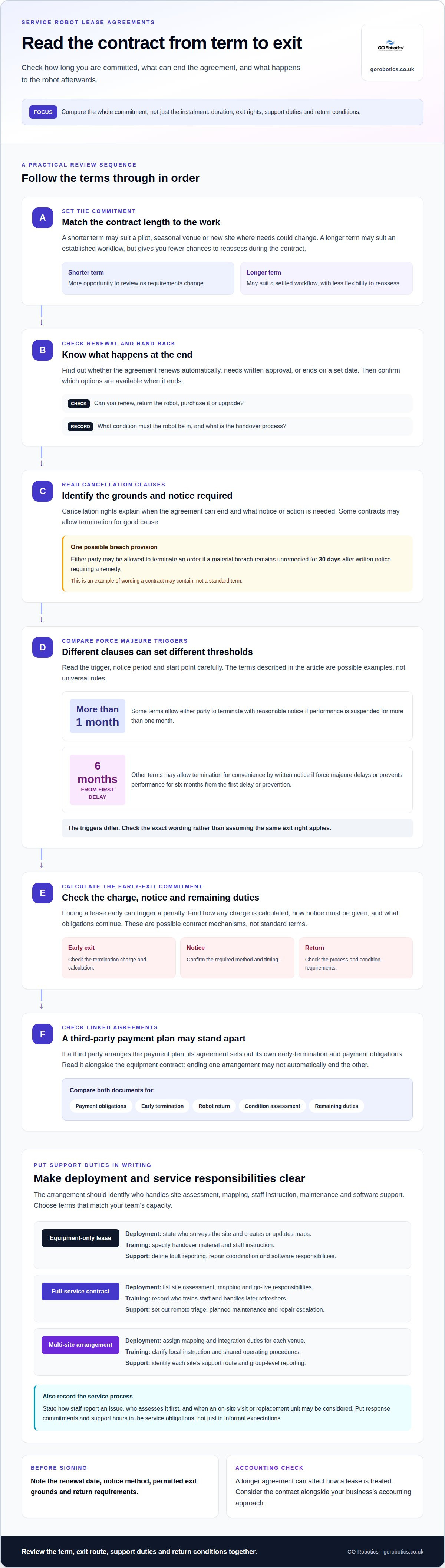
The contract duration defines how long the agreement runs and how long your business remains committed to its conditions. A shorter term may suit a pilot, seasonal venue or new site where requirements could change. A longer term may suit an established workflow, but offers less opportunity to reassess the arrangement during the contract.
Renewal terms should explain whether the agreement continues automatically, requires written approval or ends on a set date. At the end, check whether you can renew, return the robot, purchase it or upgrade. Return clauses should describe the required condition and handover process. For example, record the robot’s condition when it is delivered and returned.
Client cancellation rights
Cancellation rights explain when you can end the agreement and what notice or action is required. A contract may allow termination for good cause. It may also allow either party to terminate an order if a material breach remains unremedied for 30 days after written notice requiring a remedy.
Force majeure clauses can set different thresholds. Some terms allow either party to terminate with reasonable notice if performance is suspended for more than one month. Others allow termination for convenience by written notice when force majeure delays or prevents performance for six months from the first delay or prevention. These clauses have different triggers, so read the wording carefully.
Early termination penalties
Ending a lease early can trigger a penalty, so identify the calculation and notice process before signing. The agreement may set out continuing obligations or a termination charge. These are possible contract mechanisms, not standard terms. Compare them with your cancellation rights and the process for returning the robot.
A payment plan arranged through a third party is governed by that party’s agreement, including its early termination and payment obligations. Read it alongside the equipment contract: ending one arrangement may not automatically end the other. Check how the hardware must be returned, whether its condition will be assessed and which obligations remain.
Before signing, note the renewal date, notice method, permitted exit grounds and return requirements. The contract should explain what happens if your site closes, the workflow changes or the robot no longer suits the task. This gives you a clearer basis for deciding whether the agreement offers enough flexibility for your business.
Compare the exit clauses with the stability of the work you expect the robot to perform. A seasonal venue or new site may need different flexibility from an operation with an established workflow. Check whether the written renewal, cancellation and return conditions suit those circumstances, rather than relying on assumptions about what happens when plans change.
Equipment supplier responsibilities and service levels
The service robot lease agreement terms should identify who insures the equipment, who is liable for damage or injury, and when indemnities apply. These clauses vary by contract, so the parties’ cover, exclusions and claims process should be clear in writing.
Start with ownership and usage rights. A lease may allow your business to use the robot without transferring ownership, but the agreement should identify the owner and explain whether ownership can change. It should also set out permitted uses, location limits and restrictions on modifications. For example, clarify whether your team may adjust operating settings or attach accessories.
An equipment-only lease covers the hardware arrangement, while a full-service contract can include maintenance and technical support. Neither label defines every duty. The written terms should say who reports faults, coordinates repairs, supplies parts and arranges site visits. They should also describe service hours, response commitments and whether replacement equipment is available.
Read the service-level clauses closely. They should explain how to log an issue, what information the supplier needs and how the repair process proceeds. The terms can distinguish remote troubleshooting from an on-site visit and identify who updates you if a fault remains unresolved. Put response commitments and exclusions in the contract, rather than relying on informal expectations.
Some arrangements involve separate agreements with an equipment provider, finance company or maintenance supplier. Read each document alongside the main lease. Confirm which party handles repairs, software support, insurance and claims, and whether one agreement remains active after another ends. For example, ending a support arrangement may not itself end your hardware lease.
Return conditions matter at termination. The contract should state where and how to return the robot, who arranges collection and how its condition is assessed. Record its condition and any existing damage at delivery. Check how the agreement treats missing parts, damage beyond ordinary use or a robot returned with a fault. This helps establish responsibility for its condition.
Compare the arrangements against the duties that matter to your operation:
| Arrangement | Supplier responsibility | Contract detail to define |
|---|---|---|
| Equipment-only lease | Hardware provision and agreed equipment duties | Ownership, permitted use, repair route and return process |
| Full-service contract | Maintenance scope, support hours, response commitments and exclusions | Maintenance procedures, fault logging, support channels and response times |
| Separate provider agreements | Responsibilities split between named parties | Which agreement controls each duty and what remains after termination |
A complete review should map each duty to a named party. Choose the arrangement that matches your in-house capacity, then make every responsibility explicit. To discuss robot support for your operation, discuss your requirements with GO Robotics.
These clauses typically allocate responsibility for insuring the robot and for damage or injury, and set out when indemnities apply. They should also clarify cover and exclusions, the claims process, and how those duties fit with any separate supplier, finance or maintenance agreements.
Late payments and service suspension
Payment clauses set the commercial commitment between the parties. Read the invoice schedule, payment deadline, late-payment provisions and service-suspension process together, since each can affect day-to-day operations.
Start with the invoice details. The agreement should explain when invoices are issued, how they are delivered and when payment is due. It should also identify who handles billing queries. For example, if an invoice covers several robots or sites, the contract can specify how charges are itemised and which contact resolves a disputed line.
Fixed payments make the timing of your commitment easier to plan, but the agreement must say what each payment covers. Check whether the schedule stays the same throughout the contract or changes at a stated point. For a venue with seasonal trading, align payment dates with the business’s operating arrangements where the contract allows. Don’t assume a pause in robot use changes the payment obligation.
Late-payment clauses should explain what happens after a missed deadline. Check for any interest calculation, notice process, time allowed to remedy the breach and steps before service suspension. Some terms link interest to a benchmark rate, so the agreement should name the benchmark and explain how the applicable rate is set. Check whether the provision applies to disputed invoices or only overdue amounts.
Service suspension can affect more than robot operation. The contract should specify which services may stop, such as remote support, software access or maintenance coordination, and what happens to the equipment during suspension. It should also state how service resumes after the account is brought up to date. For example, clarify whether you must contact a named team or follow a written reinstatement process.
Before signing, map the payment process from invoice to resolution:
- Record the invoice issue date, payment deadline and accepted payment method.
- Identify the contact for billing questions and the process for disputing an invoice.
- Read the late-payment notice, interest and service-suspension clauses together.
- Confirm what operational support remains available during a suspension.
- Note the steps required to restore any paused service.
These steps help your finance and operations teams work from the same terms. A finance manager can diarise invoice deadlines, while the site lead knows whom to contact if service is interrupted. Clear responsibilities also help both parties distinguish an administrative delay from an unresolved service issue.
Review the schedule against your commercial commitments before signing, particularly where different sites use separate billing contacts. To discuss robot leasing and support for your operation, speak with GO Robotics.
GO Robotics
GO Robotics can help you turn the lease questions in this guide into a practical choice for your venue. It supplies commercial service robots, installs and integrates them, and provides ongoing support. A site survey helps identify a suitable model for your space and planned tasks before you decide how to acquire it.
Start with the work you need the robot to support. For hospitality settings, Pudu BellaBot, Pudu KettyBot and Pudu HolaBot may be relevant to your shortlist. The right comparison depends on your site’s tasks, routes and working arrangements, not just the model name. This keeps the decision grounded in your operation.
Bring the contract questions into that discussion. Consider the proposed lease duration, renewal and exit arrangements, and what happens at the end of the term. Clarify what deployment, integration, training and ongoing support cover, alongside the responsibilities that remain with your team. A clear scope helps you compare the agreement with the work you expect the robot to do.
GO Robotics offers outright purchase, lease and robots-as-a-service (RaaS), a monthly rental arrangement that can include the robot, software and support. These options structure access differently. Lease or RaaS may suit a business seeking a rental model, while outright purchase may fit a different acquisition plan. The proposed agreement should set out the service and payment details so you can assess them against your operating needs.
Before deployment, a site survey can help establish the practical requirements for your location. Useful discussion points include:
- The tasks and locations where the robot is expected to operate.
- Site conditions that could affect deployment or integration.
- Staff training, support responsibilities and fault reporting routes.
- The contract term, renewal options, exit conditions and equipment return process.
These details connect the robot choice to the agreement. For example, a hospitality operator planning to use a robot across distinct service areas can discuss how the proposed deployment fits those areas and how support responsibilities are recorded. A facilities team considering a cleaning task can explain its operating routines and assess whether the service arrangement covers the work it needs.
GO Robotics can discuss the available models and acquisition options in relation to your site and intended use. Bring your questions about lease length, support duties and end-of-term conditions to that conversation, then consider how each proposed term fits your operation. You can discuss the task and agreement together before settling on a model.
Contact GO Robotics to discuss your service robot requirements.
Plan your next step with confidence
Your service robot lease agreement terms should support a clear business decision and fit the way your venue works. Treat the contract discussion as part of choosing the right robot: match the intended tasks with the model, then assess how the agreement fits your operating plans.
GO Robotics offers Pudu BellaBot, Pudu KettyBot and Pudu CC1. Each can be part of a conversation about the work you need a robot to handle and the arrangement that suits your business. The useful next step is to bring those operational requirements into the same discussion as the lease conditions, so both the equipment and the agreement reflect your plans.
You don’t need every detail settled before starting the conversation. A clear outline of your intended use, site and preferred acquisition route gives the discussion a practical focus. From there, you can consider the available options and the terms that matter to your decision.
Discuss lease terms with GO Robotics and take the next step towards choosing a service robot arrangement that fits your operation.
Frequently Asked Questions
Does a longer lease create accounting issues?
A longer lease can affect how your organisation records its commitments, so share the signed agreement with your accountant before approval. Ask them to consider the lease term, renewal options, termination rights and any purchase option together. For example, an automatic renewal clause may change the period covered by your accounting assessment. Keep the agreement and later amendments with the relevant financial records.
What do you actually get in a lease structure?
Under the contract’s stated conditions, you receive the right to use the robot. The agreement or its schedules should identify the specific equipment, permitted users, software access and any included documents or accessories. Check that the order form matches the model and configuration being supplied. This gives your team a clear record of what was agreed, without relying on an informal description of the arrangement.
Which contract obligations are easy to overlook?
Look for operational obligations beyond the equipment description. A contract may make your staff responsible for preparing access, providing site information, keeping records or arranging safe storage. It may also define how damage, missing accessories or changes to the operating site are handled. For example, record who approves a relocation and whether it requires a written contract amendment before the robot moves.
What terms should a service robot lease agreement include in the UK?
Make sure the agreement identifies the parties, robot and order documents, and explains how amendments become binding. Check which document takes priority if the main contract, service schedule and order form differ. Also clarify permitted use, confidentiality, intellectual-property rights and dispute procedures. A signed schedule for each site can help avoid ambiguity where one agreement covers different premises or operating arrangements.
How should a service robot lease set out payment obligations and changes to the agreement in the UK?
The agreement should state how recurring payments are scheduled and what can change the agreed payment terms. Look for a defined adjustment method, notice process and effective date, rather than an unrestricted right to change terms. If a separate finance agreement applies, read its payment schedule and amendment provisions alongside the robot contract. Keep approved changes with the signed documents.
Who is responsible for installation, maintenance, repairs and software updates under a service robot lease?
Use a responsibility schedule to connect each task with the named party and its records. For instance, it can state who signs off installation, logs a repair and records a software change. Your site lead can then maintain a service history that supports fault diagnosis and handover. Distinguish routine user checks from work requiring a supplier or qualified technician, so staff know the limits of their authority.
What service levels, uptime guarantees and response times should a service robot lease specify?
Define how any service level is measured, including the assessment period and the records used to calculate it. If the contract refers to uptime, state whether the measure covers the robot alone or also the software and connectivity it needs. Set out exclusions, reporting responsibilities and the remedy for a missed commitment. This makes a service promise assessable against operating records rather than subjective impressions.
Who owns a leased service robot and its data, and what happens to data at the end of the lease?
The agreement should distinguish ownership of the physical robot from rights to software, maps and operating records. It should identify who can access each data type and whether your business can receive an export when the arrangement ends. State the format, handover method and deletion process, including who confirms completion. These details help your team plan for continuity if you change equipment or stop using the service.