Training staff to work alongside robots with practical support
Training staff to work alongside robots takes more than showing people which buttons to press. Employees need to understand how automation fits their work, what remains their responsibility and how to raise questions as routines change. A clear plan connects the robot’s assigned task with the knowledge and judgement already present in your team.
It’s understandable for staff to feel uncertain when familiar routines change. Treat their questions as useful input, not a barrier to progress. The people doing the work can help managers see where the new arrangement fits daily operations and where clearer guidance is needed.
This guide explains how to prepare employees for changing responsibilities, make learning relevant to their roles and involve staff as automation is introduced. It also covers keeping plans and instructions clear throughout implementation, so teams understand how their work fits alongside the robot’s role. The aim is a considered change that gives employees a meaningful part in how workplace automation operates.
Key Takeaways
- Explain what the robot will do, invite staff questions and use their practical feedback to shape its role.
- Plan hands-on practice at the workstation; training for a medium-complexity cobot workstation typically takes 2 to 5 days.
- Involve employees in integration, including decisions about how the robot fits into everyday work.
- Set out clear safety guidance and separate operator instruction from maintenance training.
- According to the International Organization for Standardization, ISO/TS 15066 defines requirements for collaborative robot workstations.
1. Reskilling or upskilling—how does it work in practice?
Start by matching each employee’s duties to the robot’s planned task. If a robot carries supplies, for example, staff may assign the task, check the handover and handle unusual requests. Explain which responsibilities will change and which still rely on employees’ judgement. This helps your team see how automation supports their work rather than simply replacing familiar tasks.
Reskilling prepares someone for different duties; upskilling develops skills they already use. A stockroom employee might learn to coordinate robot-assisted deliveries, while a supervisor could add robot monitoring to existing shift duties. Set a learning goal for each role, then practise it where the work happens. Keep programming and maintenance instruction separate from everyday operator tasks.
Training depends on the robot and workplace. Industrial robot instruction may focus on production tasks and the controls used there. Collaborative robot training covers shared work, safe interaction and responses to interruptions. Service robot instruction focuses on operational routines, such as assigning a delivery or managing a handover. In every case, tailor practice to the robot’s task and employees’ responsibilities.
Discuss concerns before roles change. Ask employees what could interrupt their work, where a robot might meet customers and who should respond if a task stops. A hotel team might flag a conflict between deliveries and reception activity. Record concerns, answer them directly and use staff experience to refine the work process.
For collaborative workstations, the International Organization for Standardization identifies ISO/TS 15066 as the standard defining their requirements. Employers should connect training to the site risk assessment, operating instructions and safety procedures. Explain the hazards of movement, the boundaries of the work area and the correct response if someone enters it. Staff should also know when to stop and report a problem rather than attempt an adjustment.
Plan workplace robotics training in the UK around the robot, the workplace and the duties being taught. A programme for routine operation differs from one covering programming or maintenance. Set out the topics, training location and practical assessment before sessions begin. This helps managers organise instruction around real work rather than relying on a generic presentation.
The system supplier or integrator should deliver initial technical and workstation instruction to the first operator group. HR can coordinate attendance and communicate role changes, while managers reinforce site procedures. Record who attended, when training took place and what it covered. These details help identify who needs instruction when a role or process changes.
For example, a staff member learning to manage a service robot’s supply run can practise assigning the task, monitoring its progress and following site procedures when a route is blocked. Managers can observe the handover, clarify responsibilities and identify further learning needs. This builds role-specific skills while keeping employees involved in how the robot supports their work.
2. Hands-on training at the workstation
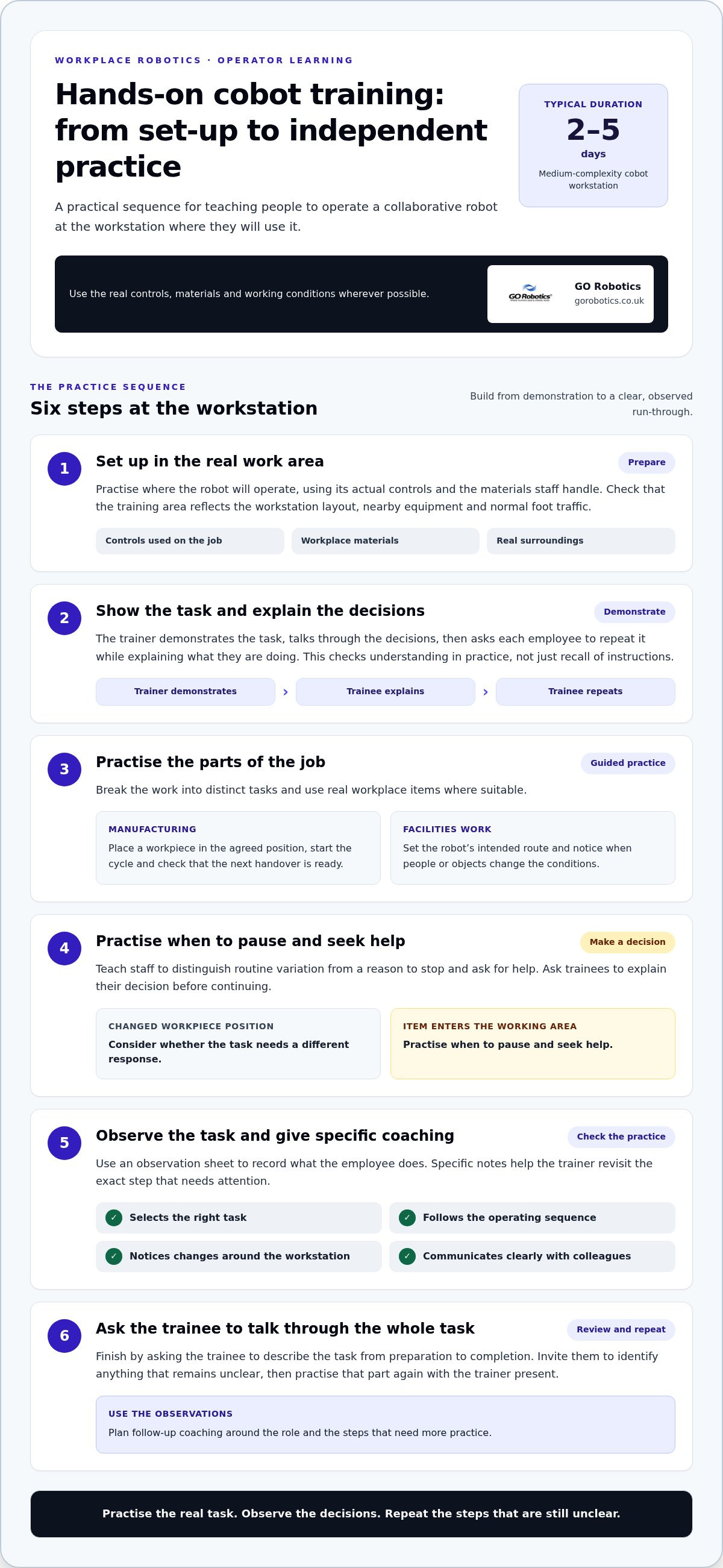
Practise where the robot will operate, using its actual controls and the materials staff handle. A conference-room demonstration cannot show how workstation layout, nearby equipment or normal foot traffic affects a task. Before practice begins, make sure the training area reflects the conditions employees will encounter during a shift.
For a medium-complexity cobot workstation, hands-on operator training typically takes 2 to 5 days. Use that time for demonstration, guided practice and independent attempts, rather than one long presentation. The trainer can show a task once, talk through the decisions, then ask each employee to repeat it while explaining what they are doing.
Build exercises around distinct parts of the job. In manufacturing, an operator might practise placing a workpiece in the agreed position, starting the cycle and checking that the next handover is ready. In facilities work, staff might practise setting the robot’s intended route and noticing when people or objects change the conditions. Use real workplace items where suitable.
Teach employees to distinguish routine variation from a reason to pause and seek help. A changed workpiece position, for instance, may call for a different response from an item entering the robot’s working area. Ask trainees to explain their decision before continuing. This checks practical understanding, rather than their ability to repeat instructions from memory.
Use a simple observation sheet for each exercise. Record whether the employee selects the right task, follows the operating sequence, notices changes around the workstation and communicates clearly with colleagues. These points make coaching specific. Instead of saying “be more careful”, a trainer can revisit the exact step where the employee missed a change in setup.
Give employees a chance to practise under the working conditions they are likely to encounter. A quiet training period may not reflect a busy production shift, so discuss how noise, nearby activity or workflow changes affect attention and communication. Practise clear handovers, such as saying that a task is paused and naming who needs to know. This helps teams coordinate around the robot.
End each practice session by asking the trainee to describe the task from preparation to completion. Invite them to identify a step that remains unclear, then practise it again with the trainer present. Managers can use these observations to plan follow-up coaching and keep training relevant to the role. Clear records also help maintain consistency when employees change shifts.
For a service robot deployment, consider how the intended route and staff handovers shape workstation practice. Compare service robot options with the tasks your team will learn to manage.
3. Personalising robots and involving staff in their integration
Give employees a role in deciding how the robot fits into daily work. A short workshop can map its planned task, handover points and likely interruptions. For example, hotel workers may identify where a delivery route crosses a busy reception area. Their practical knowledge can help managers adjust the process before the robot joins a shift.
Ask staff to suggest a familiar name or working identifier for the robot. Naming can encourage familiarity and involvement, but keep it practical: use the agreed name in shift briefings, task notes and feedback records. A clear label helps workers discuss a route issue or handover without implying that the machine has human judgement or feelings.
Use a staff session to gather details a floor plan alone may miss. Invite employees from different shifts to mark busy routes, storage points and places where people stop to help customers. A restaurant team, for example, might flag a narrow service passage that gets crowded during meal service. Record each point and decide whether the task, route or timing needs adjusting.
Then involve workers in a supervised trial of the planned task. Ask them to observe the robot during normal activity, note unclear handovers and report obstacles that interrupt work. Keep feedback focused on specific events, such as a trolley blocking a corridor or uncertainty about who handles a delivery. Managers can review observations with staff and update the working instructions.
- Invite employees who perform the task to describe its difficult steps.
- Agree the robot’s role and the human handover points before it starts work.
- Use a staff-selected name or identifier in briefings and records.
- Collect feedback from workers on different shifts and compare recurring issues.
- Explain which suggestions will change the process and which cannot be adopted.
Follow up visibly. If staff report that a delivery route clashes with cleaning duties, explain whether the route or timing will change. If it stays the same, say why and clarify what employees should do when the conflict occurs. Closing the loop shows staff that their input has been considered, rather than gathered and ignored.
Make integration an ongoing team responsibility, not a launch-day event. A named supervisor can gather observations, while operators flag changes in customer flow, stock placement or work routines. Review these notes in normal team meetings and update instructions when the robot’s task changes. This keeps employee knowledge connected to how automation operates on the floor.
4. Planning and communicating changes during implementation
Explain the change before installation begins. Set out which task the robot will perform, when it will enter the workplace and how employees’ duties may shift. For example, a robot assigned to move supplies may change who requests a delivery and who handles exceptions. Clear details help staff understand what will happen in their own work area.
Appoint a named manager as the point of contact throughout implementation. They can gather questions, share agreed answers and direct technical issues to the appropriate supplier or integrator. Tell staff how to raise a concern during a shift, rather than relying on an update they may not see. Keep the process for questions simple and consistent.
Plan communications around key stages: the initial announcement, preparation, first operation and later reviews. Before the robot arrives, explain its intended task and invite questions. During setup, share practical changes to work instructions. Once employees have seen it operate, ask what differs from the plan and explain any adjustments.
Make each update relevant to the people affected. A warehouse team may need to know how a robot fits into material handling, while reception staff may need guidance on customer interactions. Explain each group’s role, the skills required and where human judgement remains essential. Avoid sending technical details that do not relate to employees’ work.
- State the robot’s task and the reason for introducing it.
- Identify affected roles, changed duties and training needs.
- Explain who answers operational questions and reports technical problems.
- Share updated instructions when the workflow changes.
- Invite feedback and tell staff what action follows.
Address concerns directly, including questions about role changes and safety. Don’t promise that no duties will change if responsibilities are still being planned. Instead, distinguish decisions already made from matters under review, then give employees a clear way to raise individual concerns. Candid answers build more trust than broad assurances.
Use a simple change log to keep communications accurate. Record the date of each update, the instruction changed and the teams that need to know. If a robot’s handover process changes, brief every affected shift and replace outdated guidance at the workstation. This reduces the risk of employees following conflicting instructions.
Review implementation with staff after the robot starts operating. Ask which instructions helped, where handovers caused confusion and what skills need more support. Bring findings to the next team briefing and update the work procedure. Regular, practical communication helps employees understand how automation is developing and where their contribution remains essential.
5. How should employers train staff to collaborate with workplace robots?
Build training around each person’s work, not a generic robot demonstration. Start by listing the tasks the robot may perform, who will supervise them and which decisions remain with employees. In a production area, workers integrating a collaborative robot need to identify suitable tasks and understand how it connects with wider systems. That might include knowing which team handles a fault or a change to the production sequence.
Set distinct learning goals for each role. Operators need to run assigned tasks, monitor the robot and respond to problems. Employees responsible for programming need instruction in the controls and task setup. Maintenance staff need different knowledge, so keep their training separate from operator instruction. This prevents a basic operating session from being mistaken for preparation for technical work.
Arrange technical and workstation training with the system supplier or integrator for the initial group. Before training starts, define what participants must be able to do, such as run the work cycle, recognise a fault and follow the correct escalation route. A supplier-led session can then focus on the actual robot and its installed task, rather than abstract examples.
Make safety and compliance part of everyday instructions. Explain the robot’s intended capabilities, work-area hazards, safety barriers and the actions employees must take if conditions change. For example, the team should know what to do if someone enters a restricted area or the robot stops unexpectedly. Keep procedures aligned with the site risk assessment and operating guidance.
Have workers practise monitoring the robot during normal work and responding to problems. Use realistic scenarios, such as an interrupted task, an alarm or an obstruction. Ask the employee to explain the next safe action, then observe them carrying it out. Refreshers should cover changes to tasks, equipment or workplace procedures.
Record each training session so managers can see who attended, when it took place and what it covered. Use the record to identify gaps when duties change or new employees join. It also helps distinguish completed operator instruction from programming or maintenance training. Keep human skills in the process, including judgement, customer interaction and decisions that require context.
Plan a review after training. Compare the intended task with what employees actually do, then update instruction where a real working example exposes a gap. Discuss robot training for your workplace when you’re planning how equipment and staff will work together.
GO Robotics: Pudu BellaBot
GO Robotics can help you assess whether Pudu BellaBot suits your hospitality operation and how staff will work alongside it. Consider the tasks you want it to support, the routes it would use and the handovers employees need to manage. These details help shape practical workstation training around your venue, rather than a generic demonstration.
GO Robotics also offers Pudu KettyBot and Pudu HolaBot as further service robot options. The right choice depends on the task you need the robot to perform and how it fits your team’s routines.
Contact GO Robotics to discuss Pudu BellaBot and staff training for your venue.
Plan the next step with your team
Before choosing equipment, define the work you want the robot to take on and how it should fit into your venue or workplace. This gives you a practical starting point for discussing staff roles, training needs and the conditions the robot will encounter during normal operation.
Training staff to work alongside robots is most useful when it reflects the specific model and task your employees will handle. GO Robotics offers Pudu BellaBot, Pudu KettyBot and Pudu CC1. Discussing your intended use can help connect your choice of robot with the way your team works.
Bring your operational questions to GO Robotics and contact the team about your robot requirements. A clear plan can help your people approach workplace automation with confidence.
Frequently Asked Questions
How can you make the automation process easier for your employees?
Make the change easier by involving staff in planning and giving them a chance to practise before the robot takes on its usual task. Explain how employees can raise concerns and respond with practical workplace examples. For instance, agree who handles a delivery if a robot stops during a busy period. This gives training staff to work alongside robots a useful, job-specific focus.
How long does it take to train a cobot operator?
Hands-on operator training for a medium-complexity collaborative robot workstation typically takes 2 to 5 days. The time is for practical instruction at the workstation, not a universal course length for every robot or role. An operator learning a defined task needs different preparation from someone who will programme or maintain equipment. Plan the content around the workstation, the task and the employee’s responsibilities.
Reskilling or upskilling, how does it work in practice?
Reskilling prepares an employee for different duties; upskilling builds on skills they already use. A stockroom worker could learn to coordinate robot-assisted movement between storage and shop-floor teams. A supervisor who already allocates tasks might learn to monitor robot activity and report recurring interruptions. Match each learning goal to a real role, then give the employee a chance to practise that responsibility.
What should a training programme look like?
Build the programme around the real work cycle: normal operation, a routine interruption and the correct response. Start with the employee’s assigned task, then practise relevant controls and workplace procedures. Use site-specific examples, such as a blocked route or a changed handover. Finish by observing the employee complete the task and noting where further instruction would help. Update the programme when duties or processes change.
What skills does a robot operator actually need?
A robot operator needs to follow instructions, monitor the task and recognise when the robot is not behaving as expected. Clear communication matters too, especially when a colleague needs to know that a route is blocked or a task has stopped. In a hotel, an operator might coordinate a delivery handover with reception. Programming and maintenance require separate technical skills, so don’t assume every operator needs them.
Who should conduct training, the system supplier or HR?
The system supplier or integrator should deliver initial technical and workstation training because they know the equipment and its setup. HR can support employees by coordinating attendance, recording completed training and helping managers explain role changes. Supervisors can reinforce site-specific procedures in daily work. Assign clear responsibilities so technical instruction, staff communication and follow-up each have an owner.
Why do implementations face resistance?
Employees may resist a change if they don’t know what the robot will do, how their duties could change or who will address their concerns. A planned rollout can also disrupt familiar routines, especially if staff learn about changes late. Explain the intended task in plain language and invite questions before the process changes. Give specific answers about handovers and responsibilities instead of broad assurances.
What skills do staff need to work safely alongside robots?
Staff need to recognise workplace hazards, follow safety boundaries and know what to do when a robot stops or an alarm appears. They should understand which tasks they’re authorised to perform and when to report a problem rather than adjust equipment themselves. For example, an operator should distinguish routine monitoring from maintenance. Practise site procedures in context, including how colleagues communicate when a work area changes.